wayground logo

Free Printable Worksheets

NEW

Font size

S
M
L
XL
Worksheets

Edwards Unit 3 Review

Total questions: 37

Worksheet time: 37mins

Name
Class
Date
1.
What is a mixture?
a)
elements chemically combined
b)
a combination of different things
c)
it is found on the Periodic Table 
d)
it is made of chemical
2.
What type of mixture is this?
a)
heterogeneous 
b)
homogeneous
3.
Sand floating in water, but most of the sand is settled at the bottom this an example of which type of mixture?
a)
A solution
b)
A colloid
c)
A suspension
d)
A compound
4.

A solution that is considered dilute would

a)

be dark in color

b)

Have a strong scent

c)

Have a large amount of solute

d)

Have a small amount of solute

5.

How are suspensions and colloids different?

a)

Suspensions settle out and colloids do not settle.

b)

Colloids settle out and suspensions do not settle.

c)

Suspensions dissolve and colloids do not.

d)

Colloids dissolve and suspensions do not.

6.

In a solution, the substance that dissolves in the solvent is called

a)

Solute

b)

Suspension

c)

Colloid

d)

Solvent

7.

In a solution, the substance which the solute dissolves into is called a

a)

solvent

b)

suspension

c)

colloid

d)

solution

8.
____ is another name for a homogeneous mixture. 
a)
Solution
b)
Suspension
c)
Substance
d)
Liquid 
9.

Which statement is true about compounds?

a)

a pure substance where two or more elements are chemically combined

b)

a homogenous mixture of 2 or more elements

c)

a pure substance containing only one type of atom

d)

a heterogeneous mixture of 2 or more elements chemically combined

10.

The air around us is a mixture of gases.

a)

True

b)

False

11.

What is a precipitate?

a)

an insoluble reactant formed during a chemical reaction

b)

a solid that is formed when you mix two liquids together

c)

a soluble solvent in a saturated solution

d)

a soluble solute in a saturated solution

12.
You can make a solution more concentrated by adding __________.
a)
solute
b)
solvent
c)
water
13.
Solution where more solute can still be dissolved at the given temperature. 
a)
Saturated
b)
Unsaturated
c)
Supersaturated
d)
Homogeneous solution
14.

What will allow more solute to be dissolved in a solvent.

a)

adding more solute

b)

cold

c)

cooling solution

d)

heat

15.

Define the term soluble.

a)

Can dissolve in water

b)

Cannot dissolve in water

c)

Partially dissolves in water

16.
When a solvent contains as much of the solute as it can hold, the solution is said to be
a)
supersaturated
b)
diluted
c)
saturated
d)
unsaturated
17.
Acids react with
a)
water to produce bases and salts
b)
salts to produce bases and water
c)
neither bases, salts nor water
d)
bases to produce salts and water
18.

A substance is found to have the following characteristics:


Very bitter taste

Feels slippery to the touch

Produces OH- ions when dissolved in water


In what category would the substance be classified?

a)

acid

b)

base

c)

enzyme

d)

fatty acid

19.

Which releases hydrogen ions during its reaction?

a)

base

b)

strong base

c)

acid

d)

weak base

20.

KOH is ...

a)

an acid

b)

a base

c)

a salt

d)

an ionic compound

21.
Which of the following statements is correct?
a)
Blue litmus paper turns red when placed in a base.
b)
Red litmus paper turns blue when placed in a base.
c)
Blue litmus paper stays blue when placed in an acid.
d)
Red litmus paper stays red when placed in a base.
22.

Which releases hydroxide ions during its reaction?

a)

base

b)

strong base

c)

acid

d)

weak base

23.

Milk is a very weak acid. What might its pH value be?

a)

6.5

b)

7.8

c)

4.2

d)

12.2

24.

Which of the following are properties of acids?

a)

They conduct electricity when dissolved in water

b)

They taste sour

c)

They react with metals to produce hydrogen gas

d)

All of the answer choices are correct

25.

Which of the following is an acid?

a)

vinegar

b)

bleach

c)

sugar in water

d)

starch in water

e)

toothpaste in water

26.

The higher the concentration of negative (hydroxide) ions in the solution, the stronger the base is.

a)

True

b)

False

27.

The strongest bases have pH values close to

a)

0

b)

14

c)

7

d)

5

28.

If the substance is neutral, what would the pH be?11

a)

3

b)

5

c)

7

d)

9

e)

11

29.
What does a pH scale do?
a)
Tells if a substance is an acid or base
b)
Measures the strength and weakness of acids and bases
c)
Both statements are correct
30.

You can never eat or drink an acid.

a)

True

b)

False

31.
Which has a pH below 7?
a)
Acid
b)
Base
32.
Turns litmus red
a)
Acids
b)
Bases
c)
All
33.
What methods can you use to measure the pH of a solution?
a)
Observing color or clarity
b)
Measuring mass or volume
c)
Measuring density or electrical conductivity
d)
Using acid base-indicators or pH meters
34.
The esophagus is the tube that connects the mouth to the stomach. Heartburn occurs when some of the stomach juices flow backwards up the esophagus. To help relieve heartburn, a person should take medicine that is
a)
neutral
b)
basic
c)

acidic or basic.
d)
acidic
35.
If an acid is combined with a base of equal strength, the result will most likely be
a)
a neutral solution.
b)
a stronger acid.
c)
impossible to tell without testing the pH.
d)
a stronger base
36.

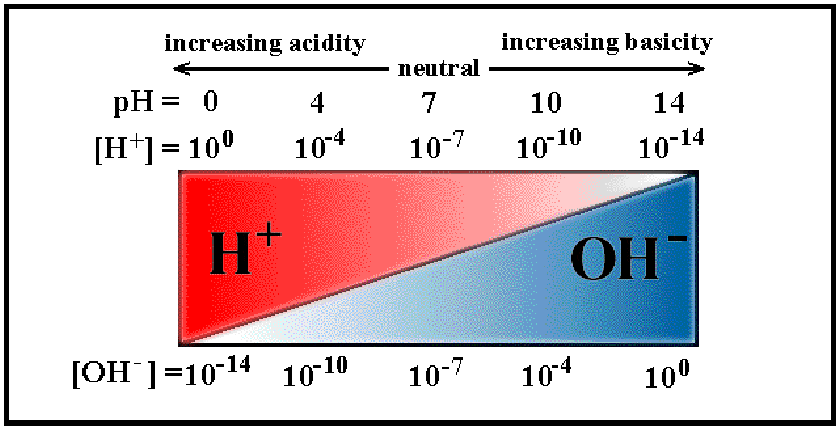
True or false: a neutral solution has equal amounts of H+ and OH-.

a)

True

b)

False

37.

Is pure water acidic, basic, or neutral?

a)

Acidic

b)

Basic

c)

Neutral