wayground logo

Free Printable Worksheets

Font size

S
M
L
XL
Worksheets

SS Review

Total questions: 63

Worksheet time: 2hrs 6mins

Name
Class
Date
1.
What did we call colonists who did NOT want independence from England?
a)
Minutemen
b)
Traitors
c)
Militia
d)
Loyalists
2.
"No ________ without representation"
a)
voting
b)
taxation
c)
rights
d)
liberty poles
3.
The Sons of Liberty were:
a)
the children of our Founding Fathers.
b)
a professional dance team.
c)
Patriots who protested taxes.
d)
the writers of the Declaration of the Independence.
4.
What was the purpose of the Boston Tea Party?
a)
to punish merchants for selling imported tea.
b)
to see who could throw a barrel further.
c)
to frame the Native Americans.
d)
to protest taxes
5.
Who were the Minutemen?
a)
Patriots who were ready to fight at a minutes notice
b)
British soldiers who were ready to fight at a minutes notice
c)
Sons of Liberty who were ready to fight at a minutes notice
d)
Hessians who were ready to fight at a minutes notice
6.
Which side had more resources and training at the beginning of the war?
a)
British
b)
Colonists
7.
Who won the American Revolution?
a)
The British
b)
The American Colonists
8.
What country joined the colonists to help them win the war?
a)
Germany
b)
France
c)
Netherlands
d)
Africa
9.
What was the name of the British king during the American Revolution?
a)
Charles III
b)
George III
c)
William III
d)
James III
10.
Who was the major author of the Declaration of Independence?
a)
Benjamin Franklin
b)
John Adams
c)
Thomas Jefferson
d)
Patrick Henry
11.
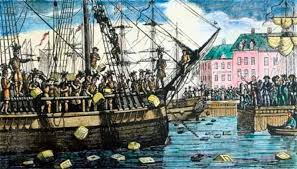
What event is depicted in this image?
a)
Boston Massacre
b)
Boston Tea Party
c)
Battle of Bunker Hill
d)
Lexington and Concord
12.
This patriot made a daring ride to warn colonists that British soldiers were approaching.
a)
Patrick Henry
b)
Paul Revere
c)
Phillis Wheatley
d)
Samuel Adams
13.
Samuel Adams and Paul Revere led members of the Sons of Liberty in this protest against taxes.
a)
First Continental Congress
b)
Boston Massacre
c)
Boston Tea Party
d)
Stamp Act Congress
14.
Of the following events, which happened first? 
a)
Saratoga
b)
Yorktown
c)
Declaration of Independence
d)
Treaty of Paris of 1783
15.
The U.S. was founded on July 4, 1776, by the approval of this document.
a)
the Treaty of Paris
b)
the Constitution
c)
the Declaration of Independence
d)
the Virginia Charter
16.

Where was the Declaration of Independence written and signed?

a)

Atlanta, Georgia

b)

Philadelphia, Pennsylvania

c)

Saratoga, New York

d)

Lexington, Massachusetts

17.

Who led the Continental Army?

a)

Abraham LIncoln

b)

Patrick Henry

c)

Benjamin Franklin

d)

George Washington

18.

Who was the patriot famous for his midnight ride to warn the colonial militia of the approach of British troops?

a)

Paul Revere

b)

Benedict Arnold

c)

George Washington

d)

Benjamin Franklin

19.

True or False: The colonists were throwing things at the British and daring them to fire their guns during the Boston Massacre.

a)

True

b)

False

20.

What was the the group that made the Boston tea party?

a)

The sons of liberty

b)

Geico

c)

Liberty mutual

d)

King George

21.

What did the colonists throw at the British soldiers during at the Boston Massacre?

a)

wood

b)

tea

c)

snow balls

d)

rocks

22.

What did the colonists dress up like so they would not be recognized as they snuck onto the ship for the Boston Tea party?

a)

Swim suits

b)

American Indians

c)

unicorns

d)

King George III

23.
What are the three inalienable rights that all people have?
a)
Food, Shelter, and Clothing
b)
Life, Liberty and Death
c)
Life, Liberty and the Pursuit of Happiness
24.
When was the Declaration of Independence written?
a)
September 11, 1789
b)
July 4, 1776
c)
June 25, 1778
25.
What is the main purpose of government?
a)
To protect the rights of the people
b)
To protect the life of people's things
c)
To give people things
26.
Who gives government the ability to govern?
a)
The people
b)
Parliament
c)
The King
d)
The Sons of Liberty
27.
What is the name of the first written plan of government for the newly independent U.S.A.?
a)
Constitution
b)
Treaty of Paris
c)
Declaration of Independence
d)
Articles of Confederation
28.
Under the Articles of Confederation, how many votes did each state get?
a)
Zero
b)
One
c)
Two 
d)
Three
29.
Which of the following is an example of a weakness in the Articles of Confederation?
a)
Congress couldn't collect taxes
b)
Weak national government
c)
Provided no common currency/money for all 13 states
d)
All of the  above
30.
Why was this first U.S. government so weak?
a)
King George III  was still in charge of USA
b)
Americans were afraid to give their new government too much power
c)
The American army did not win their independence from Great Britain and King George III
d)
ask; no
31.
The Articles of Confederation created a ________ national government.
a)
weak
b)
strong
c)
both strong and weak
d)
neither  strong nor  weak
32.

Which article of the Treaty of Paris was the most important to the Americans?

a)

That Great Britain recognize the United States as a free and independent country

b)

That both Great Britain and the United States have access to the Mississippi River

c)

That the United States owned the fishing rights in the Grand Banks

d)

That the treaty be ratified by both countries within six months of the initial signature

33.
The founding fathers thought the king
a)
had too much power
b)
was helpful
c)
was a strong leader
d)
was not a tyrant
34.
Which of the following describes federalism?
a)
the three branches check on each other
b)
the small states have equal power in the Senate
c)
the power is divided between the executive, judicial, and legislative
d)
the power is divided between the states and country
35.
States have the power to 
a)
declare war
b)
establish schools
c)
print money
d)
foreign relations
36.
The Legislative branch includes
a)
the House of Representatives and the Senate
b)
The Senate and the Supreme Court
c)
The House of Representatives and the President
d)
The Congress and the Senate
37.
What does veto mean?
a)
The president is removed from office
b)
A law is unconstitutional
c)
The law is approved
d)
The president does not approve the law
38.
Which of the following is NOT a branch of government?
a)
Executive
b)
Judicial
c)
Tyranny
d)
Legislative
39.
What is the name for a change or addition to the Constitution?
a)
Federalism
b)
Amendment
c)
Ratification
d)
Veto
40.
The first ten amendments to the Constitution 
a)
Bill of Rights
b)
Preamble
c)
Rights
d)
Bill of Laws
41.
A system that allows each branch of government to limit the powers of the other branches
a)
Checks and Balances
b)
Check and Weigh 
c)
Prohibit Abuse
d)
Monitor Power
42.

A plan that provides the rules for government

a)

Legislative Branch

b)

Constitution

c)

Supreme Court

d)

President

43.

A system in which power is divided between the national and state governments.

a)

Federalism

b)

Division of Powers

c)

Checks and Balances

d)

Localism

44.

How many amendments are in the Bill of Rights?

a)

8

b)

10

c)

12

d)

15

45.

What do the Bill of Rights protect?

a)

individual freedoms

b)

government

c)

jobs

d)

voting rights

46.

Who is considered the Father of the Constitution?

a)

James Madison

b)

George Washington

c)

Jonathan Jay

d)

Abraham Lincoln

47.

Which state did not send any delegates to the Constitution Convention?

a)

New Jersey

b)

New York

c)

Rhode Island

d)

Virginia

48.

What did the Preamble do?

a)

The Preamble states the purposes of our Constitution.

b)

The Preamble tells the laws.

c)

The Preamble explains each government power.

d)

The Preamble tells how to amend the Constitution.

49.
What is the job of the Judicial Branch?
a)
to judge the laws
b)
to enforce the laws
c)
to write the laws
d)
to veto the laws
50.
What is the job of the Legislative branch?
a)
to enforce the laws
b)
to judge the laws
c)
to check the Congress
d)
to write the laws
51.
What is the job of the Executive Branch?
a)
to enforce the laws
b)
to write the laws
c)
to judge the laws
d)
to tax the people
52.

What is the U.S Constitution?

a)

A declaration of war

b)

A document that says how the U.S government runs. It is the highest law of the land.

c)

A peace deal

d)

Is a document that says how mayors and governors should act.

53.

What are the three branches of government?

a)

Legislative, Law Enforcement, Executive

b)

Legislative, Judicial, Executive

c)

Judicial, Exemplary, Legislative

d)

Judges, lawyers, cops

54.

Why did the founders of the Constitution create a separation of powers between the three branches?

a)

So that one branch of government would not have too much power.

b)

So that everyone could be equal.

c)

So that people could vote.

d)

So that the president could have all the power

55.

Who makes up the Judicial Branch?

a)

Congress

b)

President

c)

The Supreme Court-9 Judges chosen by the President

d)

Vice president

56.

What are the 2 houses of the Legislative Branch

a)

The Senate and House of Representatives

b)

The Senate and Supreme Court

c)

House of Representatives and President

d)

Senate and President

57.

What is your first amendment?

a)

Freedom of speech, freedom of religion, freedom to petition the government for change, and freedom of the press (create a newspaper or any news reporting on the government)

b)

Right to bear arms, right to live however you want, right to live wherever you want, right to watch whatever kind of t.v channel, right to eat anything

c)

government needs a warrant to search you, your house, or belongings

d)

No cruel or unusual punishment

58.

What is your fourth amendment?

a)

Right to bear arms and start your own militia to prevent a tyrannical government

b)

Right of freedom of speech, freedom of religion, freedom of the press

c)

Freedom from fear, want, speech, and freedom of worship

d)

Government can't search you, your home, or belongings without a warrant

59.

Which Amendment protects a persons right to cruel and unusual punishments?

a)

Amendment 1

b)

Amendment 8

c)

Amendment 10

d)

Amendment 2

60.

Which Amendment protects a persons right to a trial by jury in civil cases?

a)

Amendment 7

b)

Amendment 5

c)

Amendment 3

d)

Amendment 1

61.

Amendment 2 protects a persons right to?

a)

Bear Arms

b)

States' rights

c)

Not Quarter troops

d)

Remain Silent

62.

Which Amendment protects a persons right to a speedy trial?

a)

Amendment 4

b)

Amendment 6

c)

Amendment 8

d)

Amendment 5

63.

Which Amendment protects a persons rights that are not listed in the Constitution?

a)

Amendment 1

b)

Amendment 7

c)

Amendment 9

d)

Amendment 4