
 Worksheets
IIT-JEE & NEET LEVEL - 2 (8-T)
Total questions: 100
Worksheet time: 2hrs 40mins
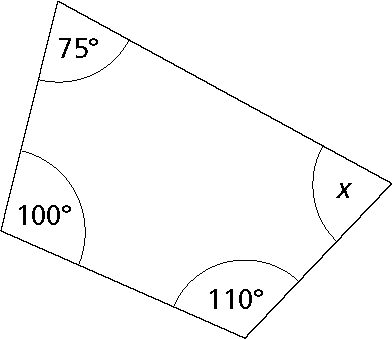
Find the missing angle.
75o
85o
100o
45o
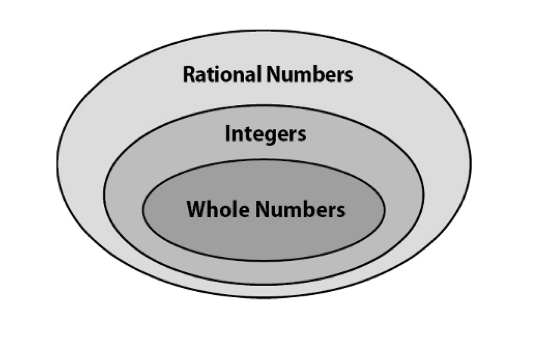
Which of the following does not represent a whole number?
9
6.0
12/4
-12/3
Rachel states that -5.5 is an integer because it is negative.
Is she correct?
Why or why not?
Yes, because all negatives are integers.
Yes, because all integers have decimals.
No, because integers do not have decimals.
No, because integers cannot be negative.
-14 could be classified as all of these EXCEPT?
Integer
Real
Rational
Whole
-18/6
Which Venn diagram correctly represents the relationship between rational numbers and irrational numbers?


Which of the following could the diagram represent?
I: rational, II: natural
I: integer, II: whole
I: integer, II: rational
I: whole, II: natural
- ½ ⅓

The sides of parallelogram ABCD
are represented as shown.
Find DA.
10
24
12
30
Diagonals Bisect each other. (Click all that apply)
Parallelogram
Rectangle
Rhombus
Square
Trapezoid
Opposite angles are supplementary (Click all that apply)
Parallelogram
Rectangle
Rhombus
Square
Isosceles Trapezoid
Which of the following is not a property of a rhombus?
Diagonals bisect corner angles
Diagonals are perpendicular
4 right angles
4 congruent sides

Given parallelogram ABCD with
m∠B = 5x and m∠C = 3x+4.
Find the number of degrees in ∠D.
70
110
73
115
If a shape is a square, then it is also a rectangle and a rhombus.
TRUE
FALSE
A trapezoid is a quadrilateral with exactly one set of parallel sides.
TRUE
FALSE

Check all that apply.
Rectangle
Rhombus
Square
Parallelogram

Check all that apply.
Parallelogram
Rectangle
Trapezoid
Rhombus

Check all that apply.
Rectangle
Square
Parallelogram
Trapezoid

Check all that apply.
Rhombus
Trapezoid
Kite
Parallelogram
Clue: This quadrilateral is a parallelogram with congruent sides and four right angles.
Rectangle
Square
Clue: This quadrilateral has two pairs of congruent adjacent sides and opposite sides that are not congruent.
Parallelogram
Kite
How many sides does a quadrilateral have?
4
3
5
6

How many right angles are in the quadrilateral?
2 right angles
3 right angles
4 right angles

Name this quadrilateral
trapezoid
rectangle

How many pairs of parallel lines are in this quadrilateral?
1 pair
2 pairs
4 pairs

Circle all the words that describe the quadrilateral.
rhombus
parallelogram
square
rectangle

What phase change occurs when a solid turns directly to a gas?
Freezing
Condensation
Sublimation
Vaporisation
Thermal energy is...
heat energy
the energy of motion
energy of nuclear processes.
an indication of physical change.
The kinetic model of matter states that
atoms and molecules move in continuous and non-random motion.
atoms and molecules move in continuous and random motion.
the kinetic energies of atoms and molecules increase with increasing temperature.
the pressure of atoms and molecules is due to the collision of these particles with the walls of the container they are in.
The energy of movement is ___.
potential energy
kinetic energy
mechanical energy
The more energy that particles have, the ___ they move.
slower
faster
The force of attraction between molecules is ___.
intermolecular forces
bridge forces
chemical bonds
Liquid particles have more energy than ___ particles.
solid
gas
The particles of ___ generally have the least amount of energy.
solids
liquids
gases
When something goes from gas to liquid, it is called...
Evaporation
Condensation
Deposition
Freezing
Particles are always moving.
True
False
liquid

Solid
Liquid
Gas

Solid
Liquid
Gas

Solid
Liquid
Gas

Solid
Liquid
Gas

Solid
Liquid
Gas

Solid
Liquid
Gas

Solid
Liquid
Gas

Solid
Liquid
Gas

Solid
Liquid
Gas

Solid
Liquid
Gas
What food substance is made by plants during photosynthesis?
Carbon dioxide
Glucose
Granulated sugar
Oxygen
Where is chlorophyll found in plants?
Leaves
Root
Flower
Stem
Which are examples of autotrophs? Select all that apply.
Bacteria
Humans
Plants
Algae
Humans cannot make their own food, what are they called?
Autotrophs
Producers
Heterotrophs
Herbivores
The factory or storehouse of the plant is the
flower
root
stem
leaves
Which of the following is not transported in plants?
minerals
oxygen
water
carbon dioxide
Which is a major source of nutrients in plants?
soil
leaves
stem
roots
This part of the transport system in plants is made up of living cells.
Xylem
Shoots
Phloem
Leaves
Water and minerals move upward from the root to the rest of the plant in this vascular tissue.
Root
Xylem
Leaves
Phloem
This vascular tissue carries substances from the leaves to the other parts of the plant.
Phloem
Leaves
Roots
Xylem
This is the process in which plants sweat.
Transportation
Transpiration
Explanation
Exportation
The flow of water in the xylem travels in two directions up and down.
True
False
What is the stomata in plants?
Large pores in the leaves
The green pigment
The chloroplast
Tiny pores in the leaves
Sweating is the process that plants use to remove excess water.
True
False
The food making process of a plant is called:
photosynthesis.
chlorophyll.
germination.
baking.
Chlorophylls helps:
the plant use energy from the sun to make food.
the plant grow roots after it sprouts from a seed.
Mrs. Nophsker and Mr. Deal stay sane.
Plants get their green color from the chemical:
chlorophyll.
photosynthesis.
germination.
Crayola.
What gives a plant the energy needed to make food?
5-hour energy
Sunlight
wind
lunch
The plant uses some of the sugar right away and
stores the rest.
drops the rest on the ground for bears to eat.
drops it in a bowl to make cookies.
During photosynthesis, plants make
oxygen
carbon dioxide
water
When humans breate out, we give the plants the _____________ they need.
carbon dioxide
water
sunlight
knock-knock jokes

