
 Worksheets
Quiz - Energy and Transfer
Total questions: 22
Worksheet time: 10mins

Students fill 2 bottles with cool water. The bottles are placed in direct sunlight. Students make observations and record the data. Most likely, the students are investigating -
force
thermal energy
gravity
colors of water

Megan uses a blow dryer in the morning to dry her hair. She thinks about the forms of energy and the conversion that is taking place when she uses it. Which is correct?
electrical energy into thermal energy and mechanical energy
electrical energy into sound energy and chemical energy
sound energy into electrical energy and mechanical energy
mechanical energy into electrical energy
Which is an example of electrical energy?
lightning
melting ice cream
eating a hamburger
a cat sleeping
Electromagnetic energy is
from a chemical reaction
resulting from electrical or magnetic waves moving through air
heat energy
from an electrical charge
Eating food is an example of
heat energy
thermal energy
chemical energy
potential energy


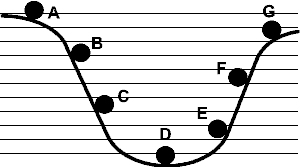

What is the unit for mass?
kilogram (kg)
meter (m)
Newton (N)
Joule (J)

What is the unit for distance?
kilogram (kg)
meter (m)
Newton (N)
Joule (J)

What is the unit for force?
kilogram (kg)
meter (m)
Newton (N)
Joule (J)

What is the unit for energy?
kilogram (kg)
meter (m)
Newton (N)
Joule (J)

What is the formula for kinetic energy?
distance / time
mass x acceleration
velocity / time
½(mass) x (velocity)2
(mass) x (acceleration of gravity) x (height)

What is the formula for gravitational potential energy?
distance / time
mass x acceleration
velocity / time
½(mass) x (velocity)2
(mass) x (acceleration of gravity) x (height)
What does a generator do?
converts electricity into mechanical energy
converts mechanical energy into electricity
transfers mechanical energy
nothing really, it just sounds cool

