
 Worksheets
Unit 5 Review (5.1-5.9)
Total questions: 74
Worksheet time: 2hrs 28mins

The graph of a twice differentiable function f is shown. Which of the following correctly orders f(2), f'(2), and f"(2)?
f(2)<f′(2)<f′′(2)
f′′(2)<f(2)<f′(2)
f′(2)<f(2)<f′′(2)
f(2)<f′′(2)<f′(2)
Let f(x) be a strictly increasing function such that f(x)<0 and g(x) be a strictly decreasing function such that g(x)>0 for all values of x. If h(x)=f(x)g(x) , which statement is true?
h(x)>0 and is strictly increasing
h(x)>0 and is strictly decreasing
h(x)<0 and is strictly increasing
h(x)<0 and is strictly decreasing

The graph of y=h(x) is shown. Which of the following could be the graph of y=h'(x)?


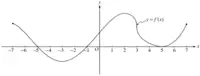
The figure shows the graph of f', the derivative of f, for [-7,7]. The graph of f' has horizontal tangents at x=−3, x=2, and x=5 and a vertical tangent at x=3.
Find all values of x, for (-7,7), at which f attains a relative minimum.
−3,5
−5,−1,5
−5 only
−1 only
The figure shows the graph of f', the derivative of f, for [-7,7]. The graph of f' has horizontal tangents at x=−3, x=2, and x=5 and a vertical tangent at x=3.
Find all values of x, for (-7,7), at which f attains a relative maximum.
2 only
−5,−1,5
−5 only
−1 only

The figure shows the graph of f', the derivative of f, for [-7,7]. The graph of f' has horizontal tangents at
x=−3, x=2, x=5 and a vertical tangent at x=3 .Find all intervals for which f′′<0 .
(−7,−3), (2,5)
(−7,−5), (0,3)
(−5,−1)
(−1,5)
The figure shows the graph of f', the derivative of f, for [-7,7]. The graph of f' has horizontal tangents at
x=−3, x=2, x=5 and a vertical tangent at x=3 .Find all intervals for which for which f has a point of inflection.
−3, 2, 5
−5, −1, 3
−5, −1, 5
f has no points of inflection

The graph of the second derivative of a function f(x) is shown. Select all of the following that are true.
The graph of f(x) has a point of inflection at x=−1
The graph of f(x) is concave down on the interval −1<x<3
The graph of f'(x) is increasing at x=2

Given the graph of the derivative, f'(x), which of the following would correctly depict a possible graph of f(x)?


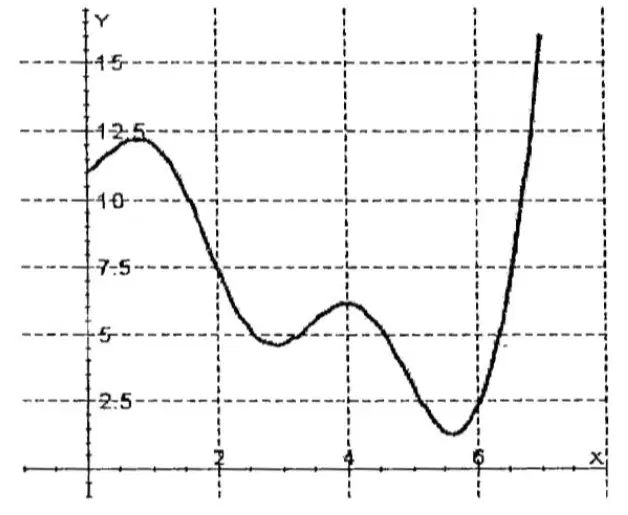
Given the graph of f(x), how many x values satisfy the result of the Mean Value Theorem on the interval [0,7]?
1
2
3
4
Identify the interval(s) on which the function f(x)=x2−x−12 is increasing.
[−∞,−3], [4,∞]
(−∞,∞)
[−3,4]
[21,∞)
Suppose f(x) is differentiable everywhere and f(−2)=−5 and f′(x)≤5 for all values of x. Using the mean value theorem, what is the largest possible value of f(8) ?
35
45
55
65
For all x in the closed interval [2,5] the function f has a positive first derivative and a negative second derivative. Which of the following could be a table of values for f?


On the closed interval f(x)=esinx , the absolute minimum of [0,2π] occurs at which x value?
0
2π
23π
2π
Let g be the function g(x)=x2ekx where k is a constant. For what values of k does g have a critical point at x=32 ?
−3
−23
−31
0
The maximum value of f(x)=2x3−15x2+36x on the closed interval [0,4] is
28
30
32
48
Consider the function f(x)=x2+3x2 whose first and second derivatives are f′(x)=(x2+3)26x and f′′(x)=(x2+3)318(1−x2) respectively.
Use f'(x) to find any critical numbers.
0
0, ±3
±3
f(x) has no critical numbers
Consider the function f(x)=x2+3x2 whose first and second derivatives are f′(x)=(x2+3)26x and f′′(x)=(x2+3)318(1−x2) respectively.
On what interval is f(x) increasing and concave down?
(−1,0)
(1,∞)
(0,1)
(−∞,−1)

Given the graph of g, does the Mean Value Theorem apply over the interval [-7,-3]?
YES
NO

Given the graph of g, does the Mean Value Theorem apply on the interval [−π,π] ?
YES
NO

Given the graph of f, does the Mean Value Theorem apply on the interval [3,6]?
YES
NO

The graph of f'(x) is shown. Which of the following statements is true about f(x)?
f is decreasing on [-1,1]
f is increasing on [-2,0]
f is increasing on [1,2]
f has a local minimum at x=0
f is not differentiable at x=-1 and x=1

The graph of f'(x) is given. On which of these intervals is f(x) decreasing?
[2,4]
[3,5]
[0,1] and [3,5]
[2,4] and [6,7]
[0,2] and [4,6]
Select all that apply: If f"(x)=x(x+1)(x−2)2 , then the graph of f has inflection points when x=
0
-1
2
How many critical points does the function f′(x)=(x+2)5(x−3)4 have?
One
Two
Three
Nine
If g is a differentiable function such that g(x)<0 for all real numbers x and if f′(x)=(x2−4)g(x) , which of the following is true?
f has a relative max at x=-2 and a relative min at x=2
f has a relative min at x=-2 and a relative max at x=2
f has a relative min at x=-2 and at x=2
f has a relative max at x=-2 and at x=2
It cannot be determined if f has any relative extrema
For what value of k will f(x)=x+xk have a relative maximum at x=−2 ?
-4
-2
2
4

Given the graph of f'(x), where is f(x) concave up?
(-3,1) and (4,7)
(-1,2) and (6,7)
(1,4)
(-3,-1) and (2,6)
Given the graph of f'(x), where does f(x) have an inflection point? Select all that apply.
-1
1
2
4
6

The function h is continuous and differentiable on the interval [-4,10]. The graph of h', the derivative of h, is shown in the graph.
On what interval(s) is h(x) decreasing?
[−4,1],[3,5]
[−2,7]
[1,3],[5,10]
[−4,−2],[7,10]
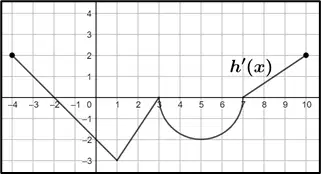
The function h is continuous and differentiable on the interval [-4,10]. The graph of h', the derivative of h, is shown in the graph.
At which x-value(s) does h(x) has a relative maximum?
−2, 3, 7
1, 5
7 only
−2 only
Let g′(x)=(x+1)3(3−x)2 . At which x value(s) does g(x) have a relative minimum?
-1, 3
-1
3
g(x) does not have a relative minimum
Let g′(x)=(x+1)3(3−x)2 . At which x value(s) does g(x) have a relative maximum?
-1, 3
-1
3
g(x) does not have a relative maximum
Where the derivative of f is undefined
Where the derivative of f is equal to zero
At endpoint a or b
If y is a function of x such that y'>0 for all x and y"<0 for all x, which of the following could be part of the graph of y=f(x)?


The graph of the derivative of f is shown. Which of the following could be the graph of f?


Let f be a function that is continuous on the closed interval [-2,3] such that f'(0) does not exist, f'(2)=0, and f"(x)<0 for all x except x=0. Which of the following could be the graph of f?


The graph of a twice-differentiable function f is shown. Which of the following is true?
f(1)<f′(1)<f′′(1)
f(1)<f′′(1)<f′(1)
f′(1)<f(1)<f′′(1)
f′′(1)<f(1)<f′(1)
f′′(1)<f′(1)<f(1)
a maximum in f(x).
a minimum in f(x)
no extrema.
a maximum in f(x).
a minimum in f(x).
no extrema.
If (j,k) is a local minimum, then what will be true about f′(j) ?
It's positive
It's negative
It's zero or DNE
Cannot be determined
Determine the critical numbers of f(x)=3x4−2x3−9x2
-1 , 0 , -1.5
-1 , 0
-1 , 2/3
-1 , 0 , 1.5
Let f(x)=x+9 and let c be the number that satisfies the Mean Value Theorem on the interval [0,16]. What is c?
6
4
5
7
increasing
decreasing
concave up
concave down
If the 1st derivative is positive on a certain interval, then that interval is decreasing.
True
False
decreasing
increasing
concave up
concave down
an inflection point
a critical point
a minimum
a maximum
If f′(2)=0 and f′′(2)>0 , what can be said about f(x) at x=2?
There is a relative maximum at x=2
There is a relative minimum at x=2
There is an inflection point at x=2
Nothing can be determined about x=2
If f′(2)=0 and f′′(2)<0 , what can be said about f(x) at x=2?
There is a relative maximum at x=2
There is a relative minimum at x=2
There is an inflection point at x=2
Nothing can be determined about x=2
If f′(2)=3 and f′′(2)<0 , what can be said about f(x) at x=2?
There is a relative maximum at x=2
There is a relative minimum at x=2
There is an inflection point at x=2
Nothing can be determined about x=2
Given a function g(x), if g''(x)=0 at a certain value of x, then g(x) must have _____________ at x.
an inflection point
a critical point
a relative extreme point
none of these

The second derivative of the function f is given by f"(x)=x(x−a)(x−b)2 . The graph of f" is shown. For what values of x does the graph of f have a point of inflection?
0 and a
0 and m
b and j
o, a, and b
b, j, and k
Let f be a function with a second derivative given by f′′(x)=x2(x−3)(x−6) . What are the x-coordinates of the points of inflection of the graph of f?
0
3
0 and 6
3 and 6
0, 3, and 6
The function f has the property that f(x), f′(x), and f"(x) are negative for all real values of x. Which of the following could be the graph of f?


Let f be the function given by f(x)=2xex . The graph is concave down when
x<−2
x>−2
x<−1
x>−1
x<0
The function f is given by f(x)=x3−2x2 . On what interval(s) if f(x) concave down?
(0,34)
(−∞,0)∪(34,∞)
(−∞,32)
(32,∞)
When calculating the absolute maximum of f on [a,b], which points need to be considered?
critical points
points of inflection and end points
critical points and points of inflection
critical points and end points
What is the first step to solve the problem below?
If f′′(x)=x(x−1)(x−2)2 , find the points of inflection for f(x) .
Take the derivative and set it equal to 0
Plug in 0 to this equation
Set this equation equal to 0
Find the second derivative and set it equal to 0
How do you justify a point of inflection?
f′′(x) changes sign
f′(x) changes from increasing to decreasing (or vice versa)
f′(x) changes sign
f"(x) changes from increasing to decreasing (or vice versa)
Which of these steps does not have to be done to find an absolute max of f(x)?
set f'(x)=0
Test end points and critical values
Find inflection points of f(x)
Evaluate endpoints or critical values into f(x)
When is the graph of f(x) concave up?
When f'(x) is positive
When f''(x) is positive
When f'(x) is increasing
When f"(x) is increasing
Let f be the function defined by f(x)=3x5−5x3 . How many relative extrema does f have?
Zero
One
Two
Three
Let f be a function with first derivative by f′(x)=x3+12x3+x2−4 for x>0. It is known that f(0)=5 and f(3)=11. What value of x in the open interval (0,3) satisfies the conclusion of the Mean Value Theorem for f on the closed interval [0,3]?
1
2
2
6
Find the absolute max of y=3x+92x2 over [-2,3]
0
1
8/3
16/3

Find the intervals of concavity for
f(x) = x2 + 2x + 1.
concave up: (-∞,∞)
concave down: (-∞,∞)
concave up: (2, ∞)
concave down: (-∞,2)
concave up: (-∞,2)
concave down: (2, ∞)
How many inflection points does y=20x5+310x4 have?
0
1
2
3
If the function f has a critical number at x=3 and f′′(3)=5 , which of the following would be true?
f has a local maximum at x=3
f has a local minimum at x=3
f has neither a local maximum or minimum at x=3
there is not enough information to know if there is a local maximum or minimum at x=3
If the function f has a critical number at x=5 and f′′(5)=−3 , which of the following would be true?
f has a local maximum at x=5
f has a local minimum at x=5
f has neither a local maximum or minimum at x=5
there is not enough information to know if there is a local maximum or minimum at x=5
If f′(2)=4 and f′′(2)=−2 , which of the following would be true?
f has a local maximum at x=2
f has a local minimum at x=2
f has neither a local maximum or minimum at x=2
there is not enough information to know if there is a local maximum or minimum at x=2

Given the table, for what values of x does the function f have a relative maximum?
-1
2
5
6
Given the table, for what values of x does the function f have a relative minimum?
-1
2
5
6
True or false: all critical points are extrema
True
False

