
NEW
Font size
 Worksheets
Gravitation 3
Total questions: 30
Worksheet time: 30mins
The value of Universal Gravitational constant is
6.673X10⁻¹¹ Nm-2kg2
6.673X10⁻¹¹ Nm2kg2
6.673X10⁻¹¹ Nm2 kg-2
6.673 x10⁻¹¹ N m-2 kg-2
Which is needed to determine the amount of gravitational force between two objects?
distance and mass
weight and time
area and weight

Kepler's Second Law states
objects attract other objects with a force that is directly proportional to the product of their masses
the square of the ratio of the periods of any two planets revolving around the Sun is equal to the cube of the ratio of their average distance from the Sun
An imaginary line joining a planet and the sun sweeps out an equal area of space in equal amounts of time.
Planets move about the Sun in an elliptical orbit with the Sun at one of the foci.
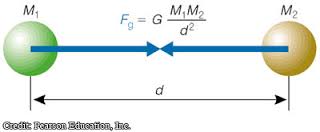

How is the gravitational force between to objects related to their mass
They are directly proportional
They are inversely proportional
They do not affect each other
They are equal

If the distance between 2 masses is increased then the force of gravitation between them will...
increase
decrease
stay the same

If the mass of either m1 or m2 is increased then the force of gravitation between them will...
increase
decrease
stay the same

The picture shows two exoplanets, b and c. The mass and radius of each planet is given in terms of M and r. What is the surface gravity on planet-c if the surface gravity on planet-b is 4 m/s2?
2 m/s2
4 m/s2
8 m/s2
32 m/s2
The mass of moon is about 0.012 times that of the earth and its diameter is about 0.25 times that of earth. The value of G on the moon will be:
Same as that on the earth
About one-fifth of that on the earth
About one-sixth of that on the earth
About one-fourth of that on the earth
An apple falls from a tree because of the gravitational attraction between the earth and the apple. If F1 is the magnitude of the force exerted by the earth on the apple and F2 is the magnitude of the force exerted by the apple on the earth, then
F1 is very much greater than F2
F2 is very much greater than F1
F1 and F2 are equal
F1 is only a little greater than F2
A stone is released from the top of a tower of height 19.6 m. Then its final velocity just before touching the ground will be:
384.16 m/ s
196 m/s
19.6 m/s
3841.4 m/s
The gravitational force between two objects is F. If masses of both objects are doubled and distance between them becomes doubled, then the gravitational force would become
4F
6F
2F
F
The weight of any person on the moon is about 1/6 times that on the earth. He can lift a mass of 12 kg on the earth. What will be the maximum mass, which can be lifted by the same force applied by the person on the moon?
60KG
72KG
96KG
54KG
The masses of two planets are in the ratio 1 : 2. Their radii are in the ratio 1 : 2. The acceleration due to gravity on the planets are in the ratio
1 : 2
2:1
1:4
4:1
On the earth, a stone is thrown from a height in a direction parallel to the earth’s surface while another stone is simultaneously dropped from the same height. Which stone would reach the ground first and why?
free fall will reach first
body with horizontal motion reach first
both will reach at same time
never reach ground
The SI unit of G
Ncm²/kg²
Nm²kg²
Nm²/kg²
Nkg/m²
The SI unit of weight
kg
N/m²
N
N cm/s²
Gravitational forces are:
always attractive
always repulsive
sometimes attractive and sometimes repulsive
None of these
The gravitational force between two objects does not depend on:
Sum of the masses
Product of the masses
Gravitational constant
(a)Distance between the masses
The acceleration due to gravity at pole and equator can be related as:
gp < ge
gp = ge = g
gp < ge = g
gp > ge
'The orbit of a planet is an ellipse with the Sun at one of the foci" is Kepler's
First law
Second law
Third Law
The value of 'g' ____ if we go inside the Earth
changes
remains the same

Kepler's Third Law states
objects attract other objects with a force that is directly proportional to the product of their masses
the square of the ratio of the periods of any two planets revolving around the Sun is equal to the cube of the ratio of their average distance from the Sun
An imaginary line joining a planet and the sun sweeps out an equal area of space in equal amounts of time.
Planets move about the Sun in an elliptical orbit with the Sun at one of the foci.
The gravitational field strength at the surface of Earth is g. Another planet has double the radius of Earth and the same density as Earth. What is the gravitational field strength at the surface of this planet?
2g
4g
2g
4g

