
 Worksheets
Chemical Equilibrium
Total questions: 20
Worksheet time: 19mins

This following is true about the graph of the concentration of reactant and products againts time except:
[A] decrease
The system is in the state of equilibrium
[B] decrease with time
After certain time, [A] and [B] remains unchanged, but the reaction did not stop
At equilibrium, __________.
all chemical reactions have ceased
the rates of the forward and reverse reactions are equal
the rate constants of the forward and reverse reactions are equal
the value of the equilibrium constant is 1
) the limiting reagent has been consumed
2A + 3B <----> 2AB
The forward reaction forms the substance __________.
A
AB
B
A + B
Define chemical equilibrium.
A reaction is reversible.
A state where the concentration of the reactants is equal to the concentration of the products.
A state where the rate of a forward reaction is equal to the rate of the reverse reaction.
A state where the reaction stops and no further change in concentration occurs.
2 NO(g) + O2(g) ⇌ 2 NO2(g)

Fe3O4(s) + 4H2(g) <=> 3Fe(s) + 4H2O(g)
Kc =
The Kc expression for the reaction 2NH3 ⇌ N2 + 3H2


If the reaction quotient Q has a smaller value than the related equilibrium constant, K, _________
the reaction is at equilibrium
the reaction is not at equilibrium, and will make more products at the expense of the reactants
the reaction is not at equilibrium, and will make more reactants at the expense of the products
the value of K will not increase until it is equal to Q
At elevated temperatures ammonium carbonate, NH2COONH4, is in equilibrium with NH3 and CO2 according to the equation;
NH2COONH4(s) ↔ 2 NH3(g) + CO2(g)
What is the equilibrium expression for this reaction?
K = 2 [NH3][CO2]
[NH2COONH4]
K = [NH3]2[CO2]
[NH2COONH4]
K = 2 [NH3][CO2]
K = [NH3]2[CO2]
2SO2(g)+O2(g) ⇌ 2SO3(g) + Heat
Adding SO2(g) will
shift equilibrium right
shift equilibrium left
increase rate of reaction
have no change
2SO2(g)+O2(g) ⇌ 2SO3(g) + Heat
Increasing the temperature will...
shift equilibrium right
shift equilibrium left
increase pressure
have no change

CoCI42- +6H2O →Co(H2O)62+ + 4CI-.
What would happen when H2O is added?
Position of equilibrium will shift to left (and become more blue)
Position of equilibrium will shift to right (and become more pink)
Keq will increase as H2O is added
Position of equilibrium will shift to left to reduce the added H2O

1N2 + 3H2 →2NH3
When the pressure on the system is increased, the equilibrium position shifts to the right. Why?
To increase the amount of products
To reduce the pressure, as the right side has fewer molecules of gas
Keq will increase when it is shifted to the right
To increase the pressure, as the right side has more molecules of gas
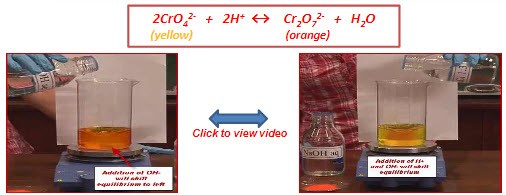
2CrO42- + 2H+ → Cr2O72- + H2O
What will happen when H+ ions are added to the system?
Position of equilibrium will shift to left and become more yellow
Color of system will turn all yellow
Color of system will turn all orange
Equilibrium will shift to right and become more orange


In which of the following systems would the number of moles of the substances present at equilibrium NOT be shifted by a change in the volume of the system at constant temperature?
CO(g) + NO(g) ↔ CO2(g) + ½N2(g)
N2(g) + 3H2(g) ↔ 2NH3(g)
N2(g) + 2O2(g) ↔ 2 NO2(g)
NO(g) + O3(g) ↔ NO2(g) + O2(g)

At what time (in seconds) is equilibrium established?
0 seconds
1 second
5 seconds
10 seconds

