
 Worksheets
Chemistry Quiz #1 (Matter/Properties/Phases)
Total questions: 50
Worksheet time: 52mins
The volume of air near Earth’s surface is mostly...
Argon
Oxygen
Nitrogen
Other gasses
Why is it difficult to breathe at high altitudes?
The temperature increases
Less oxygen compared to other gasses
The temperature decreases
The atmosphere is less dense
Choose the correct order to show how a convection current works in an atmospheric system.
Low density gas is pushed up-->Particles move faster-->Particles move apart-->Low density gas is pushed up-->The air is heated
Particles move faster-->Particles move apart-->The air is heated-->Low density gas is pushed up
The air is heated-->Particles move faster-->Low density gas is pushed up-->Particles move apart
The air is heated-->Particles move faster-->Particles move apart-->Low density gas is pushed up
Ozone is a form of Oxygen that prevents U.V. light from..
Damaging DNA
Damaging skin cells
Damaging biofabrics
Breaking up clouds
Warm air rises because...
it has higher kinetic energy which allows it to overcome gravity
it is forced upward by the surrounding cool, dense air
it reacts with turbidity flow to create an inversion
it's molecules are spread apart so they push each other upward
Density in solids and liquids is measured in...
grams per liter
grams per milliliter
kilograms per milliliter
kilograms per liter
Density in gasses is measured in...
grams per liter
grams per milliliter
kilograms per milliliter
kilograms per liter
Which list has only physical properties, no chemical properties?
Color
Hardness
Toxicity
Reactivity
Flammability
Hardness
Freezing/Melting/Boiling Points
Flammability
Malleability Conductivity
Density
Water is lighter than air because...
Well this is just crazy, water is not lighter than air
Atomic mass determines the weight of a substance
We drink water for this reason
The number of protons defines water as an element of nature

Choose the correct statement.
This substance has an average of two neutrons
This substance has an average of four neutrons
This substance has four protons
This substance has an an average atomic mass of two

Choose the correct statement.
This substance has an average of two neutrons
This substance has an average of four neutrons
This substance has four protons
This substance has an average atomic mass of three

Choose the correct statement.
This substance has twelve electrons
This substance has an average of four neutrons
This substance has 12 protons
This substance has an atomic number of six

This Meniscus reads __________, and is a ____________ meniscus.
24 ml, Convex
24 ml, Concave
25 ml, Convex
25 ml, Concave

This Meniscus reads __________, and is a ____________ meniscus.
29 ml, Convex
29 ml, Concave
29.5 ml, Convex
29.5 ml, Concave

If L = 4 cm, W = 2 cm, and H = 2 cm, what is the volume of this object? (V = L W h)
4 ml
8 ml
16 ml
32 ml

If r = 3 cm, what is d?
3 cm
6 cm
3 ml
6 ml
If the volume of this object is 10 ml, and the mass is 28 grams, what is the density?
2.8 g/ml
28 g/ml
0.35 g/ml
3.5 g/ml
If r = 3 cm, and h = 3.5 cm, what is the volume of this object? (V = π r2 h)
10.5 ml
21 ml
63 ml
99 ml
If the volume of this object is 50 ml, and it has a mass of 25 grams, what is its density?
0.2 g/ml
2 g/ml
5 g/ml
0.5 g/ml
Which 2 lab equipments are used to measure mass?


Which 3 lab equipments are used to measure volume?


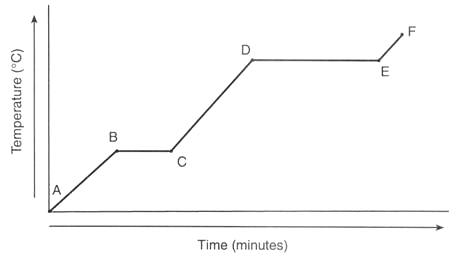
What state/phase is the object likely from points A to B?
Solid
Liquid
Gas
Plasma
What is happening to the particles in the substance between points A and B?
Melting
Freezing
Speeding Up
Slowing Down

Is the substance gaining or losing energy?
Gaining
Losing
Is the substance gaining or losing energy?
Gaining
Losing

What state/phase is the object likely from points D to E ?
Solid
Liquid
Gas
Plasma
What state/phase is the object likely from points C to D ?
Solid
Liquid
Gas
Plasma

The temperature at which a gas turns into a liquid
Melting point
Freeing point
Boiling point
Condensation point
The temperature at which a substance changes from a liquid to a gas
Melting point
Boiling point
Freezing point
Condensation point
What is the state of matter that has a fixed volume but not a fixed shape?
Solid
Liquid
Gas
The relationship between mass and volume is referred to as...
density
solubility
malleability
electrical conductivity
A characteristic that can be observed or measured such as color, state, or hardness is referred to as a...
Physical property
Chemical property
Physical change
Chemical change
Which list has only physical properties, no chemical properties?
Color
Hardness
Toxicity
Reactivity
Flammability
Hardness
Freezing/Melting/Boiling Points
Flammability
Malleability Conductivity
Density
What is the difference between physical and chemical properties?
Physical properties involve only the number of electrons, while chemical properties also involve the protons
A physical property can be observed without changing the identity of the substance, while chemical properties involve changing the identity of the substance
A chemical property can be observed without changing the identity of the substance, while physical properties involve changing the identity of the substance
Chemical properties involve only the number of electrons, while physical properties also involve the protons

