wayground logo

Free Printable Worksheets

Font size

S
M
L
XL
Worksheets

art 2020 sem 1 final

Total questions: 74

Worksheet time: 2hrs 44mins

Name
Class
Date
1.

What is the line called that runs along the outer edge of an object, shape or form?

a)

contour line

b)

outer edge line

c)

contrast line

d)

horizon line

2.

What is the visual trick in art when when one shape covers part of another shape creating the illusion of depth? One type of perspective.

a)

form

b)

squeezing

c)

overlapping

d)

detail

3.

In Aaron Easley's drawing, the illusion of form is created by ___________________

a)

cross hatching

b)

shading

c)

cross contour lines

d)

stripes of contrast

4.
 How is a tint made?
a)
Add black to a color
b)
Add the complement-ary color
c)
Add white to a color
d)
Add gray to a color
5.
 How is a shade made?
a)
Add black to a color
b)
Add the complement-ary color
c)
Add white to a color
d)
Add gray to a color
6.
What are the colors touching each other on the color wheel called?
a)
Complementary
b)
Schematic
c)
Friends
d)
Analogous
7.
This logo uses __________________ color scheme.
a)
Analogous colors
b)
Complimentary Colors
c)
Tertiary Colors
d)
Primary Colors
8.
These colors are opposite from each other on the color wheel:
a)
Tertiary Colors
b)
Primary Colors
c)
Analogous Colors
d)
Complementary Colors
9.
Three colors beside each other on the color wheel are also known as: 
a)
Analogous Colors
b)
Secondary Colors
c)
Cool Colors
d)
Complementary Colors
10.
The empty or open area between, around, above below and within objects.
a)
form
b)
balance
c)
color
d)
space
11.

Any three dimensional object that can be measured by height, width and depth.

a)

emphasis

b)

space

c)

form

d)

shape

12.

this is a...

a)

shape scale

b)

black and white rainbow

c)

color spectrum

d)

value scale

13.

has height, width and depth

a)

form

b)

space

c)

shape

d)

geometric

14.

What does the form of a vase on the left have that the shape drawing of the vase on the right does not have?

a)

color

b)

depth

c)

height and width

d)

texture

15.

This ceramic sculpture is closest to what three-dimensional form?

a)

a square

b)

sphere

c)

cube

d)

a circle

16.

What is the outer visible edge of an object, shape or form?

a)

contour

b)

outside area

c)

contrast

d)

curved lines

17.

What is the perspective term used in art when one object covers part of another like the telephone pole in this painting by Joseph Stella.

a)

form

b)

squeezing

c)

overlapping

d)

atmoshpere

18.

In Paul Klee's painting "Cat and Brid", he uses _________ colors for the eyes and nose.

a)

complementary

b)

dull

c)

neutralized

d)

mixed up

19.

In Senecio by Paul Klee, the color scheme could be considered_____________

a)

cool

b)

Al and Gus

c)

warm

d)

drab and dull

20.

This colors in this painting by Georgia O Keeffe could best be described as...

a)

special

b)

tints

c)

complementary

d)

shades

21.

The color scheme of this famous cut out by Henri Mattise is ...

a)

secondary

b)

triad

c)

bold

d)

primary

22.

the color scheme is

a)

warm analogous

b)

cool analogous

c)

blending opposites

d)

anoying

23.

Van Gogh painting Poplars at Saint-Remy with ...

a)

mostly cool colors

b)

mostly warm colors

c)

a monochromatic color scheme

d)

mostly tints of green

24.

In Alexander Calder's mobile, the empty ________ is just as important as the hanging sculpture itself.

a)

form

b)

balance

c)

color

d)

space

25.

this painting Yellow-Red-Blue by Wassily Kandinsky can be described as

a)

many overlapping shapes colors and lines

b)

many animals playing in the land

c)

few colors overlapped

d)

a mess of mahem

26.

The main element of art used in this painting is

a)

line

b)

shape

c)

color

d)

form

27.

describe the color use?

a)

purple with tints and shades

b)

purple with black

c)

Yellow + Blue

28.
a)
Organic Shape
b)
Geometric Shape
c)
Form
29.

In this painting by Gogin, is one woman closer than the other?

a)

yes she overlaps the other

b)

no they are sisters

c)

no they are at the same beach

d)

yes one is prettier than the other

30.

The lightness or darkness of a color is:

a)

texture

b)

color

c)

hue

d)

value

31.
What element of art is best represented in this picture?
a)
Color
b)
Line
c)
Texture
d)
Shape
32.

Which element is dominant in this piece by Klee

a)

Line

b)

Form

c)

color

d)

shape

33.

Shapes similar to those found in nature.

a)

Geometric

b)

Organic

c)

Symmetry

d)

plants

34.

Colors that are directly opposite on the color wheel. When mixed together, these two colors make neutral gray or brown.

a)

complementary

b)

hue

c)

analogous

d)

color

35.
What phrase best describes this image?
a)
geometric forms
b)
geometric shapes
c)
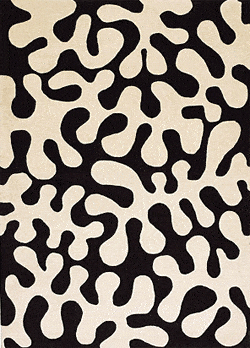
organic shapes
d)
organic forms
36.
Which of these is a three-dimensional object?
a)
a square
b)
hexagon
c)
cube
d)
a circle
37.
Clearly-defined shapes, often using many straight lines, that feel man-made or "unnatural."
a)
Geometric
b)
Form
c)
Texture
d)
Organic
38.
Shapes are
a)
the same as forms
b)
two-dimensional
c)
positive only
d)
three-dimensional
39.

Lines that follow the outer edges of an object are:

a)

cross hatch/straight

b)

stippling!smudging

c)

outline/contour lines

d)

imaginary lines

40.
Complementary colors also have high contrast. An artist might paint a red apple on a green table
a)
to create a Christmas card.
b)
because she’s hungry.
c)
to make the apple stand out.
d)
to hide the apple.
41.
Tints are light values of a color. Tints are usually made by
a)
mixing a color with white.
b)
mixing a color with black.
c)
going to your beautician.
d)
wearing colored contacts.
42.
The sun or a fire might be painted with warm colors, including
a)
white, black and gray.
b)
blue, green and purple.
c)
red, orange and yellow.
d)
bolivian Blue and purple plum
43.
Secondary colors are made by mixing
a)
two primary colors.
b)
lights and darks.
c)
coffee and cream.
d)
oil and water.
44.

The primary colors are

a)

kindergarten colors

b)

red, yellow and blue

c)

red, white and blue.

d)

orange, green and violet

45.

Artists use a _________________ to help them remember how to mix and think about colors.

a)

Selectometer

b)

Color Wheel

c)

Color Square

d)

Pneumonic

46.

We see color because of...

a)

value

b)

shadow

c)

light

d)

our eyes

47.
Orange, green, and violet are called
a)
primary
b)
secondary
c)
intermediate
d)
animalistic
48.
Which letter shows an example of negative space?
a)
S
b)
H
c)
I
d)
F
49.
This is an element of art that is two-dimensional, flat, or limited to height and width. 
a)
Line
b)
Shape
c)
Form
d)
Texture
50.
This is an element of art that is three-dimensional and encloses volume; 
a)
Form
b)
Shape
c)
Texture
d)
Line
51.
This element of art is the area between and around objects. It deals with negative space and can also refer to the feeling of depth. 
a)
Space
b)
Color
c)
Texture
d)
Form
52.
This in an element of art that indicates the lightness or darkness of tones or colors. White is the lightest value; black is the darkest. The value halfway between these extremes is called middle gray. 
a)
Texture
b)
Shape
c)
Color
d)
Value
53.
This is the element of art that deals with how light is reflected off of objects. It has three main characteristics: hue, value, and intensity. White is pure light; black is the absence of light. It is also a science.
a)
Texture
b)
Color
c)
Value
d)
Shape
54.
Line, shape, color, texture, value and space are known as ________ .
a)
color schemes
b)

style

c)
the principals of design
d)
the elements of art
55.
A monochromatic color scheme includes different values of a single color.
a)
True
b)
False
56.
What element is represented here?
a)
form
b)
line
c)
value
d)
texture
57.
Is color or shape more prominent in this work?
a)
color
b)
shape
58.
Is this a contour line drawing?
a)
Yes
b)
No
59.
What is this called?
a)
Color
b)
Complimentary Colors
c)
Color Wheel
d)
Color Circle
60.
Is white a primary color?
a)
Yes
b)
No
61.
Is black a primary color?
a)
No
b)
Yes
62.
Shape is three dimensional ?  
a)
True 
b)
False 
63.
We see these shapes in nature 
a)
Trees 
b)
Positive Shapes 
c)
Organic Shapes 
d)
Large Shapes 
64.
What is the definition of Line?
a)
A long mark on paper
b)
A short mark on canvas
c)
The edge of a surface
d)
The path of a point moving through space
65.
If you have very light areas, middle tones, and very dark areas in a drawing, you are using a _______________________.
a)
Cast shadow
b)
Highlight
c)
Lowlight
d)
Full range of value
66.
________________ is when you use your pencil to create soft gradual movements from one value to the next.
a)
Hatching 
b)
Cross Hatching
c)
Stippling
d)
Blending
67.
5. What are the three colors that can be mixed to make any other colors?
a)
electromagnetic colors
b)
supplementary colors
c)
primary colors
d)
secondary colors
68.
Why are they called primary colors?
a)
you can use other colors to make them
b)
they are the prettiest
c)
they are the brightest
d)
you can make all other colors from mixing them
69.

True or False...This Georgia O'Keeffe painting uses WARM colors

a)

True

b)

False

70.
M.C. Escher became interested in interlocking shapes in an infinite pattern. What is the name of these types of patterns?
a)
positive negative shapes
b)
tessellations
c)
tassalations
d)
asymmetrical designs
71.

You are facing a challenge in creating your art, what should you do?

a)

Give up and throw it away!

b)

Complain and say "I Can't"

c)

Think "Hmm this is challenging but with more practice I bet I can get better at this."

d)

Ask for help.

72.

What are the four golden rules in any practical classroom at this School?

a)

If you drop it, pick it up.

b)

If you spill it, wipe it up.

c)

If you open it, close it.

d)

Always concentrate.

e)

all of the above

73.

What do most unsafe acts have in common?

a)

they involve using equipment or materials incorrectly

b)

they involve fooling around

c)

they involve not reading the instructions

d)

they involve messy worksites

74.
You should charge your Chromebook every night.
a)
True
b)
False