Wayground logo

Free Printable Worksheets

Font size

S
M
L
XL
Worksheets

EC 9 SIX WEEK TEST

Total questions: 36

Worksheet time: 42mins

Name
Class
Date
1.

Will the balloons ATTRACT or REPEL each other?

a)
b)
2.

The buildup of electric charges is called . . .

a)

static electricity

b)

electric discharge

c)

electric charge

3.

Static electricity can "jump" from the charged object to another object, causing . . .

a)

static cling (objects sticking together)

b)

electric discharge (and a shock!)

4.
Two objects with LIKE static charges will
a)
attract each other
b)
even out in the end
c)
repel each other
d)
cause a spark
5.
Rubbing a balloon on hair is an example of static charge build up created by....
a)
conduction
b)
friction
c)
induction
d)
hairduction
6.
What happens when you touch a metal doorknob after rubbing your shoes on the carpet?
a)
The doorknob sends a burst of electric current into your body
b)
Millions of electrons go from your finger into the doorknob
c)
The doorknob sends millions of electrons into your finger
d)
our finger becomes negatively charged
7.
The smallest unit of an element is
a)
An electron
b)
A proton
c)
A neutron
d)
An atom
8.
A/an _________________ is an object that will allow electricity to flow through it.
a)
insulator
b)
conductor
9.
A/an _________________ is a material that will not allow electricity to flow through it.
a)
insulator
b)
conductor
10.
Which material is a conductor?
a)
glass
b)
aluminum
c)
wood
11.

_____ objects are made of atoms.

a)

Some

b)

A few

c)

Most

d)

All

12.
Rubber is a insulator.
a)
true
b)
false
13.
What is the difference between a conductor and an insulator?
a)
An insulator allows electricity to flow through it easily and a conductor does not
b)
A conductor allows electricity to flow through it easily and an insulator does not.
c)
An insulator is magnetic and a conductor is not
d)
A conductor is magnetic and an insulator is not
14.

A material that lets electric current pass through it.

a)

insulators

b)

conductors

c)

circuits

15.

A material that blocks the flow of an electric current is called a/an ___________________.

a)

insulator

b)

conductor

c)

circuit

16.

What are some examples of insulators?

a)

silver, iron, cooper

b)

metal spoon, penny, aluminum

c)

rubber, glass, wood

d)

gold, wire, nails

17.

Which group of materials are all insulators?

a)

two forks, wire, paperclips

b)

wooden chopsticks, rubber bands, electrical tape

c)

string, craft sticks, aluminum foil

d)

plastic tweezers, wire, yarn,

18.

A piece of an Ego Waffle is stuck in a toaster oven. You want to create a device to use that will help you not get shocked as you try to get the waffle out. Which group of items would be the best to use to remove the waffle without getting shocked?

a)

nails, rubber band, wooden spoon

b)

paperclip, nail, and paper towel

c)

rubber band, eraser, and wooden spoon

d)

paperclip, penny, and nail

19.
What size resistor would produce a 3 Amp current flow with a 12 Volt battery
a)
1 Ohm
b)
3 Ohms
c)
4 Ohms
d)
12 Ohms
20.
What is current measured in?
a)
Ω (Ohms)
b)
V (Volts)
c)
A (Amps)
d)
W (Watts)
21.
What is resistance measured in?
a)
Ω (Ohms)
b)
V (Volts)
c)
A (Amps)
d)
W (Watts)
22.
Electricity that flows in a closed path is called a
a)
path
b)
current
c)
circuit
d)
light
23.

Voltage divided by Resistance

(V / R)

a)

Current

b)

Power

c)

Ohms

d)

Watts

24.
If the Voltage is increased and the resistance stays the same, Current will
a)
Increase
b)
Decrease
c)
Stay the same
d)
X
25.
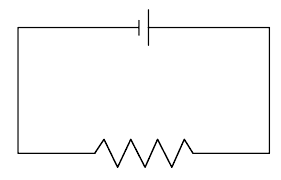
This circuit has a 24 volt battery and the resistor is 8 ohms. How many amps are running through the circuit?
a)
3 Amps
b)
192 Amps
c)
2 Amps
d)
4 Amps
26.

An alarm clock draws 0.5 A of current when connected to a 120 volt circuit. Calculate its resistance.

a)

60Ω

b)

120Ω

c)

180Ω

d)

240Ω

27.

Speakers need a household voltage of 110 V to push a current of 5.5 A through them. What is the

resistance of the speakers?

a)

10Ω

b)

20Ω

c)

30Ω

d)

40Ω

28.

An IPod uses a standard 1.5 V battery. How much resistance is in the circuit if it uses a current of 0.01A?

a)

50Ω

b)

100Ω

c)

150Ω

d)

200Ω

29.
How do you calculate voltage?
a)
Current X Resistance
b)
Resistance ÷ Current
c)
Current ÷ Resistance
d)
Measure it with a ruler
30.
What resistance is needed to cause a 50A current flow because of a 500V battery?
a)
10Ώ
b)
5Ώ
c)
2500Ώ
d)
550Ώ
31.
In the event that someone is being shocked by electricity you would never ________________.
a)
call an adult
b)
call 911
c)
touch them
d)
yell for help
32.
What's the first thing you should do if someone is shocked electrically?
a)
Use the fire extinguisher
b)
Check for breathing and heartbeat
c)
Turn off the power source
d)
Remove the person from the power source
33.

It is a good idea to not plug too many things into one outlet, since there is a risk of overloading the circuit at that outlet.

a)

true

b)

false

34.
It is always advisable to ask questions about the things you do not fully understand before doing electrical wiring work.  
a)
True
b)
False
35.

You should never wear rings or other _______________ around electricity.

a)

terminals

b)

jewelry

c)

connection points

36.

Never touch any electrical appliance with wet hands as you may suffer from an electrical

a)

circuit ground

b)

terminal

c)

shock