
Font size
 Worksheets
DNA history and Replication
Total questions: 20
Worksheet time: 20mins


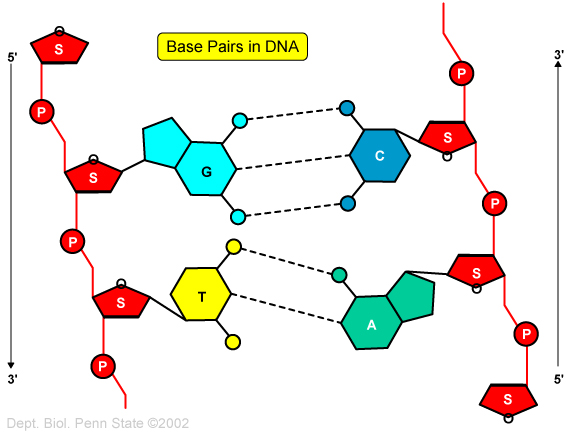
What are the two parts that make up a nucleotide?
A nitrogen base
A piece of the DNA backbone (Sugar & Phosphate)
Sugar
Phosphate

In the process of DNA replication, which of the following steps must occur first?
DNA "unzips" between the base pairs
The DNA sides "rezip" to make two identical DNA strands
Complementary nucleotides pair up
mRNA leaves the nucleus
ATG TGA CAG

order of replication
3, 2, 1, 4
2, 1, 4, 3
2, 3, 1, 4
3, 4, 1, 2

The picture below shows the steps of DNA replication beginning with step one and ending with step three.
Because you are reusing the old, or parent, DNA strand DNA replication is said to be
Semi- Conservative
Semi-discontinuous
Continuous
Fully-Conserveative

The picture below shows an enzyme unwinding and unzipping DNA.
What is the name of this enzyme?
DNA Helicase
DNA Ligase
DNA polyermase
RNA Polymerase
Which enzyme is responsible for adding the free nucleotides to the replicating DNA?
DNA Helicase
DNA Ligase
DNA polyermase
RNA Polymerase
Which is the second step?
DNA Helicase unwinds original DNA strand
RNA Primase lays down RNA primer for new nucleotide bases.
DNA polymerase builds new strands by bring in new nucleotide bases.
Ligase knits together fragments on lagging strand

Which letter in the picture below depicts the leading strand in DNA replication?
A
C
B
None of the above
Which letter in the picture below depicts the lagging strand in DNA replication?
A
C
B
None of the above
Which letter in the picture below depicts the replication fork in DNA replication?
A
C
B
None of the above
If a person suffered from a disorder where their DNA fragments were unable to fill in the missing slots in between the fragments of the lagging strand, they would most likely have a disorder that affected which enzyme?
DNA Helicase
DNA Ligase
DNA polyermase
RNA Polymerase
DNA replication runs from ______' to _____' and is said to be ______________________
5, 3, antiparallel
3, 5, antiparallel
5, 3, parallel
3, 5, parallel

What gray enzyme in the picture is shown removing the RNA primer?
DNA ligase
DNA Polymerase
Exonuclease
RNA Primase

