wayground logo

Free Printable Worksheets

Font size

S
M
L
XL
Worksheets

WILD Biologist Competition 2

Total questions: 57

Worksheet time: 48mins

Name
Class
Date
1.
A series of steps used by scientists to solve a problem or answer a question. 
a)
scientific method
b)
recipe
c)
data collection
d)
metric system
2.
This step of the scientific method is an educated guess or a prediction. 
a)
Hypothesis
b)
Research
c)
Observation
d)
Conclusion
3.
This is the group that we will compare our experimental group to. This group stays "normal."
a)
Control Group
b)
Experimental Group
c)
 Normal Group
d)
Weird Group
4.

This is the group that is affected by the variable or the group that is changed.

a)

Control Group

b)

Experimental Group

c)

Changed Group

d)

Cool Group

5.
Should experiments be repeated over and over to see if the results are the same each time?
a)
yes
b)
no
6.
This variable in an experiment is the one being changed by the scientist. 
a)
dependent variable
b)
independent variable
c)
data
d)
control group
7.
This makes an organism more suited to its enviornment
a)
species
b)
lifespan
c)
adaptation
d)
mutation
8.
Who was Charles Darwin?
a)
A naturalist who came up with the theory of evolution
b)
A scientist who studied plants
c)
A geologist who looked at rocks and fossils
d)
A paleontologist who studied dinosaurs
9.

What do you call similar structures that related species have inherited from a common ancestor?

a)

Natural Selection

b)

Analogous Structure

c)

Vestigial Structure

d)

Homologous Structure

10.

What do we call structures that no longer perform their original function?

a)

Natural Selection

b)

Analogous Structure

c)

Vestigial Structure

d)

Homologous Structure

11.

Select ALL that show evidence of evolution.

a)

DNA

b)

mutations

c)

fossils

d)

skeletal structures

12.
Which of the following is a term for a group of similar organisms that can reproduce fertile offspring?
a)
individual
b)
population
c)
species
d)
fossil
13.
Extinction can occur because of which of the following?
a)
All can be causes of extinction.
b)
Increased competition with other species
c)
New predators within the environment
d)
Loss of habitat and/or catastrophes
14.
Finches on the Galapagos Islands had different beaks in order to help them do what?
a)
Build nests
b)
Fight off predators
c)
Collect food sources
d)
Compete with rivals
15.
A remnant or trace of an organism from the past is called a _______.
a)
Ancestor
b)
Skeleton
c)
Fossil
d)
Imprints
16.
According to the diagram, which organism is older?
a)
ammonite
b)
coral
c)
gastropod
d)
trilobite
17.

Farmers breed cows to produce high amounts of milk. This is an example of...

a)

Natural selection

b)

Variations in a species

c)

Selective breeding

d)

Inbreeding

18.

Evolution is best defined as:

a)

the process which organisms die.

b)

the process which organisms change over time.

c)

the process which organisms that are extinct become revived.

d)

the process which non-living things fossilize.
19.
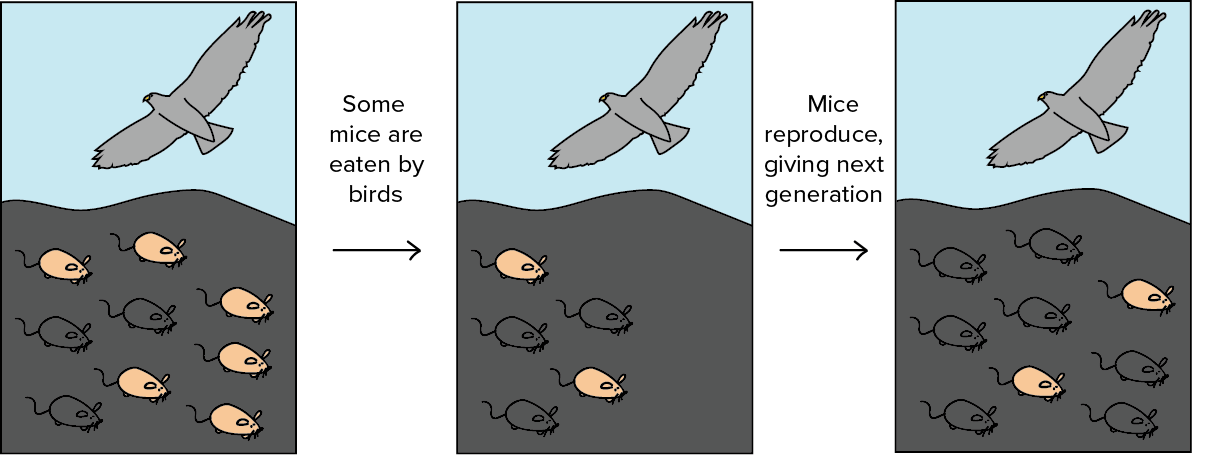
Why is the mouse population changing over time?
a)
The light mice can reproduce more successfully than the dark mice
b)
The hawks eat more dark mice than light mice because the dark mice taste better
c)
The hawks eat more light mice than dark mice because they can see the light mice more easily
d)
The hawks eat more dark mice than light mice because they can see the dark mice more easily
20.

Overproduction, Genetic Variation, Struggle to Survive, and Successful Reproduction are the 4 parts of:

a)

Natural Selection

b)

Speciation

c)

Artificial Selection

d)

Fossilization

21.
What factor would cause animals of the same species to begin competing with one another?
a)
increase in precipitation         
b)
the presence of decomposers
c)
the introduction of a new food source
d)
limited supply of resources
22.
The study of how living things interact in an environment is called
a)
Ecosystem
b)
Biology
c)
Ecology
23.

The introduction of a non-native species into an ecosystem can result in serious ecological problems. This is often because the non-native species...

a)

adapt to changes quickly

b)

mutations

c)

lacks natural predators

d)

provides additional genetic diversity

24.
What does biotic mean?
a)
Living
b)
Non living
c)
Man made
25.
What does abiotic mean?
a)
Living
b)
Non-living
c)
Man made
26.
What is a producer?
a)
an organism that gets energy from eating other organisms
b)
an organisms that uses sunlight to make its own food
c)
an organism that gets energy from eating dead organisms, non-living material or waste
d)
an organism that uses chemical energy to make its own food
27.
An animal that gets energy from eating both plants and animals is a 
a)
herbivore
b)
carnivore
c)
omnivore
d)
autotroph
28.
Which of the following is a herbivore?
a)
cricket
b)
frog
c)
hawk
d)
shrew
29.
What is this called?
a)
Food Web
b)
Food Chain
c)
Abiotic Factors
30.

The highest concentration of life exists in the top 200 meters of ocean water. What is the most important factor that influences the concentration of life?

a)

amount of gases at the surface

b)

amount of nutrients in the water

c)

large number of predators at lower depths

d)

amount of sunlight

31.

Each step in a food chain is called a trophic level. What percentage of energy available at one trophic level is transferred to organisms at the next level?

a)

about 2 percent

b)

about 10 percent

c)

about 25 percent

d)

about 50 percent

32.

Which species will have the largest population?

a)

Hawks

b)

Snakes

c)

Rabbits

d)

Grass

33.

An ecosystem is...

a)

All of the members of a species in the same area.

b)

All of the different species in the same area.

c)

All of the biotic and abiotic factors in an area.

34.
Which limiting factor would increase due to the number of individuals in a population?
a)
Unusual weather
b)
Natural disaster
c)
Births
d)
Disease
35.

True or False: Limiting factors can be population dependent and population independent.

a)

True

b)

False

36.
Largest number of individuals of a population that the environment can support...  
a)
carrying capacity
b)
population crash
c)
lag phase
d)
mutualism
37.
If the number of births in a population is the same as the number of deaths in a population, what will happen to the growth of the population?
a)
It will increase.
b)
It will decrease.
c)
It will stay the same.
d)
It will fluctuate.
38.

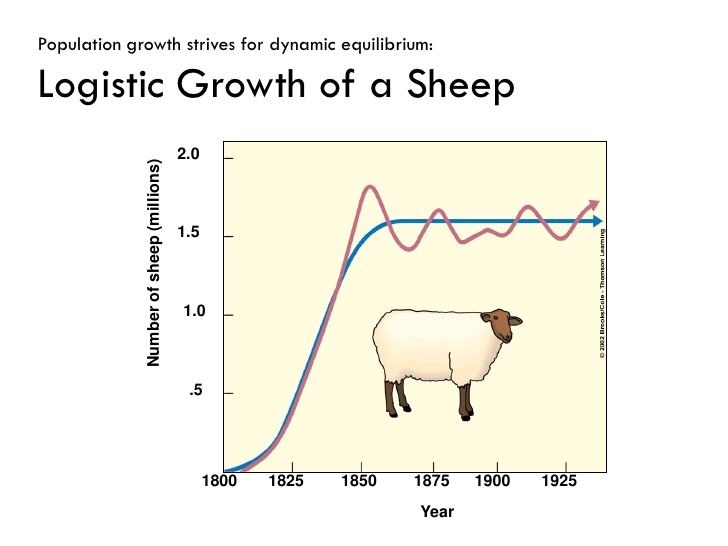
What is the carrying capacity for this sheep population?

a)

1.8 million

b)

1.25 million

c)

1.6 million

d)

1.0 million

39.

What type of growth is represented behind?

a)

exponential

b)

logistic

c)

invasive

d)

representative

40.
Any thing or organism that regulates the size of a population of another organism is known as __________.
a)
a limiting measure
b)
a limiting factor
c)
factorization
d)
materialization of precipitation
41.

Which of the following are density dependent factors? Check all that apply.

a)

competition for resources

b)

predation

c)

disease

d)

natural disasters

42.

Which of the following are examples of a density independent factors? Check all that apply.

a)

forest fire

b)

seasonal cycles

c)

storms

d)

disease

43.

Where an organism lives

a)

habitat

b)

niche

c)

biosphere

44.

Different species are most likely to compete for resources in an ecosystem if both species attempt to...

a)

occupy the same niche.

b)

successfully reproduce.

c)

live in different habitats.

d)

find different food sources.

45.
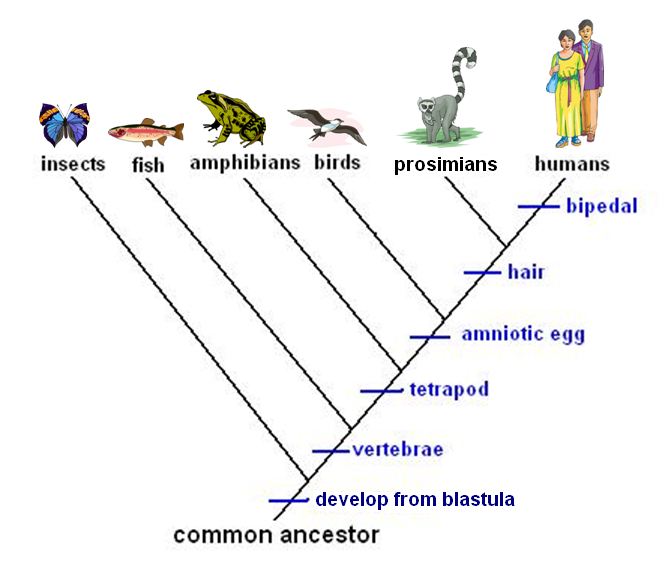
Which organisms pictured on the cladogram have hair?
a)
prosimians only
b)
prosimians and humans
c)
humans only
d)
prosimians and birds
46.

The two extant (living) species that are closely related to each other are...

a)

A and B

b)

B and C

c)

C and D

d)

D and E

47.
According to the diagram, when did the common ancestor of giant pandas and spectacled bears exist? 
a)
5-10 mya
b)
10-15 mya
c)
15-20 mya
d)
20-25 mya
48.

Remora are small fish with a sucker-like organ that allows them to attach themselves to larger animals like a shark. By doing this, the remora is able to gain protection from the presence of the shark while helping the shark stay clear from parasites. This relationship shows...

a)

parasitism

b)

mutualism

c)

commensalism

d)

predation

49.

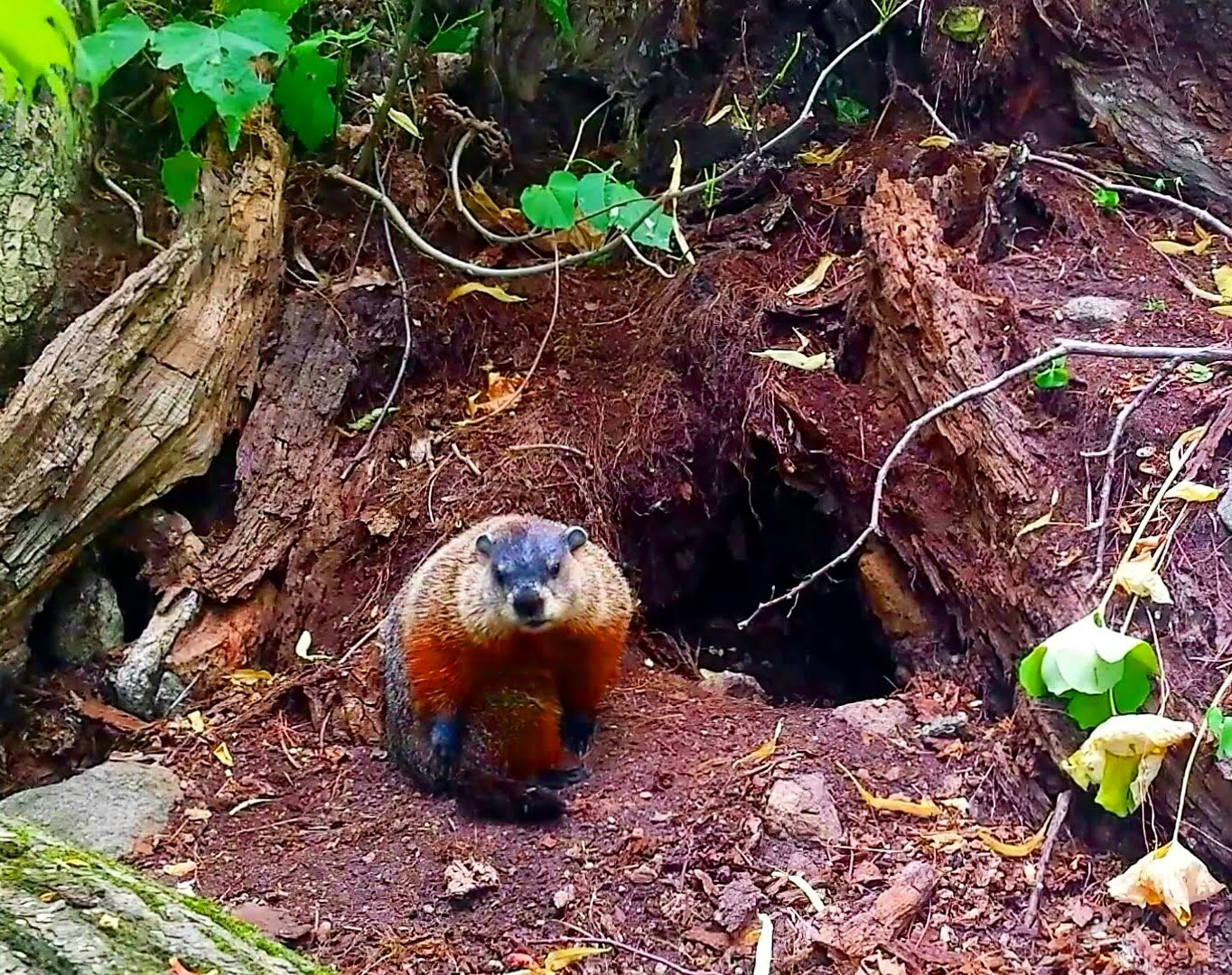
Type of symbiosis: Skunks often live in burrows that have been dug and abandoned by woodchucks.

a)

commensalism

b)

mutualism

c)

parasitism

d)

predation

50.
All of the following statements concerning characteristics of predator-prey relationship are correct EXCEPT:
a)
Camouflage is an adaptation that protects prey.
b)
A rise in the population of predators is followed by a decreased in the population of prey.
c)
A rise in the population of prey is often followed by a rise in the population of predators.
d)
The population of predators most often eliminates the population of prey
51.
How does carbon dioxide leave the atmosphere?
a)
Through transpiration
b)
Through photosynthesis
c)
Through factory emission
d)
Sunlight
52.
Which of the following processes converts C6H12O6 to an inorganic molecule CO2
a)
translation
b)
photosynthesis
c)
cellular respiration
d)
excretion
53.
How much of the atmosphere is composed of nitrogen gas?
a)
87%
b)
38%
c)
78%
d)
21%
54.
A particular golf course is using large amounts of nitrogen fertilizer. What process could move this nitrogen into a local stream?
a)
volatilization
b)
nitrogen fixation
c)
runoff
d)
ammonification
55.

Science is about...

a)

imagination and creativity

b)

curiosity and experiments

c)

experiments and research

d)

imagination, creativity, curiosity, experiments and research

56.
Which is the BEST description of biology?
a)
the study of humans and animals
b)
the study of life and living things
c)
the study of health care
d)
the study of humans, plants, and animals
57.

Do you like science?

a)

I love science! It is my life!

b)

Science is okay..

c)

I hate Science. It is boring!

d)

I AM a scientist!