
 Worksheets
CHP 3 & CHP 4: COST & PRODUCTION, MARKET STRUCTURE
Total questions: 42
Worksheet time: 35mins
In the long run...
All inputs are fixed
All input are variable
at least one input is variable and one input is fixes
at most one input is variable and one input is fixed
Which of the following is NOT considered as variable input?
A. Worker
A. Building
A. Raw materials
A. Operation manager
A firm experiences decreasing marginal return only when
Stage 1
Stage 2
Stage 3
Stage 4

At the level of 5 labors, average production is __________.
4 units
6 units
7 units
8 units

The marginal production from 3 to 4 labors is _________.
2
7
4
8

The output maximum is at labor of _______________
3 labors
4 labors
5 labors
6 labors
At Stage 1 of production, a rational producer _________.
will stop the production
will reduce the usage of labors
will continue to increase the number of labors
will stay the current combination of machine and labors.
Average variable cost (AVC) is
Explicit costs
Variable cost divided by output
The increase in output that arises from an additional unit of input
Costs that do not vary with the quantity of output produced
Fixed cost
long run ATC rises as output increases
long run ATC falls as output rises
costs that do not vary with the quantity of output produced
long run ATC stays the same as the quantity of output changes
In the third of the three stages of production:
the total product curve has an increasing slope
the marginal product curve lies completely below the average product curve.
the marginal product curve has a positive slope
marginal product is negative
Wages and salaries paid to workers are an example of implicit costs of production.
True
False
Which of the following is a variable cost in the short run?
rent of the factory
wages paid to factory workers
interest payments on borrowed financial capital
salaries paid to upper management
If a firm does not produce any output, its total cost in the short run is equal to
Zero
Its fixed costs
Its variable costs
Its marginal cost

Which levels of output are produced at the minimum possible cost per unit?
q1
q2
q3
All of the above.

The marginal cost of the 10th basketball is
$1.5
$2
$2.5
$3
Which of the following is the best definition of costs?
The total amount of income a business makes from selling products or services.
The amount of money a business has left over after paying for materials.
The total amount of money a business spends.
Which of the following is the best definition of profit?
The total amount of income a business makes from selling products or services
The amount of money a business has left over after paying for their costs.
The total amount of money a business spends.
When the average cost is equal to marginal cost, ___________________.
the average cost is at its maximum.
the marginal cost is at its maximum.
the average cost is at its minimum.
the marginal cost is at its minimum.
Which of the following short run costs continue to decrease as output increases?
Average variable cost.
Marginal cost.
Average fixed cost.
Average cost.
What is the profit maximizing condition?
MR = D
MR = MC
MC = D
D = Profits
Check all that apply: Which of the following are characteristics of a perfectly competitive market?
Many buyers/sellers
Identical Products
Price Makers
Low barriers of entry

The image above shows a firm making
Economic Profit
Economic loss
Breaking even
Shutting down

Should the following firm shutdown?
Yes
No
Not enough information present
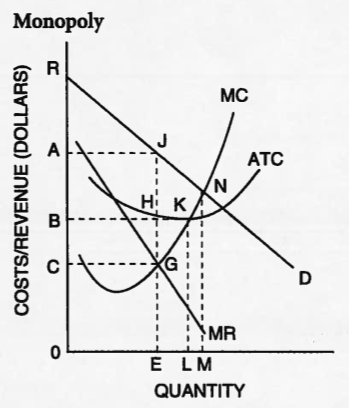
A firm operating in a perfectly competitive market will shut down when price is below the minimum of a(n) ____________.
marginal cost curve
average total cost curve
average fixed cost curve
average variable cost curve
A firm faces a perfectly elastic demand curve, if _____________.
MC = MR
MR = AR
AR = MC
ATC = AVC
Which of the following describes a monopoly firm?
Single seller
Many sellers
Many substitutes
No barrier to entry
A perfectly competitive firm
A) sells a product that has perfect substitutes.
B) has a perfectly inelastic demand.
C) has a perfectly elastic supply.
D) Answers A and B are correct.
E) Answers A and C are correct.
Hint: think of the soda market
One difference between oligopolies and monopolistically competitive markets is that
there is no deadweight loss in monopolistically competitive markets, but there is in oligopolies
the products sold in monopolistically competitive markets are identical
oligopolies have fewer barriers to entry
firms maximize profits in monopolistically competitive markets but not in oligopolies
there are fewer firms in oligopolistic markets than in monopolistically competitive ones

