
 Worksheets
Great Depression and the New Deal PRE-TEST
Total questions: 23
Worksheet time: 23mins
Name
Class
Date
1.
Ownership in shares of a company or corporation
a)
CEO
b)
Insurance
c)
Stocks
2.

The president who promised the people a "New Deal" during the Great Depression.
a)
Jesse Owens
b)
Herbert Hoover
c)
Franklin D. Roosevelt
d)
George Washington
3.

During the Great Depression people were worried because the economy was doing poorly. How did this fear affect their consumption of goods?
a)
People consumed more things because they thought they wouldn't be able to buy them later.
b)
People consumed fewer things because they wanted to save as much money as they could.
c)
People consumed more things because they wanted businesses to do better.
d)
People consumed fewer things because the government was rationing consumption.
4.
Which of the following is NOT a cause of the Great Depression?
a)
Stock Market Crash
b)
Credit
c)
Advertisment
d)
Prohibition
5.
What was the New Deal?
a)
A relief program
b)
A weapons project
c)
A Scam
d)
A Tax
6.
The Great Depression only took place in the cities.
a)
True
b)
False
7.
The Dust Bowl happened during the Great Depression?
a)
True
b)
False
8.
The Dust Bowl caused many to move EAST?
a)
True
b)
False
9.
The Great Depression began in
a)
1925
b)
1929
c)
1932
d)
1940
10.
Month and Day that Stock Market Crashed
a)
October 28, 1929
b)
October 29, 1928
c)
October 29, 1929
d)
October 29, 1939
11.
In the 1930's, people would line up at ____________ to get food. These were normally run by charities.
a)
churches
b)
businesses
c)
soup kitchens
d)
work
12.
Who was president at the time of the Stock Market Crash of 1929?
a)
Abraham Lincoln
b)
Franklin D. Roosevelt
c)
Theodore Roosevelt
d)
Herbert Hoover
13.
After the Stock Market Crash, many people lost their life savings because _______________.
a)
banks closed
b)
banks gave away their money
c)
they couldn't remember where they put it
d)
someone stole it
14.
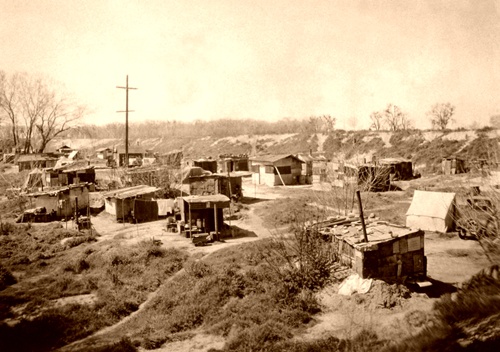
What were the villages full of shacks located in cities filled with unemployed Americans called?
a)
Hoovervilles
b)
Okies
c)
Bonus Army Bases
d)
Rooseveltowns
15.
The Bonus Army incident in 1932 best illustrates the idea that
a)
F.D.R.'
s relief programs were unsuccessful.
s relief programs were unsuccessful.
b)
many felt that Herbert Hoover was not handling the Depression well.
c)
protests by veterans during the Depression were effective.
d)
the U.S. Army had increased in size and power during the Depression.
16.
What is one way the New Deal was supposed to help the economy out of the Great Depression?
a)
by eliminating trading on the stock market
b)
by encouraging war with Germany and Japan
c)
by creating jobs through various new programs
d)
by giving people money through new bank laws
17.
Which program built roads, schools, buildings, libraries, etc?
a)
Social Security
b)
FDIC
c)
CCC
d)
WPA
18.
Which program insures banks and keeps your money safe?
a)
Social Security
b)
TVA
c)
CCC
d)
FDIC
19.
Which program builds wildlife perserves and plants trees?
a)
CCC
b)
TVA
c)
WPA
d)
FDIC
20.
Which program cleared the river valley in Tennesee and brought electricity to these rural parts near the river?
a)
CCC
b)
WPA
c)
TVA
d)
FDIC
21.
Which program sets up a tax to help benefit retired people?
a)
FDIC
b)
Social Security
c)
TVA
d)
WPA
22.
In 1929 the Great Depression started in the United States. In 1932 Franklin D. Roosevelt was elected president and he promised a "New Deal" to the American people. Which of the following BEST describes the role of the government during the New Deal?
a)
The government wanted people to take care of themselves and not use the government.
b)
The New Deal led to the government being more involved in the economy of the country.
c)
The government wanted people to let the government provide everything they needed.
d)
The New Deal led to the government being less involved in the economy of the country.
23.
The New Deal was divided into 3 categories: relief for immediate help, reform to fix problems, and _________________________ to help the people and nation “get back on their feet”.
a)
reinvent
b)
radicalize
c)
recovery
d)
reissue
100 %

