
 Worksheets
Unit 5: Space - Gravity, Solar System, Vocabulary
Total questions: 39
Worksheet time: 23mins

We live in the Solar System
True
False
Which star is the closest to Earth?
Ceres
Red Beast
Nebula
Sun
Which of the following is correct about our Sun? Select all that are correct.
It was formed about 4.6 billion years ago.
It is the largest star in the universe.
It takes 8 minutes for the sun's light to reach the Earth.
It is smaller than Jupiter.
The distance that light travels in one year is called:
A light year
A light ray
An astronomical unit
AU
The centre of the solar system is a:
Star
Planet
Asteroids
Comets
The theory that the universe originated from a gigantic explosion of a central large and dense mass is the:
Organic Evolution Theory
Steady State Theory
Big Bang Theory
Theory of tectonic plates
The attractive force between objects is called....
force
Gravity
inertia
motion
When we see the Andromeda galaxy, we are seeing it as it was 2.3 million years ago. Why?
it takes light that length of time to travel
light travels really slow in outer space
light travels faster than sound
it is an ancient galaxy

Which galaxy is the largest in the local group?
Milky Way
Andromeda
Triangulum
Le Gentil
It takes light approximately 8 minutes and 20 seconds for light from the Sun to reach Earth. Which is true about Earth's distance from the Sun
The Sun is much less than 1 light year from Earth
The Sun is 1 light year from Earth
The Sun is 8.33 light years from Earth
The Sun is so hot it burns
Why does our Sun, an average sized star, appear so much brighter than other more massive stars?
The Sun is lit
The Sun is closer to Earth than other stars
The Sun is made of different elements
The Sun is prettier so it shines brighter

List the following items from smallest to largest.
universe, solar system, galaxy
galaxy, solar system, universe
solar system, galaxy, universe
solar system, universe, galaxy

What shape of orbit does the Earth have? This was proven by astronomer Johannes Kepler.
An elliptical orbit around the moon.
An elliptical orbit around the Sun.
A circular orbit around the moon.
A circular orbit around the Sun.

Why create a new unit for distance?
Kilometers or miles were too small.
Kilometers or miles were too big.
They could not agree whether to use kilometers or miles.

1 A.U. =
1.5 x 10¹² m
93 million miles
9.3 x 10⁷
93,000,000 miles

Which unit of measurement is used to measure distances within our solar system?
inches
kilometers
miles
astronomical units
Why do we use light years and astronomical units to measure distances in space?
Scientists want to sound smart.
Hubble discovered these units and wanted to use them.
Space is too small to use miles, it wouldn't make sense.
Space is too big to use traditional units, like miles.

What is Astronomical Unit?
1000 km
The size of our solar system
The average distance between Earth and the Sun
The average distance between Earth and Moon
SELECT ALL THAT APPLY
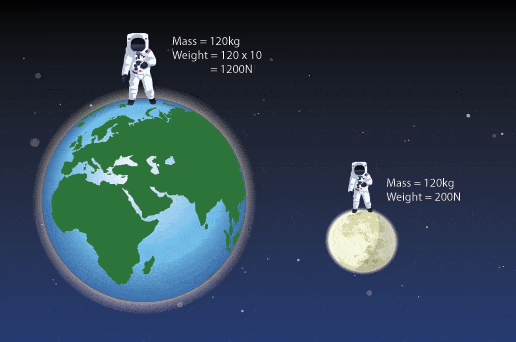
How are mass and weight different?
mass never changes
weight depends on gravity
mass depends on gravity
weight never changes

When objects are MORE MASSIVE, is the force of gravity between them STRONGER or WEAKER?
When objects are MORE MASSIVE, the gravity between the objects is STRONGER.
When objects are MORE MASSIVE, the gravity between them is WEAKER.
When objects are FARTHER APART, is the force of gravity between them STRONGER or WEAKER?
When objects are farther apart, the gravity between the objects is STRONGER.
When objects are farther apart, the gravity between them is WEAKER.
WHY does the Sun create a LARGER gravitational field than the Earth?
The Sun has more magnetism than the Earth and this creates a larger gravitational field
The Sun is hotter than the Earth and this creates a larger gravitational field.
No one knows why
The Sun has more MASS than the Earth, so it creates a larger gravitational field than the earth does.
What keeps the planets in orbit around the sun?
gravity
friction
density
distance
A brick and a pencil are dropped at the same time from the same height. Which one would hit the ground first?
brick
pencil
both would hit at the same time
What two things determine the gravity of an object?
mass & weight
mass & distance
density & mass
volume & distance
When will the forces of gravity between two objects be the GREATEST?
when the masses of both objects are small and the objects are far apart
when the masses of both objects are large and the objects are close together
when the masses of both objects are small and the objects are close together
when the masses of both objects are large and the objects are far apart
When will the gravity between two objects be the LEAST?
when the masses of both objects is small and the objects are close together
when the masses of both objects is small and the objects are far apart
when the masses of both objects is large and the objects are close together
when the masses of both objects is large and the objects are far apart
Which statement about gravity is true?
gravity causes objects to pull towards one another
gravity causes objects to push away from each other
gravity only takes place between planets
the moon doesn't have any gravity

