
 Worksheets
B4.7/8 Transport in plants and EvapoTranspiration
Total questions: 16
Worksheet time: 13mins
Name
Class
Date
1.
Vascular tissue that transports water and minerals UPWARDS from a plant's roots is know as ______.
a)
Chlorophyll
b)
Phloem
c)
Stomata
d)
Xylem
2.
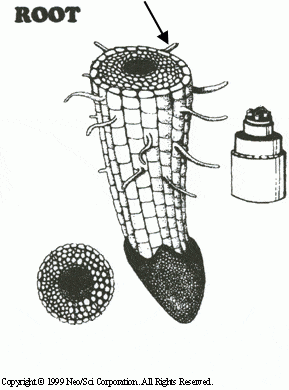
What is the name of the part of the root that allows water and minerals enter?
a)
root hairs
b)
epidermis
c)
phloem
d)
phyla
3.
How do water enter the roots from the soil?
a)
diffusion
b)
osmosis
c)
transpiration
d)
active transport
4.
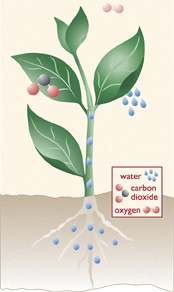
Water vapour exits a plant leaf by
a)
the stomata
b)
the epidermis
c)
the palisade cells
d)
the spongy mesophyll
5.
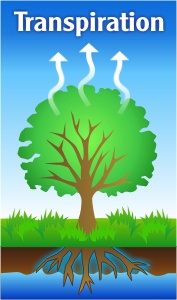
Transpiration is
a)
the movement of water through a plant from the roots up the stem
b)
the loss of water from the leaves of a plant by the process of evaporation
c)
the flow of water into plant roots by osmosis from the soil
d)
the process of minerals and sugars moving through plant veins
6.
This is the definition for which word:The movement of particles down a concentration gradient (from a high concentration to a low concentration)
a)
Osmosis
b)
Diffusion
c)
Active transport
d)
Transpiration
7.
Why is the evaporation of water from leaves important?
a)
It cools leaves and helps move water up the plant.
b)
It makes the plant wilt
c)
It helps the plant to respire
8.
Which of these is true?
a)
Xylem vessels carry water and dissolved minerals up the plant
b)
Phloem tissue carry water and dissolved minerals up the plant
c)
Xylem vessels carry dissolved sucrose up and down the plant
9.
What happens to the transpiration rate as light intensity increases?
a)
It increases
b)
It stays the same
c)
It decreases
10.
Water and minerals move in which direction within the plant
a)
Upward
b)
Down
11.
Where does sugar transport begin?
a)
Roots
b)
Leaves
c)
Root hairs
d)
Vascular bundles
12.
Plant transports food made in the leaves to __________.
a)
roots
b)
stem
c)
flowers
d)
all of the above
13.
The equation for photosynthesis is
a)
oxygen + water --> glucose + carbon dioxide
b)
oxygen + glucose --> carbon dioxide + water
c)
carbon dioxide + water --> glucose + oxygen
d)
carbon dioxide + glucose --> oxygen + water
14.
Which of the following is responsible for the cohesion of water molecules?
a)
hydrogen bonds between the oxygen atoms of a water molecule and cellulose in a vessel cell
b)
covalent bonds between the hydrogen atoms of two adjacent water molecules
c)
hydrogen bonds between the oxygen atom of one water molecule and a hydrogen atom of another water molecule
d)
low concentrations of charged solutes in the fluid
15.
Ignoring all other factors, what kind of day would result in the fastest delivery of water and minerals to the leaves of a tree?
a)
cool, dry day
b)
warm, dry day
c)
warm, humid day
d)
cool, humid day
16.
How does the mineral ions from the soil enter the roots?
a)
by osmosis
b)
by passive transport
c)
by active transport
100 %

