wayground logo

Free Printable Worksheets

Font size

S
M
L
XL
Worksheets

UNIT 1: INTRODUCTION TO EUCLIDEAN GEOMETRY

Total questions: 159

Worksheet time: 5hrs 31mins

Name
Class
Date
1.
Say 'TRUE' or 'FALSE'
Only one line pass through a single point 
a)
TRUE
b)
FALSE
2.
Say 'TRUE' or 'FALSE'
If two circles are equal, then their radii are equal
a)
TRUE
b)
FALSE
3.
Which of the following needs a proof?
a)
Theorem
b)
Axiom
c)
Definition
d)
Postulate
4.
Say 'TRUE' or 'FALSE'
Two distinct intersecting lines cannot be parallel to the same line
a)
TRUE
b)
FALSE
5.

A triangle with one 90 degree right angle.

a)

Acute Triangle

b)

Right Triangle

c)

Obtuse Triangle

d)

Equilateral Triangle

6.

Two or more lines that share a common point of intersection.

a)

Parallel Lines

b)

Intersecting Lines

c)

Ray

d)

Line Segment

7.

Two lines that intersect at 90 degree angles.

a)

Parallel Lines

b)

Skew Lines

c)

Perpendicular Lines

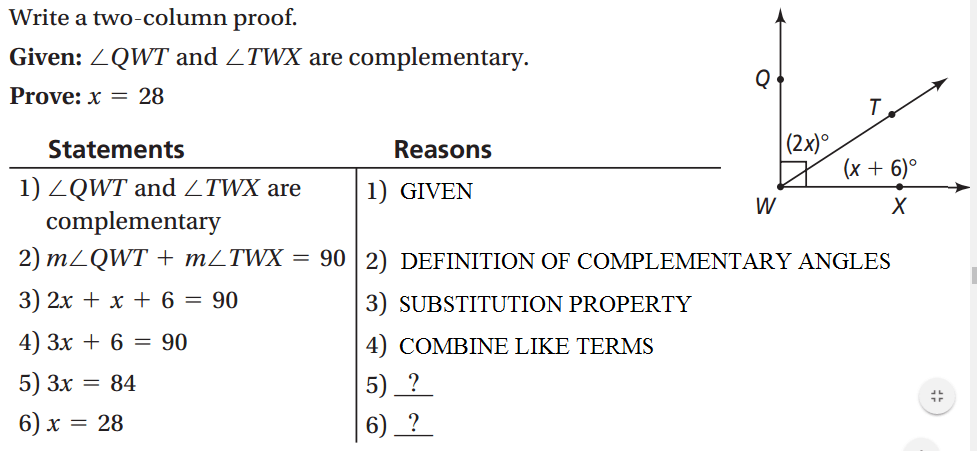
d)

Line Segment

8.

Two lines in the same plane that will never intersect

a)

Parallel Lines

b)

Skew Lines

c)

Perpendicular Lines

d)

Line Segment

9.

Two angles that sum to 180 degrees.

a)

Complimentary Angles

b)

Supplementary Angles

c)

Right Angles

d)

Obtuse Angles

10.

An angle that measures greater than 90 degrees.

a)

Complimentary Angles

b)

Straight Angle

c)

Right Angle

d)

Obtuse Angle

11.

An angle that measures less than 90 degrees.

a)

Acute Angle

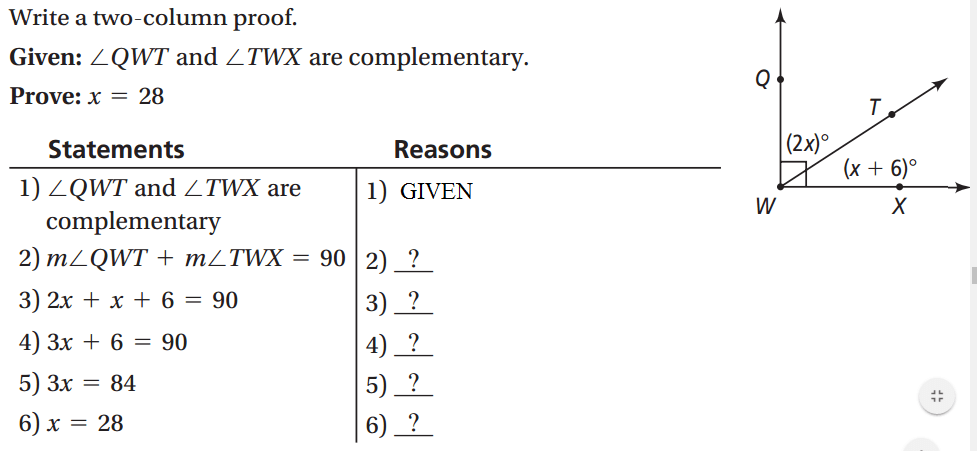
b)

Straight Angle

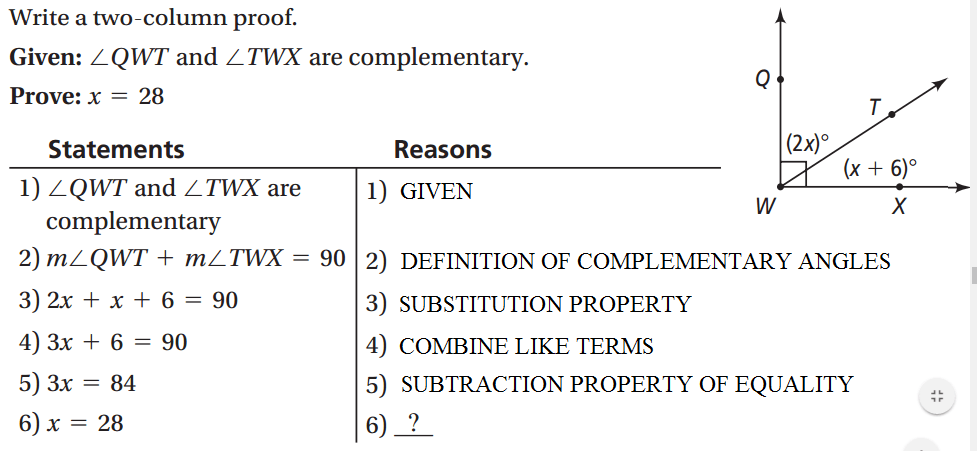
c)

Right Angle

d)

Obtuse Angle

12.

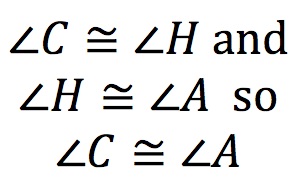
Two angles that sum to 90 degrees.

a)

Complimentary Angles

b)

Supplementary Angles

c)

Right Angle

d)

Obtuse Angle

13.

Part of a line beginning from an endpoint and then continuing forever.

a)

Ray

b)

Line

c)

Line Segment

d)

Straight Angle

14.

Part of a line consisting of two endpoints and all points in between them.

a)

Ray

b)

Line

c)

Line Segment

d)

Straight Angle

15.

A flat surface with no thickness that extends in all directions forever.

a)

Ray

b)

Line

c)

Plane

d)

Parallelogram

16.

A straight path that has no thickness and extends forever.

a)

Ray

b)

Line

c)

Plane

d)

Line Segment

17.

A location that has no size.

a)

Ray

b)

Point

c)

Plane

d)

Dot

18.
Baymax's eyes make a...
a)
Line
b)
Line segment
c)
Ray
d)
Angle
19.
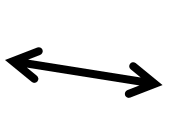
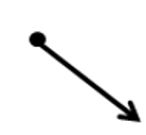
Name the figure.
a)
ray
b)
line
c)
line segment
d)
point
20.
What is the term for a part of a line with two endpoints?
a)
point
b)
ray
c)
angle
d)
line segment
21.
What is the term for a part of a line that has one endpoint and goes on endlessly in one direction?
a)
line
b)
line segment
c)
ray
d)
angle
22.
What is a ray?
a)
Part of a line with 2 endpoints
b)
Part of a line with 1 end point and goes on forever 
c)
Part of a line with 0 endpoints
d)
Part of a line with 5 endpoints
23.
What is a line?
a)
a straight path of points that goes on and on in two directions
b)
an endless flat surface
c)
an exact location in space
d)
lines that never intersect
24.
What is a point?
a)
a straight path
b)
an exact location
c)
endless flat surface
d)
lines that cross
25.

What is a name for this line?

a)
b)
c)
d)
26.

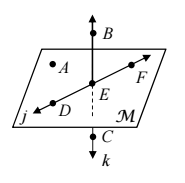
An example of coplanar points

a)

D, E, B

b)

C, B, A

c)

M, E, C

d)

A, F, E

27.
Give another name for line k.
a)
Line BC
b)
Line BCE
c)
Line ED
d)
Line k is the only name, there isn't another name.
28.

What is another name for  DE\overrightarrow{DE}  

a)

 ED\overrightarrow{ED}  

b)

 EF\overrightarrow{EF}  

c)

 DF\overrightarrow{DF}  

d)

 DB\overrightarrow{DB}  

29.

Which are a set of opposite rays?

a)

JK\overrightarrow{JK} and LK\overrightarrow{LK}

b)

NO\overrightarrow{NO} and NM\overrightarrow{NM}

c)

HN\overrightarrow{HN} and NH\overleftarrow{NH}

d)

NO\overrightarrow{NO} and MN\overrightarrow{MN}

30.

Are points F, A and O coplanar?

a)

yes

b)

no

31.

Two lines are perpendicular when they meet at...

a)

180 degrees.

b)

90 degrees.

c)

60 degrees.

d)

none of the above.

32.

Parallel lines have...

a)

Equal gradients.

b)

Equal angles.

c)

Equal sides.

d)

None of the above.

33.

What kind of angle is pictured?

a)

Obtuse

b)

Acute

c)

Right

d)

Straight

34.

What kind of angle is pictured?

a)

Obtuse

b)

Acute

c)

Right

d)

Straight

35.

What does the word "congruent" mean?

a)

Different sizes and shapes

b)

Across from each other

c)

Next to each other

d)

The same size and shape

36.

What does the word "parallel" mean?

a)

The same size and shape

b)

Never intersecting

c)

Always intersecting

d)

Across from each other

37.

What does the word "perpendicular" mean?

a)

Next to each other

b)

Across from each other

c)

Never intersect

d)

Intersect at a right angle

38.

"If A then B" represents a theorem. This implies that "if B then" A represents...

a)

a theorem as well.

b)

a proof.

c)

a corollary.

d)

the converse which may or may not be necessarily true.

39.

A theorem is...

a)

a statement of the meaning of a word or term.

b)

the reverse of a statement.

c)

a statement proved from definitions, axioms and other statements. A proven rule.

d)

a statement of lesser importance.

40.

Euclidean Geometry is an axiomatic system made up of a collection of statements, i.e. definitions and axioms, from which we expand the system by proving theorems based on the definitions, axioms and previously proved theorems.

a)

True

b)

False

41.

An axiom is...

a)

a statement of the meaning of a word or term.

b)

a self-evident statement accepted as true for the purpose of reasoning. A fundamental building block of the system.

c)

a statement proved from other statements.

d)

the reverse of a statement.

42.

The logical progression of statements based on definitions, axioms and other theorems to demonstrate the truth of a conjecture or proposition is known as a...

a)

definition.

b)

rider.

c)

solution.

d)

deductive proof.

43.

Fill in the blank: A circle can be defined as the set of all points __________________ from a given point called the centre.

a)

different distances

b)

equidistant

c)

opposite

44.
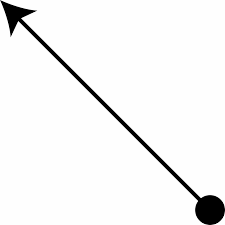
Name the image
a)
Line
b)
Ray
c)
Line segment
d)
Angle
45.

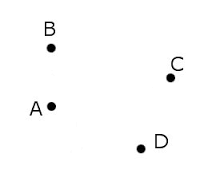
Name the image

a)

Line segment

b)

Ray

c)

Point

d)

Line

46.

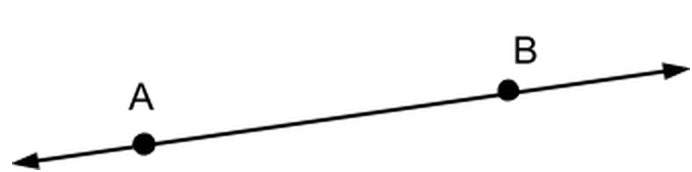
Name the image

a)

Ray

b)

Point

c)

Line

d)

Line segment

47.

Name the image

a)

Angle

b)

Line

c)

Line segment

d)

Ray

48.

Two lines intersect at a __________________.

a)

angle

b)

point

c)

line

d)

intersection

49.

Two planes intersect at a __________________.

a)

line

b)

point

c)

plane

d)

letter

50.

An exact location in space with no length or width

a)

Ray

b)

Point

c)

Line

d)

Line segment

51.

Part of a line. Has one endpoint and continues on forever in one direction

a)

Line Segment

b)

Line

c)

Ray

d)

Point

52.

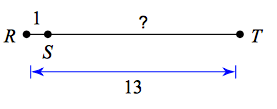
Find ST

a)

11

b)

12

c)

13

d)

14

53.

Find HG

a)

8

b)

9

c)

10

d)

11

54.

How would you describe points I, L, C?

a)

collinear

b)

non-coplanar

c)

symmetric

d)

coplanar

55.

Give another name for line k

a)

Line BC

b)

Line BCE

c)

Line ED

d)

Line k is the only name, there isn't another name

56.

Classify the pictured angle

a)

Acute

b)

Right

c)

Obtuse

d)

Straight

57.

What angle pair is pictured?

a)

Alternate interior angles

b)

Supplementary angles

c)

Vertical angles

d)

Corresponding angles

58.

Find the missing angle (find x)

a)

15o

b)

50o

c)

130o

d)

165o

59.

The sum of the adjacent angles on a straight line is:

a)

180 o

b)

90 o

c)

360 o

d)

None of the above

60.

Which property does the displayed figure refer to?

a)

Vertically opposite angles

b)

Adjacent Angles

c)

The sum of two angles is equal to 360 o

d)

Alternate Angles

61.

A line that is perpendicular to one of two parallel lines is not perpendicular to the other

a)

True

b)

False

62.

If the lines m and n are parallel to each other, then determine the angle B

a)

155

b)

125

c)

55

d)

45

63.

Form an equation in x and solve it

a)

24

b)

15

c)

336

d)

156

64.
If ∠A and ∠B are complementary,
then m∠A + m∠B = 90°.
a)
Definition of Supplementary Angles
b)
Angle Addition Postulate
c)
Definition of Right Angle
d)
Definition of Complementary Angles
65.
Solve for x
a)
6
b)
140
c)
20
d)
90
66.
Angles 4 and 6 are what type of angles?
a)
Supplementary
b)
Complementary
c)
Vertical
d)
Acute
67.
Given that angles A and B form a linear pair what is the next step we can conclude by definition of a linear pair?
a)
m∠A + m∠B = 90
b)
A and B are both acute angles
c)
m∠A + m∠B = 180
d)
A and B are both obtuse angles
68.
If <M = <L then <L = <M
a)
Transitive Property of Equality
b)
Substitution Property of Equality
c)
Symmetric Property of Equality
d)
Reflexive Property of Equality
69.
What is the justification (reason)?
a)
reflexive property
b)
definition of segment bisect
c)
definition of a midpoint
d)
substitution property
70.
Solve for x
a)
5
b)
90
c)
25
d)
10
71.
Find the value of x.
a)
52
b)
63
c)
53
d)
58
72.
Solve for angle 5
a)
50
b)
55
c)
45
d)
60
73.
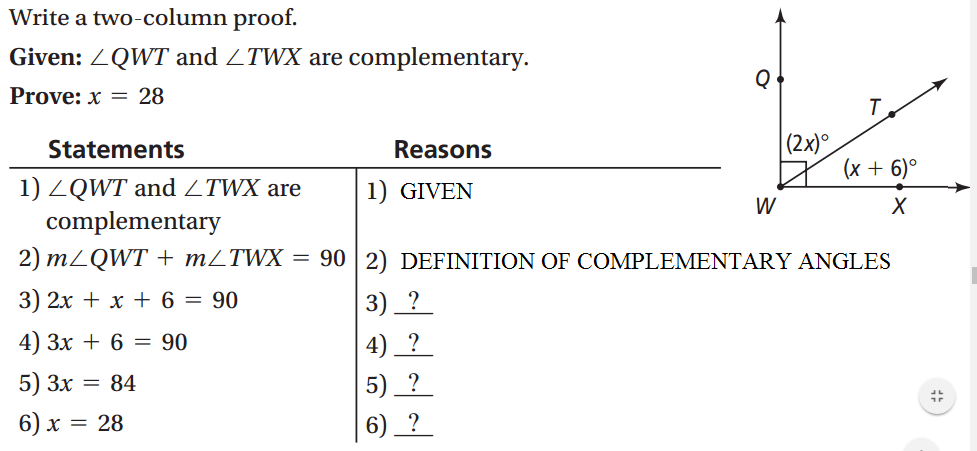
What is the REASON for Statement #3?
a)
Given
b)
Definition of Complementary Angles
c)
Substitution Property
d)
Reflexive Property of Congruence
74.
What is it called when points lie on the same line.
a)
Midpoint
b)
Coplanear
c)
Segment Bisector
d)
Collinear
75.
GH = 7y + 3, HI = 3y - 5, and GI = 9y +7. What is the value of y?
a)
9
b)
10
c)
-1
d)
2
76.

(a)   angles whose angle measurement is equal.

77.

Line segments whose lengths are equal.

a)

Line Segments

b)

Congruent Segments

c)

Postulates

d)

Segments

78.

Statement believed to be true but not yet proven.

a)

Conjecture

b)

True Statement

c)

False Statement

d)

Counter Example

79.

Statements accepted as true without requiring proof.

a)

Postulates

b)

Definition

c)

Angles

d)

Validity

80.

The point halfway between the endpoints of a line segment.

a)

Halfway point

b)

Midpoint

c)

Endpoint

d)

Quarterpoint

81.

Given: B is the midpoint of AC. What should you conclude?

a)

AB + BC = AC

b)

AB = BC

c)

A is the segment bisector of BC

d)

ABC is a straight angle

82.

Given: <1 and <3 are vertical angles. What should you conclude by the vertical angles theorem?

a)

<1 and <2 are a linear pair

b)

<1 and <3 are right angles

c)

<2 and <4 are vertical angles

d)

 <1<3<1\cong<3  

83.

Given: <1 and <2 are supplementary. What can you conclude?

a)

m<1 + m<2 = 180

b)

m<1 + m<2 = 90

c)

m<1 = m<2

d)

nothing

84.

Given: <1 and <2 are a linear pair. Conclusion: m<1 + m<2 = 180. What is the reason that allows you to draw that conclusion?

a)

Angle addition postulate

b)

Definition of straight angle

c)

Linear Pair Postulate

d)

Definition of supplementary

85.

Which of the following is an example of the transitive property?

a)

If x = 5 and and x = y, then y = 5.

b)

If x = y then y = x

c)

x = x

d)

If 2x + 4 = 2, then x = -1

86.

If an angle is a straight angle, then its measure is 180°180\degree 

 Given:  <ABC is a straight angle.
What conclusion can you draw?

a)

<ABC is not an acute angle

b)

<ABC is supplementary to another angle

c)

m<ABC = 180°180\degree  

d)

<ABC is a straight angle

87.

Which of the following conclusions CANNOT be drawn just by looking at the diagram?

a)

GH and AB intersect at D

b)

<GDA and <HDB are vertical angles

c)

D is the midpoint of GH

d)

G, D, and H are collinear

88.

Which of the following CAN you conclude from the diagram?

a)

lines l and m are perpendicular

b)

<a and <b are adjacent

c)

<a and <b are complementary

d)

m<a = m<b

89.
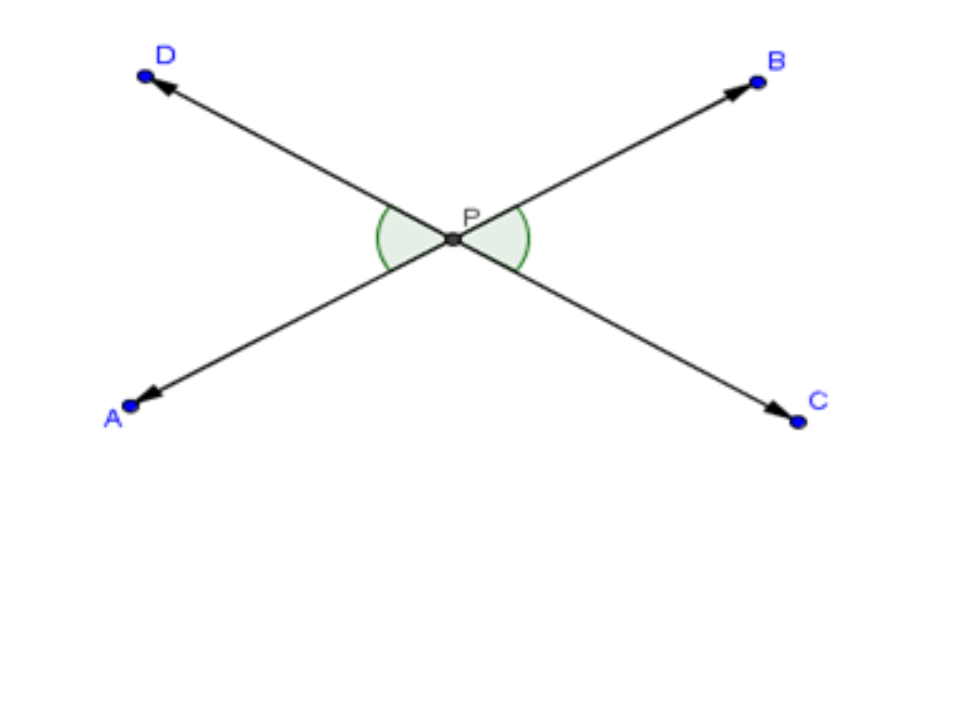
Which are pairs of vertical angles?
a)
∠COB & ∠COA
b)
∠AOD & ∠AOC
c)
∠COB & ∠AOD
d)
∠BOD & ∠AOD
90.
If LN = 32, what is MN?
a)
11
b)
20
c)
12
d)
10
91.
a)
100°
b)
80°
c)
90°
d)
180°
92.
a)
100°
b)
80°
c)
90°
d)
180°
93.
What is the value of x?
a)
90
b)
45
c)
180
d)
51
94.
a)
2x-6=7x+4
b)
2x-6+7x+4=90
c)
2x-6+7x+4=180
d)
2x-6+7x+4=360
95.
What is the justification (reason)?
a)
reflexive property
b)
definition of segment bisect
c)
definition of a midpoint
d)
substitution property
96.
If <1 and <2 are complementary, then m<1 + m<2 = 90
a)
Addition POE
b)
Subtraction POE
c)
Def of right angle
d)
Def of Complementary Angles
97.
IF <ABC ≅ <DEF, then m<ABC = m<DEF
a)
Reflexive POE
b)
Addition POE
c)
Def. of congruent angles
d)
Def. of right angles
98.
If X is between R & T on a line,
then RX + XT = RT
a)
Addition POE
b)
Substitution POE
c)
Angle Addition Post.
d)
Segment Addition Post.
99.
What is the reason?
a)
Definition of Complementary
b)
Definition of 180 
c)
Definition of supplementary
d)
Angle Addition
100.
Which property justifies the next step?
a)
Segment addition postulate
b)
Definition of an angle bisector
c)
Angle addition postulate
d)
Definition of right angles
101.
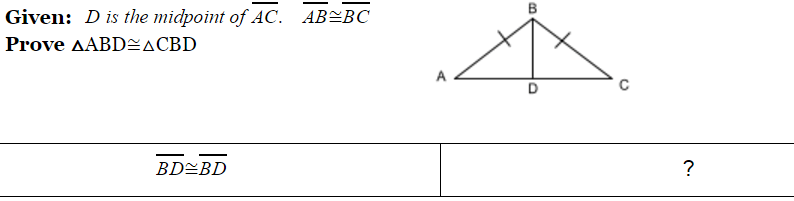
Identify the  missing statement or reason
a)
Reflexive Property
b)
Definition of Midpoint
c)
Given
d)
Vertical Angles Theorem
102.
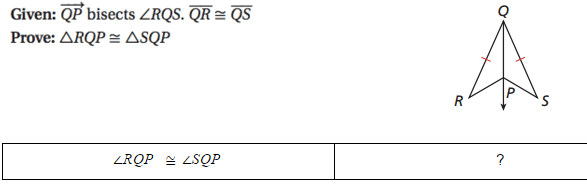
Identify the  missing statement or reason
a)
Given
b)
Vertical Angles Theorem
c)
Definition of Angle Bisector
d)
Alternate Interior Angles Theorem
103.
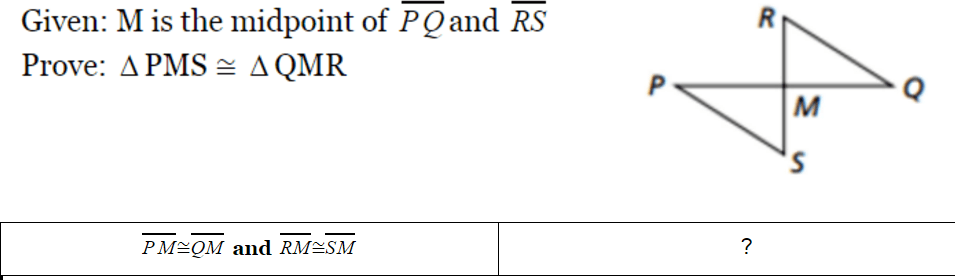
Identify the  missing statement or reason
a)
Definition of Angle Bisector
b)
Alternate Interior Angles Theorem
c)
Reflexive Property
d)
Definition of Midpoint
104.
What would be the correct "given" statements for this diagram?
a)
T is the midpoint of segment BG and
∡B≅∡G
b)
∡B≅∡G and ∡A≅∡W
c)
T is the midpoint of segment BG and ∡A≅∡W
d)
T is the midpoint of segment AW and ∡A≅∡W
105.
What would be the correct "given" statements for this diagram?
a)
∡A≅∡C, and segment DB is the angle bisector of ∡CDA
b)
BD=BD, and DB=DB
c)
∡A≅∡C, and segment DB is the angle bisector of ∡CBA
d)
∡B≅∡D, segment DB is the angle bisector of ∡DCA.
106.
What is the "statement" for step 3 of the proof?
a)
HA=HA
b)
HA=AH
c)
MA=AM
d)
MA=MA
107.
What is the "statement" for step 3 of the proof? 
a)
∡EDA≅∡DCB
b)
∡AED≅∡BEC
c)
DE=CE
d)
∡AED≅∡CED
108.
What is the "statement" for step 2 of the proof?
a)
∆BAC≅∆DAC
b)
BC=DC
c)
∡B≅∡D
d)
∡BAC≅∡DAC
109.
What is the REASON for Statement #2?
a)
Given
b)
Definition of Complementary Angles
c)
Substitution Property
d)
Reflexive Property of Congruence
110.
What is the REASON for Statement #3?
a)
Given
b)
Definition of Complementary Angles
c)
Substitution Property
d)
Reflexive Property of Congruence
111.
What is the REASON for Statement #5?
a)
Addition Property of Equality
b)
Subtraction Property of Equality
c)
Multiplication Property of Equality
d)
Division Property of Equality
112.
What is the REASON for Statement #6?
a)
Addition Property of Equality
b)
Subtraction Property of Equality
c)
Multiplication Property of Equality
d)
Division Property of Equality
113.
Which is an example of transitive property?
a)
If a=b and b=m, then a = m.
b)
If a=b then b=a.
c)
Given a number a, a=a
d)
If a=5, then 3a-5 = 3(5)-5
114.
Name the property.
If A is in the interior of <BDC, then m<BDA + m<ADC = m<BDC. 
a)
Reflexive
b)
Transitive
c)
Segment Addition Postulate
d)
Angle Addition Postulate
115.
What is the reason?
a)
Definition of perpendicular
b)
Definition of Right angle
c)
Definition of 90 
d)
Definition of angle
116.
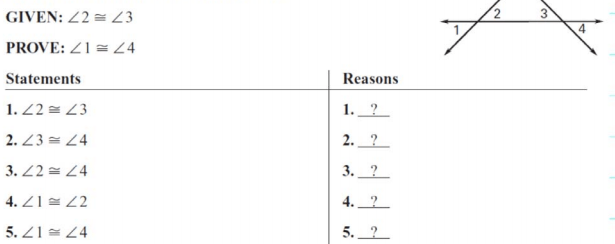
What is the justification?
a)
Symmetric Prop.
b)
Angle addition postulate
c)
Reflexive Prop
d)
Transitive Prop.
117.
AB = AB
a)
Reflexive POE
b)
Transitive POE
c)
Symmetric POE
d)
Distributive POE
118.
a)
addition POE
b)
angle addition POE
c)
subtraction POE
d)
substitution POE
119.
Which is the correct reason for statement 1 in the proof?
a)
Definition of Congruent Angles
b)
Substitution
c)
Transitive Property
d)
Given
120.
If A = B, then 8A = 8B
a)
Multiplication POE
b)
Division POE
c)
Reflexive POE
d)
Addition POE
121.
If <M = <L then <L = <M
a)
Transitive POE
b)
Substitution POE
c)
Symmetric POE
d)
Reflexive POE
122.
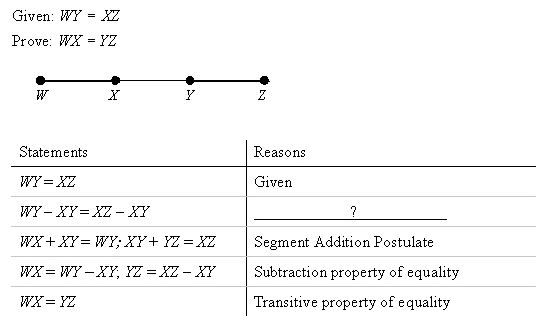
What is the missing statement in the proof?
a)
Subtraction p.o.e.
b)
Substitution p.o.e.
c)
Transitive p.o.e.
d)
Symmetric p.o.e.
123.
If M is the midpoint of AB, then AM = MB
a)
Addition POE
b)
Def. of Midpoint 
c)
Reflexive POE
d)
Symmetric
124.
What is the justification?
a)
Symmetric Prop.
b)
Angle addition postulate
c)
Reflexive Prop
d)
Transitive Prop.
125.
AB = AB
a)
Reflexive POE
b)
Transitive POE
c)
Symmetric POE
d)
Distributive POE
126.
When starting a proof you always start with:
a)
Given information
b)
What it wants you to prove
c)
Equal Angles
d)
Linear Angles
127.
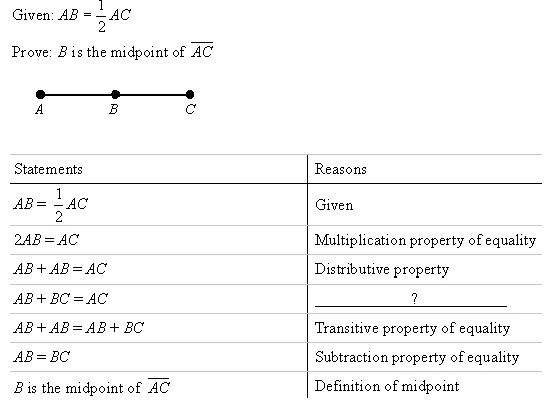
What is the missing statement in the proof?
a)
Addition p.o.e
b)
Segment Addition Postulate
c)
Substitution p.o.e
d)
Transitive p.o.e
128.

What is the REASON for Statement #6?

a)

Addition Property of Equality

b)

Subtraction Property of Equality

c)

Multiplication Property of Equality

d)

Division Property of Equality

129.

If M is the midpoint of AB, then AM = MB. Which of the following "reasons" fits for the statement?

a)

Addition POE

b)

Def. of Midpoint

c)

Reflexive POE

d)

Symmetric

130.

If A = B, then 8A = 8B Which of the following "reasons" fits for the statement?

a)

Multiplication POE

b)

Division POE

c)

Reflexive POE

d)

Addition POE

131.
If <1 and <2 are complementary, then m<1 + m<2 = 90
a)
Addition POE
b)
Subtraction POE
c)
Def of right angle
d)
Def of Complementary Angles
132.
If X = Y, then X + 5 = Y + 5
a)
Addition POE
b)
Subtraction POE
c)
Reflexive POE
d)
Transitive POE
133.
Which is the correct reason for statement 2 in the proof?
a)
Given
b)
Transitive Property
c)
Definition of Congruent Angles
d)
Vertical Angles are congruent.
134.
Which symbol means "perpendicular"?
a)
b)
c)
d)
135.
What are vertical angles?
a)
Angles that are adjacent to each other
b)
Angles that add up to 180°
c)
Angles that are opposite of each other when lines intersect
d)
Angles that add up to 90°
136.
Which are pairs of vertical angles?
a)
∠COB & ∠COA
b)
∠AOD & ∠AOC
c)
∠COB & ∠AOD
d)
∠BOD & ∠AOD
137.
Name the vertical angle to
∠h.
a)
∠f
b)
∠i
c)
∠g
d)
∠j
138.
What angle pair is pictured?
a)
Alternate Interior Angles
b)
Supplementary Angles
c)
Vertical Angles
d)
Corresponding Angles
139.
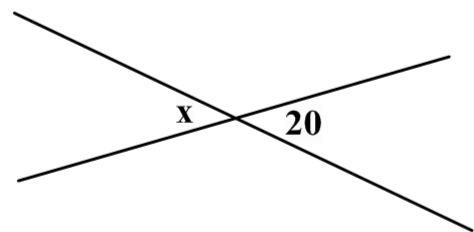
Find the missing angle.  Find x.
a)
20o
b)
70o
c)
160o
d)
180o
140.
Find the missing angle.  Find x.
a)
20o
b)
70o
c)
160o
d)
180o
141.
Vertical angles are always
a)
acute
b)
total 180 degrees
c)
congruent (equal measures)
d)
adjacent angles
142.
What is the value of x?
a)
37
b)
72
c)
108
d)
18
143.
Find the value of x.
a)
14
b)
60
c)
35
d)
180
144.

What are supplementary angles?

a)

Angles that add up to 180°

b)

Angles that add up to 90°

c)

Angles that are equal to each other

d)

Angles that are opposite of each other when lines intersect

145.
Two angles added together to produce 90 degrees
a)
Supplementary
b)
Complementary
c)
Right
d)
Vertical
146.
These angles are...
a)
Complementary
b)
Supplementary
c)
Neither
147.
Find the value of x.
a)
15
b)
30
c)
45
d)
60
148.
What is the supplement angle to 42°?
a)
48°
b)
138°
c)
100°
d)
Not possible
149.
If angle ∠ABD is 67°. What is ∠DBC?
a)
180°
b)
90°
c)
67°
d)
23°
150.
Find what the value of x.
a)
118
b)
108
c)
28
d)
58
151.
Solve for x
a)
15
b)
16
c)
18
d)
19
152.
Find the value of r
a)
46
b)
44
c)
43
d)
47
153.
Find the value of x
a)
16
b)
8
c)
32.8
d)
39.2
154.
Find the value of t
a)
-1
b)
5
c)
5.14
d)
7
155.
Find the missing angle.  Find x.
a)
20o
b)
70o
c)
160o
d)
180o
156.
Vertical angles are always
a)
acute
b)
total 180 degrees
c)
congruent (equal measures)
d)
adjacent angles
157.
If m∠1 = 30°, then m∠3 = 
a)
30°
b)
60°
c)
150°
d)
undetermined
158.
Find what the value of x.
a)
118
b)
108
c)
28
d)
58
159.
a)
15
b)
16
c)
18
d)
19