
 Worksheets
QUIZ (1) - TOPIC 1 : CHEMICAL KINETICS
Total questions: 20
Worksheet time: 20mins


Arrhenius equation is
k = AeEa/RT
k = Ae-Ea/RT
k = AeRT/Ea
k = Ae-RT/Ea
A catalyst increases the rate of a chemical reaction by
increasing the activation energy
decreasing the activation energy
reacting with reactants
reacting with products
What is collision theory?
Molecules must collide in the correct orientation with enough energy to bond.
Molecules need enough energy to collide and react.
Atoms constantly collide and react.
The minimum energy needed for atoms to react
What factors effect rate of reaction?
Temperature, Concentration, Pressure and Energy
Surface Area, Concentration, Energy and Pressure
Temperature, Pressure, Concentration and Surface area
Pressure, Surface area, Density and Energy
Decreasing the concentration of a substance will usually........
Slow down the reaction
Speed up the reaction
Have no affect on the reaction
If you shrink the container size that your gas substance is in what will happen?
The reaction rate will stay the same
The reaction rate will speed up
The reaction rate will slow down
When surface area is decreased the rate of reaction...
Decreases, because there are LESS possible sites for correct collisions
Increases, because there are LESS possible sites for correct collisions
Decreases, because there are MORE possible sites for correct collisions
Increases, because there are MORE possible sites for correct collisions

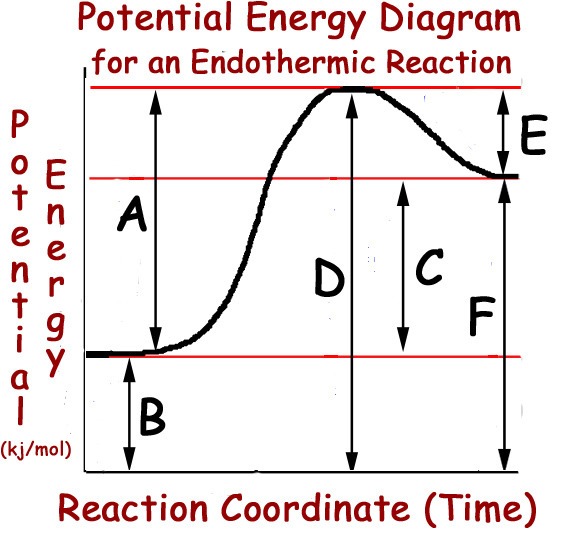
Consider the following energy profile diagram for a reaction represented by the equation X+Y→Z
Which one of the following provides the correct values of the activation energy (in kJ mol-1) and the ΔH (in kJ mol-1) for the reaction
Activation Energy = +75; ΔH = +100
Activation Energy = +100; ΔH = +175
Activation Energy = +175; ΔH = +100
Activation Energy = +200; ΔH = -125

An energy profile for a reversible chemical reaction is shown. According to this profile, the activation energy of the reverse reaction is equal to
D
C - B
A - B
C- D

Which letter represents the transition state?
A
B
C
D
E
Increasing the temperature in a reaction lowers the activation energy.
True
False

For which reaction is the activation energy higher?
With the catalyst
Without the catalyst

