wayground logo

Free Printable Worksheets

NEW

Font size

S
M
L
XL
Worksheets

Speed of a reaction

Total questions: 18

Worksheet time: 19mins

Name
Class
Date
1.

Increase in temperature causes the particles to

a)

slow down

b)

move faster

c)

stay apart from each other

d)

move in the correct order

2.

Why does a higher concentration increase the rate of reaction?

a)

it increases the amount of reactants

b)

it lowers the activation energy

c)

it increases the energy of reactant particles

d)

it increases the frequency of collision

3.
What is the rate of reaction?
a)
How fast a reaction is 
b)
How big a reaction is
c)
How loud a reaction is
d)
How much gas a reaction produces
4.

Catalyst helps to

a)

increase the amount of product obtained

b)

to lower the activation energy

c)

provide an alternative reaction route

d)

decrease the frequency of collision

5.

Increasing pressure causes the reacting particles

a)

to bond together

b)

to repel from each other

c)

gain more kinetic energy

d)

to move closer together

6.

Why does breaking up a solid reactant increase the rate of reaction?

a)

it creates more solid

b)

it creates more energy

c)

it increases the total surface area

d)

it increases the concentration

7.
Smaller particle size allows for a _________ surface area to be exposed for the reaction.
a)
larger
b)
smaller
8.
Exothermic reactions release heat to the surroundings.
a)
true
b)
false
9.

The ____________ states that atoms, ions, or molecules must collide in order to react.

a)

transition state

b)

activation energy

c)

rate law

d)

collision theory

10.
A ______________ is a substance that increases the rate of a reaction without being used up during the reaction. 
a)
catalyst
b)
product
c)
reactant
d)
solute
11.

The minimum amount of energy needed for colliding particles to react is called

a)

Chemical Energy

b)

Kinetic Energy

c)

Activation Energy

d)

Potential Energy

12.
Why don't all collisions between particles cause a reaction?
a)
the particles also need to collide with a catalyst
b)
not all the particles collide with enough energy
c)
not all the particles collide at a high enough temperature
d)
the particles need to collide with each other twice
13.

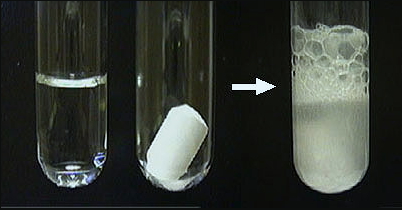
How could we make this reaction happen more quickly?

a)

Decrease the concentration of the acid

b)

crush the chalk to increase the surface area

c)

Put the test tube in an ice bath

14.

The major theory of reaction rate is called

a)

Collision theory

b)

Crash theory

c)

Newton's laws

d)

Thermodynamics

15.
The following graph shows two different reaction pathways for the same overall reaction at the same temperature. Which pathway is slower and why?
a)
Red, because the activation energy is larger
b)
Blue, because the activation energy is lower
c)
both reaction progress at the same rate
16.
Products will form faster if____________
a)
the particle size of the reactants are larger.
b)
temperature is decreased.
c)
concentration of the reactants are increased.
d)
the reaction is not stirred.
17.

If the reactant particles collide with less energy than the activation energy, the particles will be rebound, and no reaction will occur.

a)

True

b)

False

18.
Hydrochloric acid can react with sodium thiosulfate solution to form a sulfur precipitate. The equation is:
Na2S2O3(aq) + 2HCl(aq) → 2S(s) + SO2(g) + 2NaCl(aq) + H2O(l)
Which list below contains only changes that will decrease the rate of this reaction?

a)
Increase the temperature, increase the hydrochloric acid concentration and add a catalyst
b)
Decrease the temperature and add a catalyst
c)
Decrease in temperature, decrease in concentration of the hydrochloric acid, addition of water to the sodium thiosulfate
d)
Decrease the concentration of the sodium thiosulfate solution and increase the temperature