

wayground logo

Free Printable Worksheets

NEW

Font size

S
M
L
XL
Worksheets

Chemistry Midterm Exam

Total questions: 75

Worksheet time: 1hrs 15mins

Name
Class
Date
1.
Covalent bonds are between...
a)
two or more nonmetals
b)
sodium and chlorine
c)
metals and metals
d)
metals and nonmetals
2.
What kind of chemical bond forms between a metal and a nonmetal?
a)
ionic
b)
covalent
c)
fake
d)
metallic
3.
What kind of bond forms when atoms share electrons?
a)
ionic
b)
covalent
c)
artificial
d)
univalent
4.
What are valence electrons?
a)
sum of the protons and neutrons
b)
protons minus electrons
c)
electrons in the inner shells
d)
electrons in the outer shell
5.
Which is described as the force holding atoms together?
a)
formula unit
b)
cation
c)
lattice
d)
chemical bond
6.
Electronegativity is...
a)
the ability of an atom to attract/ accept electrons
b)
the ability of an atom to lose electrons
c)
the energy required to remove an electron from a specific atom
d)
how easy it is to make friends. 
7.
As atoms of elements in group 16 are considered in order from top to bottom, the electronegativity of each successive element....
a)
decreases
b)
increases
c)
remains the same
d)
none of the above
8.
Which periodic group has the smallest atomic radius?
a)
Alkali metals
b)
Halogens
c)
Noble Gases
d)
Transition metals
9.

When an atom gains an electron, the size of atom

a)

will increase

b)

will decrease

c)

will not change

10.

Which group/family has the largest atomic radius on the Periodic Table?

a)

Alkali Metals

b)

Halogens

c)

Noble Gases

d)

Transition Metals

e)

Actinide Series

11.

What are the vertical columns on the periodic table called?

a)

groups

b)

periods

c)

protons

d)

valence electrons

12.
The period for Bromine is ___________.
a)
3
b)
2
c)
4
13.
Beryllium is in group number______.
a)
Group 2
b)
Group 3
c)
Group 4
d)
Group 7
14.
The majority of elements on the periodic table are
a)
man made.
b)
nonmetals.
c)
metals.
d)
gases.
15.
Ionization energy is the...
a)
energy needed to remove the outermost electron.
b)
ability of an atom to attract electrons from another atom.
16.
Electronegativity is the...
a)
energy needed to remove the outermost electron.
b)
ability of an atom to attract electrons from another atom.
17.
Atomic radius generally increases as we move __________.  
a)
down a group and from right to left across a period 
b)
up a group and from left to right across a period 
c)
down a group and from left to right across a period 
d)
up a group and from right to left across a period 
18.
Electronegativity __________ from left to right within a period and __________ from top to bottom within a group.
a)
decreases, increases 
b)
increases, increases
c)
increases, decreases 
d)
stays the same, increases
19.
Atomic Radius is...
a)
the relative size of the atom's nucleus
b)
the relative size of the atom's electron cloud
c)
the energy required to shield the outer electrons from the nucleus
d)
a measure of the ability of an atom to attract electrons
20.
Which atom has the largest atomic radius?
a)
potassium
b)
rubidium 
c)
francium
d)
cesium
21.
As you move down the periodic table atoms get bigger.  This is because ____________.
a)
The atoms have more mass.
b)
The atoms have more protons.
c)
The atoms have more energy levels
d)
The atoms have more nuetrons
22.
Which statement correctly and completely identifies a trend?
a)
Atomic radius decreases across a period and increases down a group.
b)
Electronegativity decreases across a period and decreases down a group.
c)
Ionization energy increases across a period and increases down a group.
d)
Ionic radius increases across a period and increases down a group.
23.
Families all have similar 
a)
Names
b)
atomic numbers
c)
atomic masses
d)
properties
24.
Which has the greater Electronegativity: 
N or C?
a)
C
b)
N
25.
Which is larger:
P or P-3
a)
P
b)
P-3
c)
both are same size
26.
Which periodic group has the smallest atomic radius?
a)
Alkali metals
b)
Halogens
c)
Noble Gases
d)
Transition metals
27.

Which element in Period 2 has the greatest atomic radius?

a)

Be

b)

C

c)

Na

d)

Li

28.
Which of the following will have a lower ionization energy than Scandium (Sc)?
a)
Helium (He)
b)
Titanium (Ti)
c)
Calcium (Ca)
d)
Magnesium (Mg)
29.
Which of the following will have a higher ionization energy than arsenic (As)?
a)
Gallium (Ga)
b)
Neon (Ne)
c)
Antimony (Sb)
d)
Germanium (Ge)
30.

When an atom gains an electron, the size of atom

a)

will increase

b)

will decrease

c)

will not change

31.

When an atom loses an electron the size of atom

a)

will increase

b)

will decrease

c)

will not change

32.

Cations have atomic radii that are larger than their atomic radii.

a)

True

b)

False

33.

Anions have atomic radii that are larger than their ionic radii.

a)

True

b)

False

34.

What are valence electrons?

a)

Electrons in the outermost energy level.

b)

Electrons closest to the nucleus.

c)

Electrons that identify the atom as that of a particular element.

d)

Electrons that release photons and move from a higher to lower energy level.

35.

Which of the following has the largest atomic radius following the predicted atomic radius trend?

a)

hydrogen (H)

b)

lithium (Li)

c)

rubidium (Rb)

d)

sodium (Na)

36.

According to the octet rule most elements need _______ valence electrons to be stable.

a)

2

b)

8

c)

6

d)

18

37.

When drawing Lewis structures, only __________ electrons are used.

a)

inner shell

b)

core

c)

valence

d)

stable

38.
This is a correct dot diagram for fluorine (F)
a)
true
b)
false
39.
This is the correct dot diagram for nitrogen (N)
a)
true
b)
false
40.
This is a correct dot diagram for magnesium (Mg)
a)
true
b)
false
41.

How many valence electrons does Carbon have

a)

1

b)

4

42.

How many valence electrons does Argon have

a)

8

b)

11

43.

Electron dot notation is . . . .

a)

A representation of an element in which only valence electrons of an atom are shown

b)

A representation of how compounds are formed.
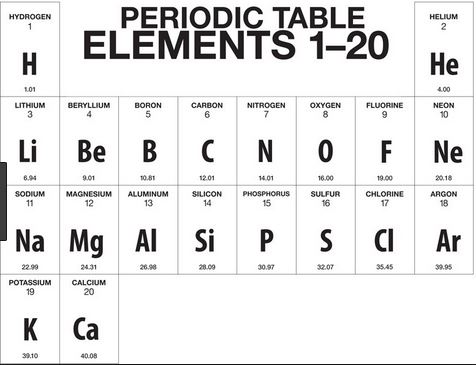
44.

How many valence electrons does Magnesium Have?

a)

1 Valence electron

b)

2 Valence electron

c)

3 Valence electron

d)

4 Valence electron

e)

5 Valence electron

45.

How many valence electrons does Aluminum Have?

a)

1 Valence electron

b)

2 Valence electron

c)

3 Valence electron

d)

4 Valence electron

e)

5 Valence electron

46.
How many electrons should Helium have around its Lewis dot model?
a)
1
b)
2
c)
7
d)
8
47.
What is the name of this element?
a)
Helium
b)
Hydrogen
c)
Argon
d)
Silver
48.
What is the name of this element?
a)
Lithium
b)
Boron
c)
Carbon
d)
Neon
49.
How many valence electrons?
a)
2
b)
3
c)
5
d)
10
50.

What is this element?

a)

Beryllium (atomic #4)

b)

Boron (atomic #5)

c)

Carbon (atomic #6)

d)

Nitrogen (atomic #7)

51.

What group does this element belong to?

a)

1

b)

2

c)

17

d)

18

52.

Which Bohr model represents Neon?

a)
b)
c)
d)
53.
Which elements have the most similar chemical properties?
a)
K and Na
b)
K and Ca
c)
K and Cl
d)
K and S
54.

Name group 1 on the periodic table.

a)

alkali metals

b)

alkaline earth metals

c)

noble gases

noble gases

d)

halogens

55.

Name group 2 on the periodic table.

a)

alkali metals

b)

alkaline earth metals

c)

noble gases

d)

transition metals

56.
Name groups 3B - 12B on the periodic table.
a)
noble gases
b)
halogens
c)
metalloids
d)
transition metals
57.
Which group has the most reactive nonmetals?
a)
alkali metals
b)
noble gases
c)
metalloids
d)
halogens
58.
Where are the nonmetals located on the periodic table?
a)
top left corner
b)
bottom left corner
c)
top right corner
d)
bottom left corner
59.
What statement is true about ALL of the elements in Group 18 OR Group 8A?
a)
They ALL have 6 valence electrons.
b)
They ALL are gases at room temperature.
c)
They ALL react easily with other elements.
d)
They ALL form +2 charges.
60.

Name group 17 on the periodic table.

a)

transition metals

b)

metalloids

c)

halogens

d)

alkali metals

61.
A charged particle that has gained or lost electrons is called a _____.
a)
molecule
b)
ion
c)
isotope
d)
element
62.
A cation is a ____ ion.
a)
negative
b)
positive
c)
neutral
d)
ficticious
63.
A anion will be a ____ ion.
a)
negative
b)
positive
c)
neutral
d)
ficticious
64.
Beryllium will ____ valence electrons when forming an ionic bond.
a)
lose 4
b)
gain 4
c)
lose 2
d)
gain 2
65.
Boron will ____ valence electrons when forming an ionic bond.
a)
lose three
b)
gain three
c)
lose 5
d)
gain 5
66.
Nitrogen will ____ valence electrons when forming an ionic bond.
a)
gain 1
b)
lose 1
c)
gain 3
d)
lose 3
67.
Which of the following would produce an anion?
a)
Ca
b)
Al
c)
K
d)
F
68.
Which of the following will form an ion with a 2- charge?
a)
Ca
b)
Se
c)
Ge
d)
N
69.
If an element has 3 valence electrons, what charge will likely form on its ion ?
a)
+3
b)
+5
c)
-3
d)
-5
70.
Which is most likely to form a negative ion?
a)
an element from group 17
b)
a metal
c)
an element from group 1
d)
an element with atoms that have eight valence electrons
71.

How many energy levels does a sodium (Na) atom have?

a)

1

b)

2

c)

3

d)

11

72.
An atom becomes _________ when it gains electrons.
a)
Positive
b)
Negative
c)
Neutral
d)
Invinsible
73.
Atoms are most stable when their outer shell is complete.
a)
true
b)
false
74.
Why do elements bond?
a)
To be friends
b)
To create a new element
c)
To become stable
75.

What kind of element forms covalent bond?

a)

metals

b)

semi -metals

c)

non metals

d)

metal and non metal
