wayground logo

Free Printable Worksheets

NEW

Font size

S
M
L
XL
Worksheets

Test A: Force and Momentum

Total questions: 40

Worksheet time: 2hrs 57mins

Name
Class
Date
1.

Which of the following is the formula for momentum?

a)

p = mv

b)

M = mv

c)

F = ma

d)

g = mc2

2.

Which of the following is the unit for momentum?

a)

kg·m/s

b)

kg·m

c)

kg·m/s2

d)

Momentum has no unit.

3.

Calculate the momentum of a 55-kg running back moving westward at 10 m/s.

a)

550 kg·m/s, west

b)

550 kg·m/s

c)

550 m/s, west

d)

550 kg, west

4.

Which of the following objects has the greatest momentum?

a)

a 7.6-kg ball moving at 6.3 m/s westward.

b)

a 10.8-kg ball moving at 3.8 m/s eastward.

c)

a 3.2-kg ball moving at 13.3 m/s northward.

d)

a 5.2-kg ball moving at 8.8 m/s southward.

5.
A biker with a mass of 75 kg moves along the path with a constant velocity of 5 m/s. What is the biker's momentum?
a)
25 m/s
b)
375 m/s
c)
25 kg m/s
d)
375 kg m/s
6.
When a bat collides with a baseball, the momentum of the bat
a)
transfers to the momentum of the ball
b)
transfers from the momentum of the ball
c)
does not transfer from the bat to the ball
d)
does not transfer from the ball to the bat
7.
If two objects collide and stick together, what will happen to their overall momentum?
a)
momentum will decrease
b)
momentum will increase
c)
momentum will stay the same
d)
none of the above
8.
The momentum of a truck traveling in a straight line at 25 m/s is 37,500 kg m/s. What is the truck's mass? 
a)
937,500 kg
b)
937,500 N
c)
1,500 N
d)
1,500 kg
9.
What is a force?
a)
a push or pull
b)
speed or acceleration 
c)
potential or kinetic energy
d)
balanced or unbalanced force
10.
When objects remain in the same place, it is called...
a)
gravity
b)
friction
c)
balanced force
d)
unbalanced force
11.
Force is measured in....
a)
Galileos 
b)
Newtons
c)
Di Vincis
d)
Einsteins 
12.
Inertia is....
a)
for every action, there is an equal and opposite reaction
b)
larger objects take more force to move 
c)
an object in motion tends to stay in motion unless acted on by an opposite force
d)
a push that acts in the opposite direction and it slows down.
13.
Friction helps objects to move easier.
a)
true
b)
false
14.
The sum of all forces acting on an object.
a)
Contact Force
b)
Balanced Force
c)
Unbalanced Force
d)
Net Force
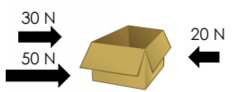
15.
Calculate the Net Force. 
a)
60N, Left 
b)
40N, Right 
c)
0N
d)
60N, Right
16.
What is the net force?
a)
400 N Up
b)
400 N Down
c)
- 400 N Down
d)
800 N Down
17.
_______ was the scientist who gave us the Laws of Motion.
a)
Sir Isaac Newton
b)
Gregor Mendel
c)
Dmitri Mendeleev
d)
Albert Einstein
18.
"For every action, there is an equal and opposite reaction."
a)
Newton's 1st Law
b)
Newton's 2nd Law
c)
Newton's 3rd Law
d)
Newton's 4th Law
19.
Force = Mass x Acceleration
a)
Newton's 1st Law
b)
Newton's 2nd Law
c)
Newton's 3rd Law
d)
Newton's 4th Law
20.
"An object in motion (or at rest) will to stay in motion (or at rest) until an outside force acts upon it."
a)
Newton's 1st Law
b)
Newton's 2nd Law
c)
Newton's 3rd Law
d)
Newton's 4th Law
21.
A 20 kg bike accelerates at 10 m/s2.  What was the force?
a)
25 Newtons
b)
20 Newtons
c)
200 Newtons
d)
10 Newtons
22.
If a 10 kg object accelerates suddenly at 15 m/s2, how much force was applied to the object?
a)
150 Newtons
b)
15 Newtons
c)
150 kilograms
d)
100 kilograms
23.

How much force is needed to accelerate a 3kg skateboard at 5m/s2?

a)

8N

b)

1.6N

c)

0.6N

d)

15N

24.
What is the force on a 1000 kg elevator that is falling freely at 9.8 m/s2?
a)
102.04 N
b)
9,800 N
c)
980 N
d)
103 N
25.

Student A is pushing at 63 newtons, and student B is pushing at 56 newtons. What is the net force (calculation).

a)

119 N Right

b)

7

c)

7 N Right

d)

119

26.

Student A is pulling at 57 newtons and student B is pushing at 96 newtons. What is the net force (calculation).

a)

153 N Left

b)

39 N Left

c)

153 N Right

d)

39

27.

What is the force on a 1000 kg elevator that is falling freely at 9.8 m/sec2

a)

102.04 n

b)

9,800 n

c)

980 n

d)

103 n

28.

A force of 250 N is applied to an object that accelerates at a rate of 5 m/sec2. What is the mass of the object?

a)

100kg

b)

1,250kg

c)

50kg

d)

5kg

29.

What is the acceleration of a 50 kg object pushed with a force of 500 newtons?

a)

100 m/s2

b)

25,000 m/s2

c)

10 m/s2

d)

25 m/s2

30.

A 50 kg skater pushed by a friend accelerates 5 m/sec2. How much force did the friend apply?

a)

45 N

b)

15 N

c)

10 N

d)

250 N

31.

A stunt car crashes into a wall with a momentum of 46,500Ns. The mass of the car is 1,500 kg. How fast was the car going?

a)

54 m/s

b)

120 m/s

c)

15 m/s

d)

31 m/s

32.
How much momentum does a 50 kg mass moving at 10 m/s have?
a)
5 kg m/s
b)
500 kg m/s
c)
5 N
d)
500 N
33.

Which object has more momentum?

a)

motorcycle at 15 mph?

b)

bike at 15 mph

c)

car at a stoplight

d)

runner at 10 mph

34.

If an object has a momentum of 40 kgm/s and a mass of 60 kg, what is it's velocity?

a)

2400 m/s

b)

1.5 m/s

c)

240 m/s

d)

.67 m/s

35.

If an object has a velocity of 15 m/s and a momentum of 30 m/s, what is its mass?

a)

450 m/s

b)

2 m/s

c)

4,500 m/s

d)

.5 m/s

36.
When the speed of an object is doubled, its momentum
a)
remains unchanged in accord with the conservation of momentum.
b)
doubles
c)
quadruples
d)
decreases
37.

What is the unit for FORCE?

a)

N (Newtons)

b)

lbs (pounds)

c)

g (grams)

d)

m/s (meters per second)

38.

What is the formula for solving force?

a)

mass x acceleration

b)

force / mass

c)

mass x velocity

d)

distance / time

39.

Student A is pushing at 82 newtons, and student B is pushing at 82 newtons. What is the net force (calculation).

a)

164 N

b)

0 N

c)

82 N Right

d)

0

40.
How much momentum does a stationary battle ship have if it has a mass of 2,575,000 kg?
a)
2,575,000 N
b)
2,575,000 kg m/s
c)
0 Momentum requires mass and velocity
d)
none of the above