wayground logo

Free Printable Worksheets

NEW

Font size

S
M
L
XL
Worksheets

APUSH Period 6 (Foner ch. 16-19)

Total questions: 76

Worksheet time: 52mins

Name
Class
Date
1.

Who of the following represented the American notion that through hard work, even a poor immigrant could become tremendously successful?

a)

Andrew Carnegie

b)

John D. Rockefeller

c)

Jay Cooke

d)

Thomas Edison

2.

As American industry expanded in the late nineteenth century, its energy source shifted from

a)

electric to steam

b)

water to coal

c)

coal to iron

d)

steam to water

3.

Why did so few African American men hold factory jobs in the US in 1890?

a)

there were almost no factories in the South, where the majority of African Americans lived at that time

b)

white-dominated labor unions generally refused to allow blacks to join and seek industrial employment

c)

factory owners could satisfy labor needs with immigrant workers, so they rejected most black applicants

d)

black workers intensely disliked factory work and preferred agricultural or casual urban labor

4.

During the 1800s, an adult male immigrant from which of the following locations would most likely be a skilled worker?

a)

Poland

b)

Wales

c)

Italy

d)

Greece

5.
During the Gilded age, workers came together under ___________________________ to work for better pay, working conditions, and less hours.
a)
Philanthropy
b)
Labor Unions
c)
Political Bosses
d)
Credit Unions
6.
William Graham Sumner, a researcher during the Gilded Age,  believed that government programs to help the poor were useless because people had a certain place that could not be changed.  This philosophy was called...
a)
Evolution
b)
Monetary Policy
c)
Social Darwinism
d)
Welfare Capitalism
7.
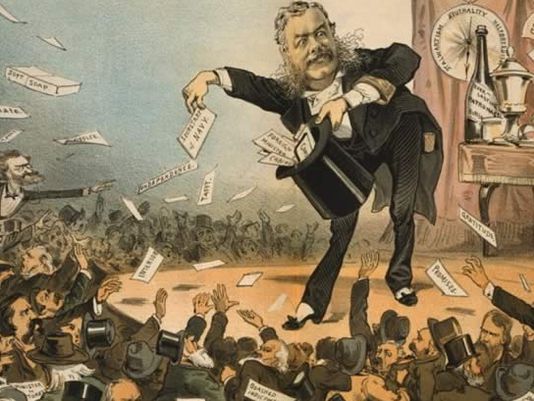
Based on your knowledge of the Industrial Revolution in the United States, what statement is this cartoon making?
a)
The federal government was placing too many restrictions and regulations on business owners.
b)
The oil industry is thriving due to a healthy working relationship with the federal government.
c)
The owner of Standard Oil has too much power and influence over the federal government.
d)
Emissions from oil refineries are polluting the air and harming the environment.
8.
Which of these best describes life in a turn of the century tenement?
a)
Very crowded
b)
Spreading sickness and disease
c)
No windows, heat, or plumbing
d)
All of the above
9.
What did the steelworkers do when Henry Clay Frick tried to bring in replacement workers?
a)
Barricaded the mill
b)
Opened their own factory in Ohio
c)
Pleaded to Andrew Carnegie
d)
Threw a dynamite bomb at police
10.
The steel industry owed much to the inventive genius of
a)
Jay Gould
b)
Henry Bessemer
c)
J.P. Morgan
d)
Thomas Edison
11.

This movement advocated for a return to traditional ways of life and challenged white dominance in society.

a)

Ghost Dance Movement

b)

Temperance Movement

c)

The Pullman Strike

d)

The People's Party

12.

The innovation of this transportation help open up the national market

a)
b)
c)
d)
13.
Men such as Andrew Carnegie believed in giving money to libraries, musuems and schools to help benefit people who wanted to move up in the social ladder. 
a)
geopolitical
b)
political bosses
c)
Social Darwinism
d)
Gospel of Wealth
14.

Due to the corruption of the railroads companies, the U.S. government created this act to regulate railroad companies to be reasonable in prices.

a)

Interstate Commerce Act

b)

Dawes Act

c)

Transcontinental Act

d)

Laissez Faire Act

15.

What New York politician ran a political machine in New York City beginning in 1869, during the Gilded Age, that was incredibly corrupt? For example, a projected cost of $250,000 for a courthouse turned in to $13,000,000 because of kickbacks and bribes.

a)

Daley

b)

Grant

c)

Tilden

d)

Tweed

16.
What was a city government marked by corruption, bribery, and Kickbacks (common during the Gilded Age) called?
a)
credit mobilier
b)
political machine
c)
corrected democracy
d)
electoral politics
17.

Congressional action taken in 1890, during the Gilded Age, that made "contracts, conspiracies, and combinations" that restrained free trade illegal. This was done to stop the abusive practices of organized trusts in oil, sugar, tobacco, etc.

a)

Sherman Antitrust Act

b)

Celler-Kefauver Act

c)

Clayton Antitrust Act

d)

Interstate Commerce Act

18.
What did the NAACP focus on?
a)
child labor
b)
equal rights
c)
conservation
d)
protection of animals
19.

What image below best explains suffrage?

a)
b)
c)
d)
20.
What was the time period called that suggested that the U.S. appeared to be fine, but beneath the surface there was corruption and serious problems?
a)
False America
b)
Gilded Age
c)
Teasing Times
d)
Erroneous Era
21.
What is the name given to the belief that the United States had the right and duty to expand across the North American continent?
a)
Manifest destiny 
b)
Monroe Doctrine 
c)
Great Awakening 
d)
Louisiana Purchase
22.
Which of the following explains the major drawback of mining?
a)
mining became useless as new technology replaced natural resources
b)
mining proved to be unprofitable
c)
mining was destructive to the natural environment
d)
mining did not provide any jobs for local residents
23.
What was the effect of the Transcontinental Railroad?
a)
Became a more efficient form of transportation for settlers
b)
Increased trade between the east and west and boosted the economy
c)
Polluted the air and the natural environment
d)
All of the above
24.
What invention helped prevent cattle from escaping?
a)
bean picker
b)
barbed wire
c)
steel plow
d)
windmills 
25.

Where were General George Custer and his men killed?

a)

Little Bighorn

b)

Crazy Horse

c)

Sand Creek

d)

Wounded Knee

26.
How did the passage of the Dawes Act impact Native Americans? 
a)
It started a series of Indian Wars with massive casualties on the Great Plains
b)
It attempted to assimilate them into mainstream culture by allocating lands to individual Indians.
c)
Retention of original tribal territory occurred through a peace treaty with the U.S. Army.
d)
It supported their existing cultural tribal traditions and customs
27.

Name the tribe of Sitting Bull that fought against Western settlers and later started the Ghost Dance Tradition

a)

Cheyenne

b)

Sioux

c)

Apache

d)

Nez Perce

28.

Perfected the incandescent light bulb

a)

Edwin L. Drake

b)

Henry Bessemer

c)

Thomas Alva Edison

d)

Alexander Graham Bell

29.

Which of the following did Social Darwinism discourage?

a)

hard work

b)

industrialization

c)

government regulation

d)

accumulation of wealth

30.

Why were scabs unpopular with striking workers during the late 1800s?

a)

They were socialists.

b)

They were federal troops.

c)

They were part of management.

d)

They were workers used to break strikes.

31.

Millionaire tycoon who made his riches in the steel industry

a)

Andrew Carnegie

b)

J.D. Rockefeller

c)

J.P. Morgan

d)

Cornelius Vanderbilt

32.

Millionaire tycoon who made his riches in the railroad industry

a)

Andrew Carnegie

b)

J.D. Rockefeller

c)

J.P. Morgan

d)

Cornelius Vanderbilt

33.

Millionaire tycoon who made his riches in the finance industry

a)

Andrew Carnegie

b)

J.D. Rockefeller

c)

J.P. Morgan

d)

Cornelius Vanderbilt

34.

Millionaire tycoon who made his riches in the oil industry

a)

Andrew Carnegie

b)

J.D. Rockefeller

c)

J.P. Morgan

d)

Cornelius Vanderbilt

35.

Why did President Lincoln and Congress wish to provide inexpensive homesteads to the public?

a)

For jobs

b)

To visit their families

c)

To help expand the country

d)

For the climate change

36.

What is the name of the place that was the gateway for over 12 million immigrants to the U.S. as the United States' busiest immigrant inspection station? It's located in New York.

a)

Hull House

b)

Ellis Island

c)

Pullman House

d)

Staten Island

37.

What is the name of this machine that made large productions of steel and was inexpensive?

a)

Steel

b)

Cotton Gin

c)

Steel Maker

d)

Bessemer Process

38.

Who invented the telephone?

a)

Alexander Hamilton

b)

Alexander Graham Bell

c)

Alexander Edison

d)

Alexander Wright

39.

Who invented the first plane?

a)

Bessemer Brothers

b)

Rockefeller Brothers

c)

Right Brothers

d)

Wright Brothers

40.
Areas of land set aside for Native Americans
a)
nomadic
b)
sodbusters
c)
homestead
d)
reservations
41.
A route that connected the Atlantic and Pacific coasts
a)
nomadic
b)
transcontinental
c)
sooners
d)
vaqueros
42.
Eager settlers who claimed the best land in Oklahoma
a)
nomadic
b)
transcontinental
c)
sooners
d)
vaqueros
43.

Carnegie made a fortune by mastering the concept of

a)

philanthropy

b)

vertical integration

c)

horizontal integration

d)

plausible deniability

44.

Rockefeller made a fortune by utilizing

a)

vertical integration

b)

horizontal integration

c)

graft

d)

strikes

45.
Assimilation can be defined as
a)
when one becomes more like the dominant culture.
b)
when a person refuses to learn the dominant culture
c)
when a culture is practice all over the world
d)
when a culture is similar to another culture
46.

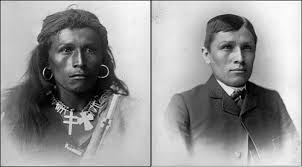
Changing their names, cutting their hair, forcing them to adopt Christianity, requiring them to learn English, etc. These are all examples of what pushed on many Immigrants, but especially the Indians (Native Americans)?

a)

Assimilation

b)

Nativism

c)

Protectionism

d)

Temperance

47.

Who is most associated with political machines in New York City?

a)

"Boss" Tweed

b)

John Rockefeller

c)

Jane Adams

d)

Andrew Carnegie

48.
During the late 19th century, most immigrants to the US found work as-
a)
Educated professionals
b)
skilled workers
c)
Factory/sweatshop workers
d)
Scientists
49.
Which group believed in survival of the fittest and people were naturally selected to succeed?
a)
social darwinist
b)
political bosses
c)
nativist
d)
political machines
50.
In the late 1800's, which was NOT a reason Congress passed restrictions on Chinese immigrants?
a)
Chinese immigrants took jobs
b)
Nativist & racial hate
c)
Chinese immigrants were moving east
d)
Chinese workers took lower pay
51.
The political party that advocated for farmers was known as the ______party.
a)
Republican
b)
Democrat
c)
Populist
52.
Which candidate was the Populist party's candidate?
a)
Andrew Johnson
b)
Ulyssess Grant
c)
William Jennings Bryan
d)
William McKinley
53.
Farmers support the ________standard for money.
a)
Bimetalism 
b)
Gold 
54.

Railroads' high fees for shipping goods to market would eventually lead to....

a)

Farmers organizing the Grange Movement and the Populist party

b)

The government authorizing the use of silver to help farmers

c)

The Populist demand that the government help farmers by raising tariffs

d)

The government demanding that farmers slaughter mivestock to increase prices.

55.

Who was responsible for the idea of the "Gospel of Wealth?"

a)

John Rockefeller

b)

Andrew Carnegie

c)

John Morgan

d)

Jay Gould

56.

Americans who were against all immigration

a)

America First Party

b)

Emigrants

c)

Nativists

d)

Round Heads

57.
________________ is the term used to describe the wealthy that used ruthless business practices. 
a)
Industrial Giants
b)
Captains of Industry
c)
Robber Barons
d)
Union Leaders
58.

Mark Twain coined this phrase to describe industrial America and the corruption in political America

a)

Progressive Era

b)

Imperial America

c)

Era of Good Feelings

d)

Gilded Age

59.
In this political cartoon, who is in charge of the Senate?
a)
The US Senators
b)
the US Constitution
c)
The owners of monopolies/ industrialists
d)
the American people
60.
One of the methods by which post-Civil War business leaders increased their profits was 
a)
Elimination of as much competition as possible
b)
Supporting a centrally planned economy
c)
Funding research on new technologies
d)
Elimination of the tactic of vertical integration
61.
This period during the 1870s to 1900 is known for its rise of railroads, big business, industrialization and social problems in the United States.
a)
World War I
b)
Progressive Era
c)
Gilded age
d)
Roaring Twenties
62.
In 1890, who wrote about and photographed the horrible living conditions of America's working poor in the book How the Other Half Lives?
a)
Upton Sinclair
b)
Ida Tarbell
c)
Ida Wells
d)
Jacob Riis
63.
During the age of industrialization, the South
a)
was not targeted by northern industrialists who sought to introduce factories into the region
b)
received preferential treatment from the railroads
c)
turned away from agriculture
d)
remained overwhelmingly rural and agricultural
64.
in 1882, the Government passed this legislation that restricted immigration for 10 years from a certain group into the United States.
a)
Nativist Act
b)
Mexican Reparition Act
c)
Dawes Act
d)
Chinese Exclusion Act
65.

•Government policy of NOT regulating the economy

•Government keeps its “hands-off” the economy

a)

conservative economics

b)

laissez faire

66.

Immigration where people were mainly coming from Southern and Eastern Europe

a)

old immigration

b)

new immigration

67.

How many immigrants came to America between 1890-1920

a)

20 million

b)

30 million

68.

•Reaction to wage cuts

•President Hayes sided with the RRs

a)

Great Railroad Strike

b)

Pullman Strike

69.

•Carnegie Steel Plant

•Wages were cut by 20%

•Strikebreakers were called in

a)

Pullman Strike

b)

Homestead Strike

70.

•Pullman Palace Car - luxury railroad cars

•Workers went on strike, President Cleveland used troops to end the strike

a)

Pullman Strike

b)

Homestead Strike

71.

•Called for increased industrialization in the South; emergence of more textile factories

a)

New South

b)

Southern Dream

72.

Political organizations that provided jobs and services to constituents and received support in return

a)

ward bosses

b)

political machines

73.

The first transcontinental railroad was completed in 1869 with a Golden Spike at this location...

a)

St. Louis, Missouri

b)

San Francisco, California

c)

Custer, Nebraska

d)

Promontory Point, Utah

74.

The Compromise of 1877 came after a disputed presidential election and lead to all of these, EXCEPT

a)

Rutherford B. Hayes became president.

b)

Labor conditions were settled in the railroad industry.

c)

Federal forces were removed from the South.

d)

African Americans were left without support from the Republican Party.

75.

The U.S. Supreme Court in the case of Plessy vs Ferguson, established...

a)

Separate but equal.

b)

Separate is not equal.

c)

Chinese Exclusion Act is constitutional.

d)

Voting rights for African American males.

76.

Was the Dawes Act successful in forcibly assimilating Native Americans into US society?

a)

Yes

b)

No