
 Worksheets
Chemical reaction - Assignment
Total questions: 18
Worksheet time: 22mins
Name
Class
Date
1.
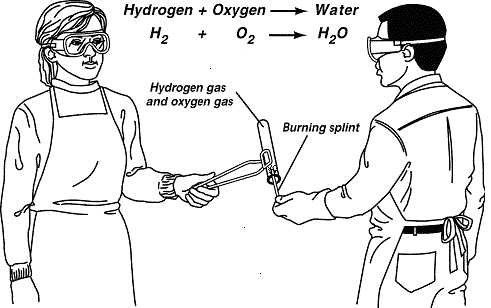
Identify the reactant(s) and product(s) of the reaction.
a)
All three are reactants and none are products.
b)
Hydrogen and water are the reactants, and oxygen is the product.
c)
Water and oxygen are the reactants, and hydrogen is the product.
d)
Hydrogen and oxygen are the reactants, and water is the product.
2.

Identify the Reactants in this equation.
a)
A
b)
B
3.
A precipitate is a
a)
liquid that forms when two solids are reacted
b)
a solid that forms when two liquids are mixed
c)
a gas that forms when vinegar and baking soda react
d)
a change of color in a solution
4.
What is the Law of Conservation of mass?
a)
Mass is created in a chemical reaction
b)
Mass is created in a physical change
c)
New chemicals formed from a chemical reaction have a larger overall mass than the original reactants
d)
Mass is never created or destroyed
5.
Which are the reactants in the following reaction?
2Mg + O2 ---> 2MgO
2Mg + O2 ---> 2MgO
a)
Mg and O
b)
MgO
c)
Mg and MgO
d)
O and MgO
6.

According to the law of conservation of mass, how much mercury was present in the mercury (II) oxide?
a)
55.8 g
b)
64.2 g
c)
60.0 g
d)
126.0 g
7.

Copper (Cu) and sulfur (S) were heated in a covered container. After the reaction was complete, the unreacted sulfur was removed. The table contains the results of the investigation. How much sulfur in grams failed to react with the copper?
a)
1.32 g
b)
4.54 g
c)
5.02 g
d)
10.88 g
8.
32 g of Oxygen completely reacts with 8 g of Hydrogen to produce _____ g Water
a)
8
b)
12
c)
24
d)
40
9.
12g of Carbon react with 16g of Oxygen, how much carbon monoxide (CO) is formed?
a)
28 g
b)
4g
c)
30g
d)
12g
10.
Which of the following is not evidence of a chemical reaction?
a)
Formation of a precipitate
b)
Production of gas
c)
Change in temperature
d)
Change in state of matter
11.

Is TNT exploding a physical or chemical change?
a)
Physical
b)
Chemical
c)
Both physical and chemical
d)
Neither physical nor chemical
12.

Which is an example of a chemical change?
a)
Burning wood
b)
Rust on a car
c)
Cooking food
d)
All of the above
13.
In the reaction methane + oxygen turns into carbon dioxide + water, the methane and oxygen are called _______________.
a)
reactants
b)
products
c)
neutrals
d)
energizers
14.
What type of change occurs when a new substance is formed that has different properties from the original substances?
a)
chemical change
b)
nuclear change
c)
physical change
d)
mutation
15.
Which of the following represents a chemical change?
a)
cutting a piece of paper with scissors
b)
cooling a mixture of air and kerosene vapor to obtain liquid kerosene
c)
burning a piece of notebook paper in the presence of oxygen
d)
heating water over a flame to its boiling point
16.
Which of the following is an example of a physical change?
a)
souring milk
b)
mixing baking soda and vinegar
c)
rusting metal
d)
mixing oil and vinegar
17.
Which is an example of a physical change?
a)
sodium and chlorine form salt
b)
a copper ring turns white and green
c)
a log burns in a fire
d)
using sand and water to build a sand castle on a beach
18.
Your mother used pancake mix, eggs, and milk to make pancakes. Which of these is the product?
a)
the pancake mix
b)
the eggs
c)
the milk
d)
the pancakes
100 %

