Wayground logo

Free Printable Worksheets

Font size

S
M
L
XL
Worksheets

Dichotomous Keys and Classification

Total questions: 20

Worksheet time: 22mins

Name
Class
Date
1.
The scientific name for an organism is made from the:
a)
class and family name
b)
genus and species name
c)
domain and kingdom name
d)
kingdom and phylum name
2.
Tool used by a taxonomist to identify an unknown organism is a:
a)
dichotomous key
b)
binomial nmenclature
c)
scientific name
d)
binomial key
3.
A dichotomous key for trees is provided. Hikers found a tree that has large brown cones and single sharp needles. What species of tree have the hikers found?
a)
Juniper
b)
Pine
c)
Spruce
d)
Fir
4.
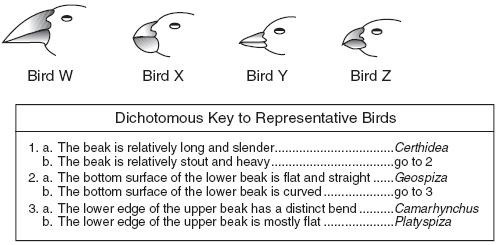
What is the name of bird W?
a)
Certhidea
b)
Geospiza
c)
Camarhynchus
d)
Platyspiza
5.
When using a dichotomous key to identify organisms, what do we look at?
a)
physical features
b)
weather patterns
c)
environment
d)
diet
6.
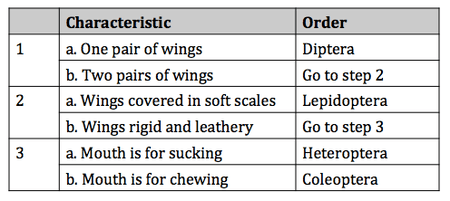
A dichotomous key for insects is given. To what order does an insect with two pairs of scaly wings belong?
a)
Coleoptera
b)
Heteroptera
c)
Diptera
d)
Lepidoptera
7.
A botanist discovers a new plant in the jungle. Which of the
following observations of the plant’s characteristics would be useful in determining its identity with a dichotomous key?
a)
It was discovered in the summertime
b)
It is wet from a recent rain storm.
c)
Its leaves curl up on the edges.
d)
It is eaten by native jungle ants.
8.
Why do we use scientific names to name organisms instead of relying on common names?
a)
Because common names vary regionally
b)
Because everyone understands and speaks Latin
c)
To make scientists sound smart
d)
Because they are the most descriptive
9.
What term refers to the two part naming system used in traditional classification?
a)
binomial nomenclature
b)
systematics
c)
cladistic analysis
d)
taxonomy
10.
Which of the following shows taxonomic groups in order from broadest to most specific?
a)
kingdom, phylum,order, class, genus, species
b)
species, genus, family, order, class, phylum, kingdom
c)
kingdom, phylum, class, order, family, genus, species
d)
phylum, kingdom, order, class, genus, family, species
11.
If I found an organism that was multicellular, heterotrophic, with a cell wall made of chitin, what kingdom would I place it in?
a)
eubacteria
b)
plantae
c)
animalia
d)
fungi
12.
Using this dichotomous key, identify the name of the circled Fish, J.
a)
peacock flounder
b)
band-tail puffer
c)
trumpet fish
d)
spotted goat fish
13.

The largest grouping of organisms is ____________________ and the smallest is _________________________________.

a)

Domain, species

b)

Domain, kingdom

c)

Species, domain

d)

Kingdom, species

14.

In the scientific naming system, __________________ is capitalized and __________________ is written in lower case.

a)

genus, species

b)

species, genus

15.

What is a dichotomous key?

a)

A tool for classifying organisms based on their physical traits

b)

A map for finding animal habitats

c)

A key that opens a scientist's laboratory

16.

Which of these categories would likely NOT appear on a dichotomous key?

a)

Has fur/does not have fur

b)

Has wings/has no wings

c)

Carnivore/herbivore/omnivore

d)

Is mean/is nice

17.

Which of the following is the best definition of "classification"?

a)

The practice of grouping animals randomly and studying their characteristics

b)

The practice of grouping animals based on their characteristics

c)

The practice of studying animals in their natural habitats

d)

The practice of studying animals under a microscope
18.
What is the purpose of a dichotomous key?
a)
to find a common ancestor
b)
to show the evolution of organisms
c)
to show relationships between organisms
d)
to identify organisms
19.
What should you do when typing a scientific name?
a)
Capitalize the first word
b)
Capitalize the first word and underline the whole thing
c)
Capitalize the first word and italicize the whole thing
d)
Nothing
20.
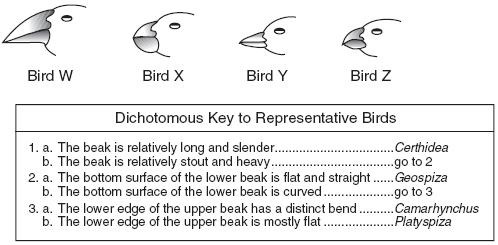
What is the name of bird Z?
a)
Certhidea
b)
Geospiza
c)
Camarhynchus
d)
Platyspiza