wayground logo

Free Printable Worksheets

NEW

Font size

S
M
L
XL
Worksheets

Atmosphere

Total questions: 20

Worksheet time: 10mins

Name
Class
Date
1.

The atmosphere is divided in...

a)

Gases

b)

Layers

c)

Sun Rays

2.

The 5 layers of the atmosphere are:

a)

Stratosphere, ozone, metoritesphere, thermosphere and ionosphere

b)

troposphere, mesosphere, ionosphere, ozone layer

c)

troposphere, stratosphere, mesosphere, thermosphere and exosphere

3.

The ozone layer is in the...

a)

exosphere

b)

stratosphere

c)

troposphere

4.

Precipitation occur in the...

a)

Ozone layer

b)

stratosphere

c)

troposphere

5.

Meteorologists are scientists who

a)

study the layers

b)

study weather conditions

c)

study the atmosphere

6.

Which gas in our atmosphere is most abundant?

a)

Argon

b)

Oxygen

c)

Nitrogen

d)

Carbon Dioxide

7.

What happens to air pressure as you go higher in the atmosphere?

a)

It increases.

b)

It decreases.

c)

It stays the same.

d)

It increases and then decreases.

8.
James plans to climb to the top of Mount Everest.  Which of the following statements about his climb will be the most accurate?
a)
Air pressure will rise and the temperature on a thermometer will increase.
b)
Air pressure will fall and the temperature on a thermometer will decrease.
c)
Air pressure will rise and the temperature on a thermometer will decrease.
d)
Air pressure and thermometer will not change.
9.

What protects us from dangerous ultraviolet radiation from the sun?

a)

Ozone

b)

Mrs. Suazo

c)

Mr. Fú

d)

Carbon Dioxide

10.
What would happen if the Earth had no atmosphere, as in no air?
a)
No life or weather
b)
It would be the same as now just a little harder to breathe
11.

The atmosphere keeps the Earth...

a)

Warm enough for life

b)

Too Cold for Life

c)

Spinning

d)

Orbiting the sun

12.
The lower the atmosphere pressure, the ____________________ you are on land or sky.
a)
Higher
b)
Lower
13.
We live in the __________________layer, a level of the atmosphere.
a)
Troposphere
b)
Stratosphere
c)
Mesosphere
d)
Exosphere
14.
The gases that make up Earth’s atmosphere are commonly referred to as air. Approximately what percentage of air is made up of gases other than nitrogen and oxygen?
a)
1%
b)
11%
c)
21%
d)
99%
15.
The atmosphere exerts a force (pressure) on Earth. Why does the atmosphere exert pressure on Earth?
a)
because of the pull of Earth’s gravity on air molecules
b)
because of electromagnetic radiation from outer space
c)
because of the effect of the ozone layer on solar radiation
d)
because of the effect of greenhouse gases on heat radiating from Earth
16.

An astronomer studying planets outside our solar system has analyzed the atmospheres of four planets. Which of these planets’ atmospheres would be most able to support a colony of humans?

a)

Planet A: 76% Nitrogen, 23% Oxygen, 1% Other

b)

Planet B: 82% Nitrogen, 11% Oxygen, 7% Other

c)

Planet C: 78% Nitrogen, 1% Oxygen, 21% Other

17.

The air on top of the mountain is ___ dense than the air at sea level

a)

More

b)

Less

18.

The kind of heat transfer that travels through space in electromagnetic waves is ______________________.

a)

insulation.

b)

Radiation

c)

Conduction

d)

Convection

19.
Which of the following is the best example of conduction?
a)
A light bulb warming a lampshade
b)
An egg cooking in a frying pan
c)
Water boiling in a pot
d)
Gases circulating in the atmosphere
20.
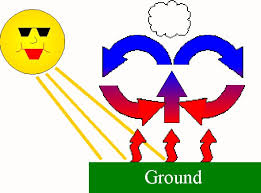
Warm air rises and the cool air sinks demonstrates this type of heat transfer. 
a)
conduction
b)
convection
c)
radiation
d)
Insolation