
 Worksheets
Forces and Motion Review
Total questions: 40
Worksheet time: 36mins


The net force of the following diagram is
70 N Left
90 N Left
Balanced forces
160 N Left


How can you tell an unbalanced force is acting on an object?
The object is moving.
The force will cause the object to move or stop moving.
The object is at rest.
The object will have gravity.

The tendency of an object to resist a change in motion is called?
Inertia
Friction
Gravity
Acceleration

Calculate the net force and direction.
7
7N
7N to the left
7N to the right

A boy pushes a box, his brother helps by pulling in the same direction. The box will...
go the same speed
increase in speed
decrease in speed
stop

Who will win?
The blue team with a net force of 300 N.
The green team with a net force of 300 N.
The green team with a net force of 200 N.
The blue team with a net force of 300 N.

Luke and Sarah have an assignment to construct an experiment that shows how the amount of force needed to accelerate an object is proportional to its mass. Which answer would BEST describe the motion of the cart, assuming there is no friction?
The cart will move to the left at a constant speed.
The cart will move to the right at a constant speed.
The cart will accelerate (increase speed) to the left.
The cart will accelerate (increase speed) to the right.

A bag of potatoes hangs motionless from a hook.
What forces are acting on the bag of potatoes, and what are their relative magnitudes and directions?
The force of gravity on the potatoes and the force of the hook. The force of gravity is larger than the force of the hook. The force of gravity points downward and the force of the hook points upward.
The force of gravity and the force of the bag. The force of gravity is exactly balanced by the force of the bag. The force of gravity points downward and the force from the bag points upward.
The force of gravity is pulling the potatoes and the bag. The force of gravity is directed downward toward the ground. No other forces are acting on the potatoes.
The bag is pulling upward on the potatoes. Because the bag is not moving, no other force is acting on the potatoes.

A book is lying still on a table.
Are the forces on the book balanced? Why or why not?
Yes, because gravity is pulling the book down and the table is pushing the book up.
Yes, because gravity is pulling the book up and gravity is pushing the book down.
No, because the force of gravity and the table exert a different amount of force.
No, because the force of gravity and the table are not of the same magnitude.

What is air resistance?
air that is slow
when an airplane flies into a cloud
when you feel the air hitting your face
air that creates a force opposite the direction of a moving object

When two objects or surfaces collide or slide past each other some of the energy is converted into....
potential energy
thermal energy
chemical energy
motion energy


Which scientific unit is used to represent Force?
N - Newton
Y - yee
kg - kilogram
a - acceleration

Which scientific unit is used to represent mass?
N - Newton
P - pounds
kg - kilogram
a - acceleration

Rockets are launched into space using jet propulsion where exhaust accelerates out from the rocket and the rocket accelerates in an opposite direction.
The Law of Inertia
The Law of Acceleration
The Law of Action-Reaction
Universal Gravitation

Pushing a child on a swing is easier than pushing an adult on the same swing, because the adult has more inertia.
Newton's 1st Law
Newton's 2nd Law
Newton's 3rd Law
Law of Intertia

An object and rest will stay at rest and an object in motion will stay in motion unless acted on by a force, is which one of Newton's Laws of Motion?
4th Law of Motion
1st Law of Motion
3rd Law of Motion
2nd Law of Motion

When an object resists change, like a body in a turning car, it is called ________________.
inertia
force
friction
drag force

For every action, thereʼs an equal and opposite reaction. *Action-Reaction*
Newton's First Law
Newton's Second Law
Newton's Third Law
force

a push and/or a pull.
force
net force
normal force
drag force

A force that results from two objects rubbing past each other.
Gravity
Friction
Inertia
Force

If there are two forces going in the same direction how would you find the net force?
Subtract
Add
Neither
Multiply

With unbalanced forces, the object will move in the direction of the _______ force.
larger
smaller
equal
objects don't move with unbalanced forces

When a cannon fires a cannonball forwards we observe Newton's third law. Which force is the reaction force?
The cannon moving forward
The cannonball moving forward
The cannon moving backward
The cannonball moving backward

According to Newton's second law, if you increase the force applied to an object :
it accelerates more
it doesn't move
you get more inertia
it decelerates

This person bought coffee and put it on the seat next to them. If they stopped quickly and the coffee spilled which law would that represent?
Newton's 1st Law
Newton's 2nd Law
Newton's 3rd Law
Universal Law of Gravitation

Gravity is a force that exists between any two objects with mass. This is an example of a...
electromagnetic force
contact force
push force
non-contact force

An object will accelerate in the direction of the force applied to it.
Newton's 1st Law
Newton's 2nd Law
Newton's 3rd Law
Newton's 4th Law
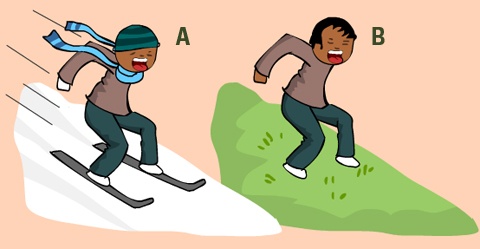


What kind(s) of objects have inertia?
all objects with mass
only objects at rest
only objects in motion
only objects whose motion is being changed

After a cannonball is fired into frictionless space, the amount of force needed to keep it going equals
twice the force with which it was fired
the same amount of force with which it was fired
1/2 the force with which it was fired
zero, since no force is requires to keep it moving.

One object has twice as much mass as another object. The first object also has also twice as much...
velocity
gracitational acceleration
inertia
all of these

Which of the following best describes Newton's 1st law?
Objects keep doing what they are doing unless a force is applied
Objects react to outside forces
Unbalanced forces on an object keep it at rest
More mass = more inertia

