
 Worksheets
Petroski - Plate Tectonics
Total questions: 52
Worksheet time: 2hrs 37mins
The type of plate boundary where two plates come together is a .....
Convergent Boundary
Divergent Boundary
Transform Boundary
Plate Boundary
Which of the following causes Earth's tectonic plates to move?
Energy from the Sun
Magnetic Pole Reversal
Convection currents in the mantle
Faults in Mountain Ranges

What type of event will occur at this boundary?
Earthquake
Volcano Eruption
Tornado
Mountain Building
A divergent boundary occurs when plates ....
Pull apart
Come together
Slide past each other
subducting
Which of the following is the name of the ancient supercontinent formed 28 Million Years ago.
Pangea
Gondwanda
Laurasia
Neverland
Mountains are created when....
Two continental plates collide
Two oceanic plates pull apart
An Oceanic plate subducts under a Continental Plate
Two continental plates pull apart
The Great Rift Valley in Africa and the Mid-Ocean Ridge were all created by this boundary
Divergent
Convergent
Reform
Transform

Which of these events can ONLY happen on a DIVERGENT BOUNDARY?
Rift Valley
Mountain
A peninsula
An Insanely complex, long answer that you will click out of instinct.
The tectonic plates float on the
lithosphere
lower mantle
outer core
asthenosphere
What occurs when two plates come together and the denser one is forced under back into the mantle?
reduction
conduction
subduction
convection
The youngest rocks on the seafloor are most likely found...
closest to a mid-ocean ridge
farthest from a mid-ocean ridge
near the coastlines
closest to a deep sea trench

What geologic process formed the Himalayas?
two continental plates converging
an earthquake in a subduction zone
a tectonic plate moving over a hot spot
movement at a transform fault boundary


This famous fault in California has a lot of earthquakes!
New Madrid
Denali Fault
Ramapo Seismic Zone
San Andreas Fault

What type of boundary is shown in the diagram?
Divergent
Convergent
Transform

What type of boundary is shown in the diagram?
Divergent
Convergent
Slide/Transform

What type of plate boundary is shown in the picture?
Convergent
Divergent
Transform

What type of plate boundary is shown in the picture?
Convergent
Divergent
Transform
What geologic event would most likely be found at a transform boundary?
Volcano
Mountain
Earthquake
Mid-Ocean Ridge
What landform would you most likely find at a divergent boundary between two pieces of oceanic crust?
Rift Valley
Mountain
Mid-Ocean Ridge
Volcano
What landform would you most likely find at a divergent boundary between two pieces of continental crust?
Mid-Ocean Ridge
Rift Valley
Mountain
Volcano
What landform would you most likely find at a convergent boundary between two pieces of continental crust?
Mid-Ocean Ridge
Oceanic Trench
Mountain
Volcano
What landform would you most likely find at a convergent boundary between two pieces of oceanic crust?
Rift Valley
Mid-Ocean Ridge
Mountain
Ocean Trench
When one tectonic plate sinks under another, this is called...
Convegent
Divergent
Subduction
Transform


What evidence was NOT used by Wegener as proof of continental drift?
land features
erosion
climate
fossils
Any trace of an ancient organism that has been preserved in rock is called a
landform
continent
fossil
landmass
What is the process that continually adds new crust to the ocean floor along both sides of the mid-ocean ridge?
subduction
continental drift
convergent
sea floor spreading

What type of landform is at C?
mid-ocean ridge
continental crust
deep ocean trench
sea floor spread

Identify the landform labeled A
mid-ocean ridge
deep ocean trench
sea floor spread
In sea floor spreading, molten material rises from the mantle and erupts
along the edge of the continents
along the mid-ocean ridges
in deep ocean trenches
at the North and South pole


In some areas of the world, like California and Japan, earthquakes are a common occurrence. How can this best be explained?
The strong ocean currents are undermining both areas causing earthquakes.
Both areas are located near the edge of the Pacific Ocean, the unstable sand causes earthquakes.
Both areas are subjected to strong ocean wind and waves that causes earthquakes.
Both areas are on the boundary of active plates, the motion of the plates causes earthquakes.
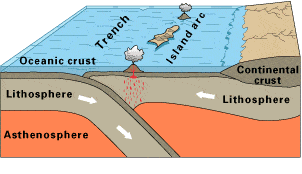
Observe this diagram of a plate boundary. One statement BEST describes what is happening. It is that
the oceanic crust is melting.
the denser ceanic crust is subducting under the less dense oceanic crust
volcanic islands are forming.
the tectonic plates are moving away from each other.
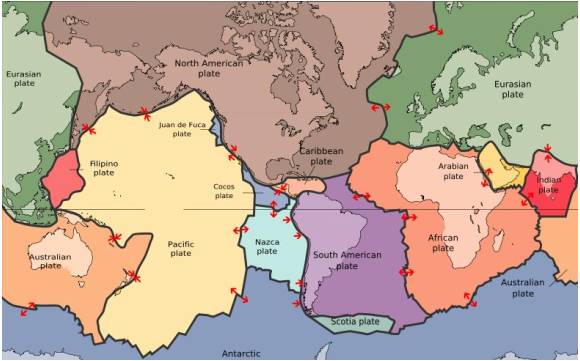
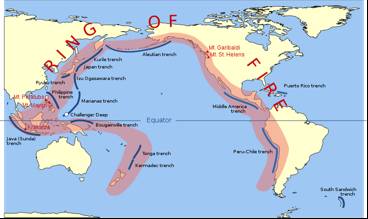
The map in the picture shows tectonic plate boundaries. This map would be useful in predicting the location of future
droughts
hurricanes
earthquakes
tornadoes
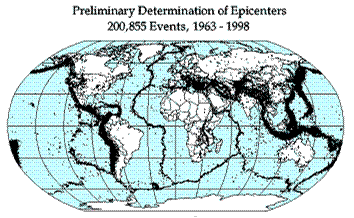
Earthquake epicenters (center of where the earthquakes started) were mapped for a 35 year period in the diagram above. The black dots indicate these epicenters. The black dots appear along what feature on Earth?
hot spots
plate boundaries
rift zones
sea floor spreading
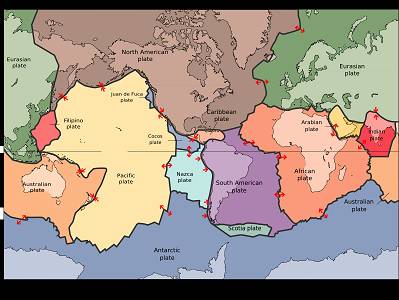

What is the correct order (starting from the surface) of Earth’s layers?
crust, outer core, inner core, mantle
mantle, outer core, inner core, crust
crust, mantle, outer core, inner core
outer core, inner core, crust, mantle
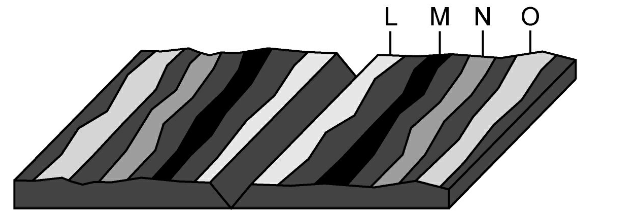


How is it possible for new crust to be formed without increasing the surface area of the Earth?
Crust is destroyed at the same time it is created
New crust is underwater where it sinks
New crust breaks more easily than old crust

Ocean Ridges are formed by _______ plate boundaries
Convergent Oceanic / Continental
Convergent Continental / Continental
Convergent Oceanic / Oceanic
Divergent

