
 Worksheets
Unit 4 Review
Total questions: 42
Worksheet time: 3hrs 5mins
Name
Class
Date
1.

The weather is...
a)
The typical state of the atmosphere in a long period of time.
b)
The state of the atmosphere at a particular time.
2.

The climate is...
a)
The typical state of the atmosphere over a long period of time.
b)
The state of the atmosphere at a particular time.
3.
The condition of the atmosphere, such as temperature, cloud cover, wind speed and rainfall
a)
climate
b)
weather
c)
trend
d)
season
4.

Pieces of information used to analyze information
a)
experiment
b)
Conclusion
c)
Questions
d)
Data
5.

the amount of water vapor in the air
a)
warm front
b)
precipitation
c)
humidity
d)
air pressure
6.

The location where cold air mass is replacing a warm air mass
a)
storm front
b)
hot front
c)
warm front
d)
cold front
7.

The location where warm air mass is replacing a cooler air mass
a)
cold front
b)
warm front
c)
icy front
d)
storm front
8.
Temperature in the Arctic region is cold . This statement is an example of
a)
Weather
b)
Climate
9.
Weather is the state of the atmosphere over a longer period of time. True or False
a)
True
b)
False
10.
Which best describes climate
a)
Yesterday , it was rainy
b)
Summer was hot and dry
c)
It rained last week
11.
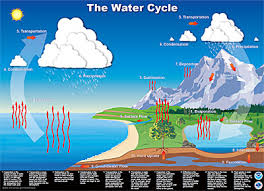
During which stage do clouds form?
a)
condensation
b)
evaporation
c)
precipitation
12.
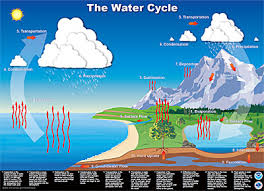
Which stages does liquid water from the ocean turn into water vapor?
a)
condesantion
b)
evaporation
c)
precipitation
d)
run off
13.
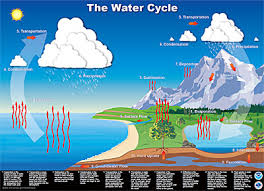
Which stage does ground water try to return to the ocean or soak into the ground?
a)
condensation
b)
evaporation
c)
precipitation
d)
run off
14.
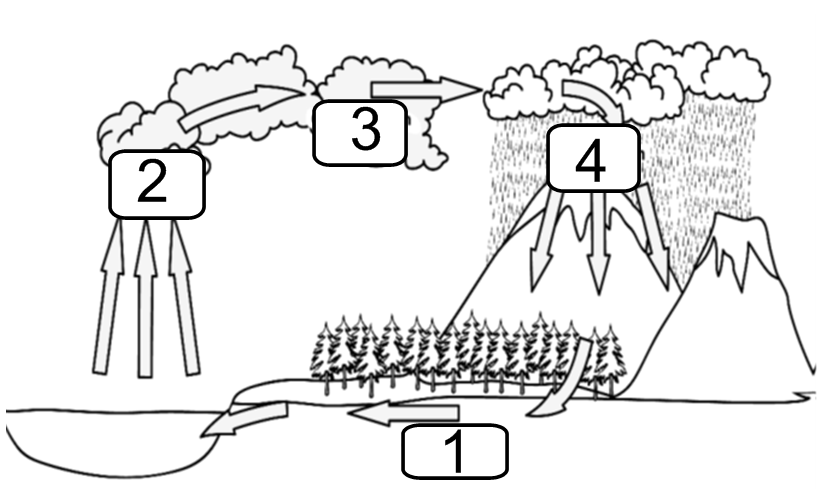
Which stage does the #2 show in the diagram?
a)
condensation
b)
evaporation
c)
precipitation
d)
run off
15.

Which stage does the #3 show in the diagram?
a)
condensation
b)
evaporation
c)
precipitation
d)
run off
16.

what does the #4 show in the diagram?
a)
condensation
b)
evaporation
c)
precipitation
d)
run off
17.
What is the water cycle?
a)
the 3 forms of water
b)
the movement of water on, above, or below the surface of the Earth
c)
when water melts
d)
when clouds form
18.
Which best explains why runoff is important?
a)
It returns water to other locations on Earth
b)
It increases the chance of flooding
c)
It makes evaporation occur faster
d)
It increases condensation
19.
What follows evaporation during the water cycle? How does this occur?
a)
Water evaporates into water vapor
b)
Water vapor condenses and forms a cloud
c)
Water precipitates to the ground
d)
Water runs down into the hydrosphere
20.

The sun will cause water in the puddle to change from
a)
a gas to a liquid
b)
a liquid to a gas
c)
solid to a liquid
d)
a liquid to a solid
21.
Water in lakes and rivers that does not contain salt-
a)
recycled water
b)
new water
c)
salt water
d)
fresh water
22.
The earth is tilted on its _____
a)
line
b)
equator
c)
axis
d)
core
23.
Earth does a complete revolution every _______
a)
10 years
b)
12 hours
c)
24 hours
d)
365 days
24.
The earth rotates every
a)
24 hours
b)
15 hours
c)
365 days
d)
hour
25.
How many moons does earth have
a)
2
b)
5
c)
9
d)
1
26.
Whats the 5th planet in our solar system
a)
pluto
b)
earth
c)
mars
d)
jupiter
27.
The earth is the only planet that
a)
supports life
b)
has water
c)
contains humans
d)
all of the above
28.
How many planets are there in our solar system?
a)
4
b)
8
c)
12
d)
7
29.
What causes day and night cycles?
a)
mars
b)
seasons
c)
earths rotation
d)
moon phases
30.
The process of Earth spinning on its axis is referred to as
a)
revolution
b)
ionization
c)
rotation
d)
ellipse
31.
Which of the following is a characteristic of both the Earth and the Moon?
a)
Atmosphere containing oxygen
b)
Rocky surface covered with landforms
c)
Flowing water in oceans and rivers
d)
Fossils and fossil fuels under the surface
32.
Among the Earth, Sun, and Moon, what makes the Earth unique? Only the Earth –
a)
can generate energy
b)
lacks an atmosphere
c)
is made mostly of rock
d)
contains water in liquid form
33.
Which of the following lists the Earth, Sun, and Moon in order of size, from largest to smallest?
a)
Earth, Sun, and Moon
b)
Earth, Moon, and Sun
c)
Sun, Earth, and Moon
d)
Sun, Moon, and Earth
34.
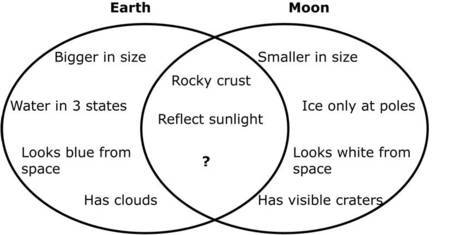
A student created a diagram to compare the characteristics of the Earth and the Moon.
Which of the following characteristics could be placed in the center part of the diagram?
Which of the following characteristics could be placed in the center part of the diagram?
a)
orbits another object
b)
strong gravitational pull
c)
rotates every 24 hours
d)
has an atmosphere
35.

Which has landforms?
a)
Sun
b)
Sun, Earth, Moon
c)
Earth and Moon
d)
only Earth
36.
The Sun, Earth, and the Moon share the same similarities in their
a)
Shape (Sphere)
b)
Color
c)
Size
37.

Which of the listed characteristics describe both Earth and the moon?
a)
b)
c)
d)
38.

This model can be used to show some relationships between the Earth, Sun, and Moon.
The model shows all of the following EXCEPT –
The model shows all of the following EXCEPT –
a)
the relative sizes of the Moon and Earth
b)
the way the Moon revolves around the Earth
c)
the composition of the Moon, Earth, and Sun
d)
how the Moon and the Earth revolve around the Sun
39.
Of the Earth, Sun, and Moon, which ones orbit another object?
a)
the Sun and the Earth
b)
the Sun and the Moon
c)
the Moon and the Sun
d)
the Moon and the Earth
40.
I am a medium sized star. Who am I?
a)
Sun
b)
Earth
c)
Moon
41.
I provide light and thermal energy for life on Earth. Who am I?
a)
Sun
b)
Earth
c)
Moon
42.
I am the center of our solar system. Who am I?
a)
Sun
b)
Earth
c)
Moon
100 %

