wayground logo

Free Printable Worksheets

NEW

Font size

S
M
L
XL
Worksheets

The Water Cycle

Total questions: 30

Worksheet time: 3600secs

Name
Class
Date
1.

In the morning, you observe that water droplets have formed on grass. Which process occurred when the water droplets formed on the grass?

a)

condensation

b)

deposition

c)

evaporation

d)

sublimation

2.

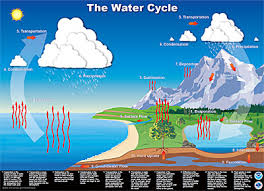
What process is happening step A?

a)

transpiration

b)

evaporation

c)

condensation

d)

accumulation

3.

What is the correct order of the water cycle?

a)

cloud, water vapor, rain,

b)

water vapor, cloud, rain

c)

rain, cloud, water vapor

d)

water vapor, rain, cloud

4.

During what part of the water cycle does water vapor turn into liquid droplets?

a)

evaporation

b)

condensation

c)

precipitation

d)

run off

5.

What must happen to water vapor in order for it to turn into liquid droplets?

a)

It must be heated.

b)

It must be cooled.

c)

It must remain the same temperature.

d)

It must be pushed by wind.

6.

What is the correct order of the water cycle?

a)

precipitation, evaporation. run off, condensation

b)

evaporation, run off, precipitation, condensation

c)

evaporation, condensation, precipitation, run off

d)

run off, condensation, evaporation, precipitation

7.
In the water cycle, what happens during evaporation?
a)
Water vapor changes to liquid water.
b)
Water falls to the ground from clouds.
c)
Liquid water changes to water vapor. 
d)
Water flows over the ground. 
8.
Rain, sleet, snow and hail are all examples of 
a)
evaporation.
b)
condensation. 
c)
weathering. 
d)
precipitation. 
9.
The water cycle has
a)
a beginning and an end. 
b)
no beginning an no end. 
c)
only a beginning. 
d)
only an end. 
10.
What is the water cycle?
a)
When water rides a bike. 
b)
The movement of water between Earth's surface and atmosphere. 
c)
How water is created. 
d)
How water is destroyed. 
11.
What is the atmosphere?
a)
The blanket of air that surrounds Earth. 
b)
Hydrogen
c)
The different layers of soil on Earth. 
d)
How much air is needed for humans to survive.
12.
How many main steps does the water cycle have?
a)
Unlimited
b)
None
c)
4
d)
100
13.
Why is the sun important to the water cycle?
a)
The sun provides electricity for the water to flow to earth. 
b)
The sun provides Earth with light and heat energy to make the cycle work. 
c)
The plays no role in the water cycle. 
d)
The sun creates runoff for the water cycle to begin. 
14.
What is the energy source for the water cycle?
a)
the sun
b)
the earth
c)
water
d)
the moon
15.
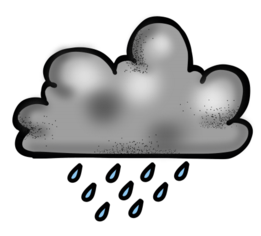
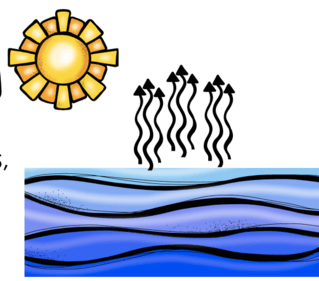
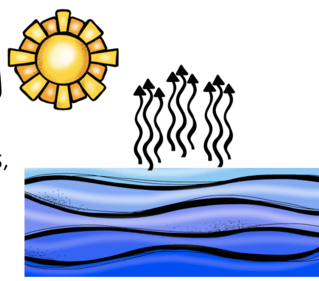
What part of the water cycle does this picture show?
a)
condensation
b)
precipitation
c)
evaporation
16.
What part of the water cycle does this picture show?
a)
condensation
b)
precipitation
c)
evaporation
17.
What part of the water cycle does this picture show?
a)
condensation
b)
precipitation
c)
evaporation
18.
Evaporation happens when the sun ___________ water and turns it into vapor.
a)
cools
b)
heats up
c)
freezes
d)
lights up
19.
Precipitation happens when clouds of water droplets are too ______________.
a)
cold
b)
light
c)
heavy
d)
hot
20.
When water condenses, the liquid water forms ______________.
a)
water vapor
b)
steam
c)
air
d)
clouds
21.

When water vapor condenses directly onto a surface __________________ occurs.

a)

condensation

b)

dew

c)

rain

d)

water vapours

22.

Which of these is an example of precipitation?

a)
b)
c)
d)
23.

What is the water cycle?

a)
b)
c)
d)
24.
During which stage do clouds form?
a)
condensation
b)
evaporation
c)
precipitation
25.
What is water that flows in rivers and streams into the oceans and lakes?
a)
evaporating
b)
condensing
c)
precipitating
d)
runoff
26.
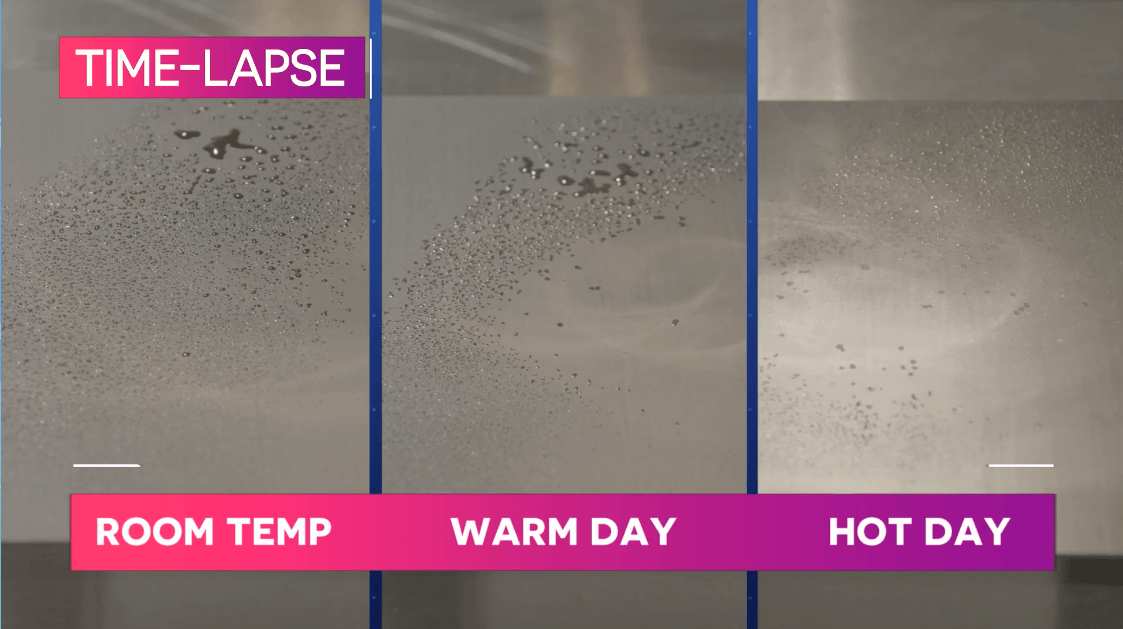
When does water evaporate fastest?
a)
at room temperature
b)
on a warm day
c)
on a hot day
d)
on a cold day
27.
a)

Evaporation-physical change in matter from a liquid to a gas

b)

Condensation-physical change in matter from a gas to a liquid

c)

Precipitation- rain, snow, sleet, and hail that falls from clouds in the sky

d)

Runoff - the movement of water on a surface to areas of lower elevation

28.
a)

Evaporation-physical change in matter from a liquid to a gas

b)

Condensation-physical change in matter from a gas to a liquid

c)

Precipitation- rain, snow, sleet, and hail that falls from clouds in the sky

d)

Runoff - the movement of water on a surface to areas of lower elevation

29.
a)

Evaporation-physical change in matter from a liquid to a gas

b)

Condensation-physical change in matter from a gas to a liquid

c)

Precipitation- rain, snow, sleet, and hail that falls from clouds in the sky

d)

Runoff - the movement of water on a surface to areas of lower elevation

30.
a)

Evaporation-physical change in matter from a liquid to a gas

b)

Condensation-physical change in matter from a gas to a liquid

c)

Precipitation- rain, snow, sleet, and hail that falls from clouds in the sky

d)

Runoff - the movement of water on a surface to areas of lower elevation