Wayground logo

Free Printable Worksheets

Font size

S
M
L
XL
Worksheets

Semester One Midterm Review - AH!

Total questions: 181

Worksheet time: 4hrs 52mins

Name
Class
Date
1.

Who was the president of the Confederate States of America?

a)

Abraham Lincoln

b)

Ulysses S. Grant

c)

Jefferson Davis

d)

Robert E. Lee

2.
Where did the Civil War begin?
a)
Gettysburg
b)
Antietam
c)
Fort Sumpter
d)
Manassas
3.
To break away from a group
a)
state's rights
b)
slavery
c)
Gettysburg
d)
secede
4.
One of General Lee's most important generals who would stand like a "Stonewall" during battles and was accidentally killed by his own men.
a)
Jefferson Davis
b)
Thomas "Stonewall" Jackson
c)
Robert E. Lee
d)
Ulysses S. Grant
5.
President of the U.S. during the Civil War who issued the Emancipation Proclamation which freed slaves in the states that seceded.
a)
George Washington
b)
Thomas Jefferson
c)
Ulysses S. Grant
d)
Abraham Lincoln
6.
3 day battle that the South lost and is considered the turning point in the war
a)
Gettysburg
b)
Fort Sumter
c)
The Atlanta Campaign
d)
Uncle Tom's Cabin
7.
The 1st and only President of the Confederacy during the Civil War.
a)
Abraham Lincoln
b)
Robert E. Lee
c)
Ulysses S. Grant
d)
Jefferson Davis
8.
An advantage that the Union had was: 
a)
a larger population
b)
more railroads
c)
more factories
d)
All of these were Union advantages
9.
An advantage of the Confederacy was:
a)
A larger population
b)
Better weapons
c)
Better generals
d)
All of these are Confederate advantages
10.
A major invention during the Civil War was:
a)
Airplanes
b)
Rockets
c)
Ironclad ships
d)
Railroads
11.
Which of the following is true of the Emancipation Proclamation?
a)
It abolished slavery in the United States
b)
It helped Lincoln get elected in 1860
c)
It freed slaves in the Confederacy, but not the border states
d)
It made it illegal for African Americans to join the Union Army
12.
Robert E. Lee was:
a)
The President of the Confederacy
b)
An important Union General
c)
An important Confederate General
d)
The inventor of the Ironclad ship
13.
Which battle gave the Union control of the Mississippi River?
a)
Vicksburg
b)
Gettysburg
c)
Pittsburgh
d)
Antietam
14.
Who was the Union general who eventually led the North to victory?
a)
Ulysses S. Grant
b)
George McClellan
c)
Ambrose Burnside
d)
Robert E. Lee
15.

The name given to the North

a)

Confederacy

b)

Rebels

c)

Union

d)

Revolutionaries

16.

What battle was the single bloodiest battle in US history?

a)

Antietam

b)

Shiloh

c)

Gettysburg

d)

Vicksburg

17.
Who won the Civil War?
a)
Union
b)
Confederates
18.

The name given to the South

a)

Confederacy

b)

Rebels

c)

Union

d)

Revolutionaries

19.

California being admitted as a free state and the Fugitive Slave Law are both part of

a)

The Missouri Compromise of 1820

b)

The Kansas-Nebraska Act

c)

The Compromise of 1850

d)

The Nullification Act

20.

California being admitted as a free state and the Fugitive Slave Law are both part of

a)

The Missouri Compromise of 1820

b)

The Kansas-Nebraska Act

c)

The Compromise of 1850

d)

The Nullification Act

21.

The Missouri Compromise

a)

created rules for all new territories regarding slavery

b)

allowed slave states to come in without a free state to balance them out

c)

maintained the balance of slave and free states

d)

established rules for statehood in the Mexican Cession

22.
Which of the following words means that a person places the interests of a small area over the interests of the entire country?
a)
Nationalism
b)
Sectionalism
c)
Popular Sovereignty
d)
Secession
23.
The Compromise of 1850...
a)
allowed California to enter as a free state.
b)
ended the Fugitive Slave law.
c)
gave all of the land taken from Mexico to Texas.
d)
banned slaver in Washington D.C.
24.
An abolitionist supported which of the following causes?
a)
outlawing alcohol
b)
ending slavery
c)
limiting slavery to southern states
d)
ending women's suffrage
25.
What was the secret organization that helped slaves to escape to freedom?
a)
Underground Railroad
b)
Seneca Falls Convention
c)
National Road
d)
American Temperence Union
26.
Who was the abolitionist who raided the federal arsenal at Harper's Ferry, Virginia and further heightened sectionalism by adding to the slave owner's fear of a revolt?
a)
John Brown
b)
Dred Scott
c)
Harriet Beecher Stowe
d)
Andrew Jackson
27.

Who won the presidential election of 1860?

a)

John Breckenridge

b)

Abraham Lincoln

c)

John Bell

d)

Stephen Douglas

28.
The Civil War began in which year?
a)
1861
b)
1862
c)
1863
d)
1860
29.
What years did the civil war last?
a)
1860-1870
b)
1865-1880
c)
1781-1785
d)
1861-1865
30.
A civil war is
a)
a war between north and south
b)
a war between people of the same country
31.
4. Which is not an advantage the North had over the South?
a)
Industry
b)
Population
c)
$Money$Banks$
d)
Will to Fight 
32.
What was a major advantage of the South during the Civil War?
a)
heavy industrial development
b)
a network of railway lines to transport supplies and troops
c)
superior military leadership
d)
an alliance with Britain and France
33.
List an obstacle that settlers faced traveling west.
a)
mountains
b)
crossing rivers
c)
the great plains
d)
all of the above
34.
Which territory was added as a result of the Mexican War?
a)
California
b)
Florida
c)
Oregon
d)
Louisiana
35.
What was the term for the idea that expansion was the right of the US?
a)
Manifest Destiny
b)
Righteous Growth
c)
Sovereign Development
d)
Due Process
36.
Who's invention caused an increase in the demand for cotton and slave labor?
a)
Robert Fulton
b)
Jo Anderson
c)
Cyrus McCormick
d)
Eli Whitney
37.
What did Robert Fulton invent?  It provided faster river both with and against the river current?
a)
The steam locomotive
b)
The automobile
c)
The steamboat
d)
The river flatboat
38.
How did the steam locomotive impact travel in the 1800's?
a)
It made it cleaner and better for the environment
b)
It provided faster land travel
c)
It caused people to want to stay east
d)
It wasn't invented until the 1900's
39.

The Homestead Act was when the United States gave away ___________ to settlers.

a)

lumber to build houses

b)

plots of land

c)

seeds to grow crops

d)

wagons to travel out west

40.

What was the main goal of the Lewis and Clark Expedition?

a)

To meet and trade with the Native Americans

b)

To explore and map out the land west of the Mississippi River

c)

To pan for gold in the rivers

d)

To map out a trail through the Appalachian Mountains

41.

What happened during the Gold Rush?

a)

People from all over the world moved to California

b)

Prospectors stayed in mining camps to explore an area and hunt for gold

c)

Thousands of people panned for gold hoping to become rich

d)

All of the above

42.

During the Westward Expansion the United States more than doubled in size.

a)

True

b)

False

43.

Millions of people became rich during the Gold Rush in California

a)

True

b)

False

44.

The area of America from the Missouri River to the Rocky Mountains. The land was mostly flat and grasslands.

a)

Great Plains

b)

frontier

c)

homestead

d)

Sitting Bull

45.

A town the has a sudden burst of population growth due to the gold rush.

a)

homestead

b)

frontier

c)

boomtown

d)

Great Plains

46.

A person who takes the law into his/her own hand

a)

vaquero

b)

vigilante

c)

Exoduster

d)

buffalo soldier

47.

Urbanization is when

a)

people move from the city to the farm

b)

the creation of farming towns

c)

people move from the farm to the city

d)

the improvement of living conditions

48.
Why were railroads so important during this time?
a)
they moved goods more quickly and less expensively over greater distances
b)
they were fun to ride on to go visit family in other states
c)
people could ride on railroads to get to their jobs in another city
49.
Who invented cotton gin and interchangeable parts?
a)
John Deere
b)
Eli Whitney
c)
Samuel Slater
d)
Elias Howe
50.
Who invented the steamboat?
a)
Robert Fulton
b)
Samuel Morse
c)
Cyrus McCormick
d)
Francis Cabot Lowell
51.
Under the Articles of Confederation, which government had the MOST power?
a)
Legislative branch
b)
the president
c)
the state governments
d)
national government
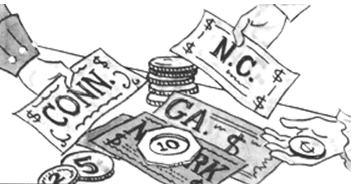
52.
Which of the following weaknesses  in the Articles of Confederation does  this picture represent?
a)
no common currency (money)
b)
no executive branch
c)
no power to tax
d)
one vote for each state
53.
Which of the following is an example of a weakness in the Articles of Confederation?
a)
Congress couldn't collect taxes
b)
Weak national government
c)
Provided no common currency/money for all 13 states
d)
All of the  above
54.
What is the name of the first written plan of government for the newly independent U.S.A.?
a)
Constitution
b)
Treaty of Paris
c)
Declaration of Independence
d)
Articles of Confederation
55.
Because of the Articles  of  Confederarion the government could NOT regulate(control) ______ among the states.
a)
food quality
b)
laws
c)
travel
d)
commerce (trade)
56.
Under the Articles of Confederation Congress could only pass a law if ____________ out 13 states agreed. 
a)
13
b)
8
c)
9
d)
10
57.
Many of our individual liberties are protected by which document?
a)
The Articles of Confederation
b)
The Declaration of Independence
c)
The Bill of Rights
d)
The Fundamental Orders 
58.
Which president was also called the Father of the Constitution?
a)
George Washington
b)
Thomas Jefferson
c)
Alexander Hamilton
d)
James Madison
59.
What is the name for a change or addition to the Constitution?
a)
Amendment
b)
Preamble
c)
Ratification
d)
Compromise
60.
Which group wanted to keep the Articles of Confederation and give more power to the states?
a)
Federalists
b)
Anti-Federalists
c)
Judiciary
d)
Legislature
61.
Central and national are two words that mean the same thing as - 
a)
state
b)
federal
c)
local
d)
regional
62.
What was the name for the essays written in support of ratification of the Constitution?
a)
Letters from a Pennsylvania Farmer
b)
The Anti-Federalist Essays
c)
The Federalist Papers
d)
The Fundamental Orders
63.
Which compromise concerned the issue of how to count slaves for representation and taxation?
a)
The Great Compromise
b)
The Commerce Compromise
c)
The 3/5 Compromise
d)
The Connecticut Compromise
64.
Which compromise concerned how many representatives different sized states would have in Congress?
a)
The Great Compromise
b)
The 3/5 Compromise
c)
The Commerce Compromise
d)
The Intolerable Compromise
65.
Who is the head of the executive branch?
a)
The Supreme Court
b)
The Senate
c)
The President
d)
The Cabinet
66.
Which of the following is a system that allows each branch of government to limit the powers of the other branches in order to prevent abuse of power?
a)
Tyranny
b)
Checks and balances
c)
Federalism
d)
Ratification
67.
What year was the Constitution written in?
a)
1776
b)
1787
c)
1803
d)
1861
68.
Was Alexander Hamilton a federalist or an anti-federalist?
a)
Federalist
b)
Anti-Federalist
69.
George Washington was the _____ President of the United States.
a)
11th
b)
1st
c)
100th
d)
last
70.
The Revolutionary War began in _____.
a)
2000
b)
1885
c)
1775
d)
1665
71.
In 1787, George led a group to form the government in the __________.
a)
United States of America
b)
NFL
c)
continent of Africa
d)
Olympics
72.
Washington was president for _____ years.
a)
100
b)
8
c)
4
d)
18
73.

People will remember George Washington as the __________.

a)

"Father of our Country"

b)

"Father of the World"

c)

"Mr. Universe"

d)

"Big Daddy"

74.
Washington's Secretary of the Treasury was:
a)
Benjamin Franklin
b)
Thomas Jefferson
c)
John Adams
d)
Alexander Hamilton
75.
The only President without a political party was:
a)
Washington
b)
Adams
c)
Jefferson
d)
Hamilton
76.
The Democratic Republican Party was created by supporters of:
a)
George Washington
b)
John Adams
c)
Thomas Jefferson
d)
Alexander Hamilton
77.
Supporters of Alexander Hamilton created which Political Party?
a)
Federalist
b)
Democratic-Republican
c)
Whig
d)
Tupperware
78.
In 1775, he became Commander in Chief of the __________.
a)
Navy
b)
Continental Army
79.
Which of the following describes the area of the Louisiana Purchase?
a)
From the Atlantic Ocean to the Mississippi River
b)
From the Mississippi River to the Rocky Mountains
c)
From the Appalachian Mountains to the Rocky Mountains
d)
from the Rocky Mountains to the Pacific Ocean
80.
In what year did the Louisiana Purchase take place?
a)
1776
b)
1787
c)
1803
d)
1812
81.
With the purchase of the Louisiana Territory, the United States could expand ___.
a)
to the north
b)
to the south
c)
to the west
d)
to the east
82.
The United States purchased the Louisiana Territory from what country?
a)
Great Britain
b)
France
c)
Russia
d)
Spain
83.
What president arranged the Louisiana Purchase?
a)
Thomas Jefferson
b)
George Washington 
c)
Andrew Jackson
d)
William Henry Harrison
84.
How much did the United States pay for the Louisiana Territory?
a)
$100,000
b)
$1 million
c)
$15 million
d)
$100 million
85.
How did Sacagawea help Lewis and Clark?
a)
She made maps of the Louisiana Territory.
b)
She took care of Clark's children.
c)
She helped guide them through the unfamiliar land.
d)
She collected rocks, plants, and animals for them.
86.

In 1800 Napoleon Bonaparte controlled

a)

Great Britain

b)

Spain

c)

Germany

d)

France

87.

Some of the most important help received by Lewis and Clark came from

a)

Sacagawea

b)

Mauel de Godoy

c)

Toussaint Louverutre

d)

Robert Livingston

88.

US leaders were concerned about French ownership of Louisiana because

a)

they thought that the British had the right to own and occupy Louisiana

b)

they had already made an agreement to buy Louisiana from the Spanish

c)

they feared that the French would persuade Louisiana Indian tribes to attack the Americans

d)

it could block future US expansion westward and interfere with trade along the Mississippi River

89.

How was the Lewis and Clark expedition successful?

a)

learned about Western lands

b)

found a river route to the Pacific Ocean

c)

discovered gold

d)

defeated the Spanish

90.

The Louisiana Purchase

a)

did not occur until Congress passed an amendment approving it

b)

doubled the size of the US

c)

offered the US an opportunity to expand its commercial and manufacturing industries

d)

tripled the size of the US

91.
Why was the port of New Orleans so important?
a)
It was the best place to go fishing
b)
It was a party town
c)
It was the Catholic headquaters
d)
It was the main center for trade along the Mississippi river
92.
Who sold the Louisiana territory to the US?
a)
Spain
b)
France
c)
Britian
d)
Portugal
93.
What doubled the size of the US?
a)
Mexico
b)
Canada Purchase
c)
Louisiana Purchase
d)
California Purchase
94.
The Emperor of France that sold the Louisiana Territory to the USA?
a)
Toussaint Louverture
b)
Napoleon Bonaparte
c)
Simon Bolivar
d)
Friedrick Von Steuben
95.

In what state is the Erie Canal?

a)

New York

b)

Ohio

c)

Vermont

d)

Pennsylvania

96.

What is unique about a canal?

a)

it is a manmade waterway

b)

it is a freshwater source

c)

it is larger than most major rivers in the US

d)

it mixes salt and freshwater

97.

Based on the map, the Erie Canal and Hudson River contributed directly to the

a)

decisions to restrict immigration

b)

rapid increase in population in upstate New York

c)

settlement of New England

d)

acquisition of land from Canada

98.

Completion of the Erie Canal in 1825 encouraged the growth of the Midwest because it

a)

linked the Great Lakes to the Atlantic Coast

b)

helped force the removal of British forts in the Northwest Territory

c)

stimulated development of cotton production in the Ohio River valley

d)

increased trade with Asia

99.
In which country did the Industrial Revolution begin?
a)
The United States
b)
England
c)
France
d)
Germany
100.
What are identical components that can be used in place of each other?
a)
Interchangeable parts
b)
Factories
c)
Dynamos
d)
Assembly Lines
101.
Mass production led to:
a)
Products being more superior in quality
b)
goods became less expensive
c)
laborers received higher wages
d)
industries moved to rural areas
102.
Before the Industrial Revolution all products were created by
a)
Factories
b)
Hand
c)
Slaves
d)
Royalty
103.
Who designed the first efficient steam engine?
a)
James Hargreaves
b)
John Kay
c)
Richard Arkwright
d)
James Watt
104.
This machine separated the seed from cotton fibers.
a)
Spinning Mule
b)
Spinning Jenny
c)
Steam Engine
d)
Cotton Gin
105.
Who invented the cotton gin?
a)
Eli Whitney
b)
Jim Morse
c)
James Watt
d)
the guy that delivers your pizza
106.
Why were railroads so important during this time?
a)
they moved goods more quickly and less expensively over greater distances
b)
they were fun to ride on to go visit family in other states
c)
people could ride on railroads to get to their jobs in another city
107.
Who invented the steamboat?
a)
Robert Fulton
b)
Samuel Morse
c)
Cyrus McCormick
d)
Francis Cabot Lowell
108.

Who invented the telegraph?

a)

Samuel Adams

b)

Samuel Morse

c)

Robert Fulton

d)

Francis Lowell

109.

Which group most likely received the greatest benefit from the invention of the cotton gin.

a)

factory managers

b)

Irish immigrants

c)

plantation owners

d)

textile workers

110.

The combination of resources, improved transportation, and technological breakthroughs all led to the

a)

industrial revolution

b)

adoption of gold standard

c)

era of good feelings

d)

formation of agricultural cooperatives

111.

During the mid-1800s the development of the factory system in the United States contributed to .....

a)

a decline in number of immigrants

b)

the rapid growth of cities

c)

the overall lowering of standard of living

d)

a decrease in agricultural production

112.

Which statement is true?

a)

Children were not allowed to work in the mines during the Industrial Revolution.

b)

Work conditions were closely regulated

c)

There were no labor laws that prevented children from working

d)

Children were allowed to work but they were treated fairly

113.

The powered loom made textile production easier. What is the best synonym for "textile?"

a)

Steel

b)

Coal

c)

Cloth

d)

Cotton

114.

Which of the following was a major effect of the Industrial Revolution?

a)

Poverty was completely eliminated.

b)

Societies moved from agriculture to industry.

c)

The number of wars between countries decreased dramatically.

d)

Unemployment increased dramatically.

115.
The change from individual production of goods to machine production is called
a)
urbanization
b)
industrialization
c)
agrarian societs
d)
nullification
116.
Which of the following was NOT associated with early factory working conditions?
a)
Low wages
b)
Safe working conditions
c)
Dangerous working conditions
d)
Widespread pollution
117.
What invention is this?
a)
Cotton Gin
b)
Spinning Jenny
c)
Steam Engine
d)
Steam Boat 
118.

Another word for farming

a)

Agriculture

b)

Manufacturing

c)

Technology

d)

Invention

119.

How did the Cotton Gin affect the price of cotton clothing?

a)

The price of clothing stayed about the same

b)

The price of clothing was cheaper

c)

The price of clothing was higher

120.

What other process was changed by Eli Whitney?

a)

Manufacturing using interchangeable parts

b)

Improve horse harnesses

c)

Manufacturing using electricity

d)

Improved steam engine machinery

121.
What provided faster water/river travel?
a)
Steam boat
b)
Steam Locomotive
c)
ships
d)
cars
122.
Where was most industrialization happening in the 1800s? 
a)
The south
b)
The North
c)
The Western territories
d)
The south west
123.

One of the ways the workers on the Erie Canal kept motivated was by creating songs with a strong cadence.

a)

True

b)

False

124.

The creation of factories began to create tension between the North and the South.

a)

True

b)

False

125.

The Spanish created Florida.

a)

True

b)

False

126.

The Spanish created the oldest city ion North America, called St.Augustine.

a)

True

b)

False

127.

Jamestown was located in Massachusetts

a)

True

b)

False

128.

Plymouth was settled for religious freedom

a)

True

b)

False

129.

Both Jamestown & Plymouth were English colonies.

a)

True

b)

False

130.

According to the Declaration of Independence, what truth was "self-evident"?

a)

All men are created equal

b)

Rights are given by good kings

c)

Government exists to protect us from ourselves

d)

Only a democracy can protect our rights

131.

According to the Declaration of Independence, where does government get its power?

a)

From the King

b)

From the Supreme Court

c)

From God

d)

From the people

132.
Why was the Declaration of Independence written?
a)
To stop taxes from the British Empire.
b)
To make a United States army.
c)
To gain independence from the British Empire
d)
To install their own king in America
133.

The List of Grievances were the part of the Declaration that

a)

detailed the colonists' complaints with King George.

b)

listed a man's natural rights.

c)

introduced the Declaration.

d)

concluded the Declaration, declaring America a free country.

134.

Why is July 4, 1776 an important date in U.S. history?

a)

Common Sense was published.

b)

The Olive Branch Petition sent to King George III.

c)

The American Revolution ends.

d)

The Declaration of Independence is signed.

135.

Why were the colonists angry about British taxes?

a)

Representatives of the colony had not voted on the tax

b)

they had never paid taxes

c)

they did not think the British needed money

d)

They did not think the King was collecting enough taxes from people in England

136.

Colonists who chose to side with the British were known as

a)

Redcoats

b)

Loyalists

c)

Neutrals

d)

Patriots

137.
Why did pilgrims come to the New World?
a)
They were escaping a drought
b)
They wanted religious freedom
c)
They were criminals on the run
d)
They thought they were traveling to India
138.
Life in the early colonies was...
a)
Easy! They had everything they needed!
b)
Difficult! New diseases, attacks from Native Americans, and starvation made life hard.
c)
Fun! They had new adventures everyday!
d)
Boring! Colonist had nothing to do.
139.
What did the Mayflower Compact create?
a)
Laws made by and agreed upon by the colonists
b)
A government that broke away from the rule of the King
c)
A system of farming in the New World
d)
The holiday Thanksgiving
140.
Which colony came first?
a)
Plymouth
b)
Roanoke
c)
Jamestown
d)
Buffalo
141.
Which of the following was NOT a reason people moved to the New World
a)
New Opportunities
b)
Freedom of Religion
c)
Free Government
d)
They are all reasons
142.
What is the first successful English colony?
a)
Roanoke
b)
Plymouth
c)
Jamestown
d)
Salem
143.

Describe the climate of the New England Colonies

a)

mild winters and hot summers

b)

moderate winters and moderate summers

c)

difficult, long and cold winters

144.

Describe the climate of the Middle Colonies

a)

mild winters and hot summers

b)

difficult, long and cold winters

c)

moderate winters and moderate summers

145.

Describe the climate of the Southern Colonies

a)

mild winters and hot summers

b)

difficult, long and cold winters

c)

moderate winters and moderate summers

146.

Describe the economic activities of the New England Colonies

a)

sailors, fishermen, merchants, traders

b)

small farms (wheat, oats, & grain) lumber & shipbuilding

c)

large plantations (cotton, tobacco, & indigo); slave labor

147.

Describe the economic activities of the Middle Colonies

a)

fishermen, sailors and merchants

b)

small farms (wheat, oats & gain) and shipbuilding and lumber

c)

large plantations (cotton, tobacco, indigo) used slave labor

148.

Describe the economic activities of the Southern Colonies

a)

sailors, fishermen, and merchants

b)

small farms (oats, grain, and wheat) lumber and shipbuilding

c)

large plantations (cotton, tobacco, indigo) used slave labor

149.
How did the Boston Tea Party express the views of many colonists?
a)
It showed that many colonists did not like tea?
b)
It showed that many colonists supported the Mohawk Indians.
c)
It showed that the colonists strongly protested the tea tax.
d)
It showed that the tea would remain in Boston.
150.
What event caused Great Britain to pass the Intolerable Acts in order to punish colonies?
a)
Boston Massacre
b)
First Continental Congress
c)
Committees of Correspondence
d)
Boston Tea Party
151.
Who was a Patriot?
a)
A colonists who wanted to be free, or independent of Great Britain.
b)
A British soldier
c)
A colonist who agreed with King George and Parliament.
d)
A Hessian mercenary
152.
Which battle is the first battle of the Revolutionary War and became known as the shot heard round the world?
a)
Bunker Hill
b)
Yorktown
c)
Lexington
d)
Breed's Hill
153.
Why was the signing of the Declaration of Independence a dangerous thing to do?
a)
There was a chance that no many people would sign it.
b)
It was an agreement with George III
c)
Those men who signed it belonged to another country.
d)
Those who signed it would be considered traitors by King George and Parliament.
154.
Which of the following BEST describes a Loyalist?
a)
A colonist who opposed King George III of England.
b)
A colonist who remained loyal to King George III of England
c)
A British citizen who supported King George III
d)
A British citizen who opposed taxes
155.
What was the act by Parliament that allowed British soldiers to enter homes of colonists and demand shelter and food?
a)
Sugar Act
b)
Quartering Act
c)
Tea Act
d)
Intolerable Acts
156.
Name the document that officially ended the Revolutionary War.
a)
The Declaration of Independence
b)
Treaty of Paris
c)
Letters of Correspondence
d)
The Olive Branch Petition
157.
Why did Great Britain begin taxing the colonies after the French and Indian War?
a)
The king wanted colonists to return to England.
b)
Britain needed money
c)
Britain thought that the colonists were too wealthy
d)
Britain wanted to give money to the colonists to improve their cities.
158.

Why did Parliament pass the Sugar and Stamp Acts on the colonist?

a)

to pay for gifts to Native Americans to keep them west of the Appalachians

b)

to control the kinds of businesses and contracts colonists entered into

c)

to reverse the effects of the boycott of British goods

d)

to pay part of the cost of defending the frontier (French and Indian War) and colonial governments

159.

The Sons of Liberty were formed to

a)

oppose British policies

b)

carry out violent protests

c)

burn tax stamps

d)

throw tea in the sea

160.

How did the Intolerable Acts punish Massachusetts economically?

a)

forbade trade with other colonies

b)

forced people to feed and house troops in their home

c)

replaced elected officials with appointed officials

d)

closed the port of Boston until the colonist paid for the tea

161.

Where did the First and Second Continental Congress meet?

a)

New York, New York

b)

Boston, MA

c)

Philadelphia, PA

d)

Hershey, PA

162.

The French fleet helped the Continental Army at the Battle of Yorktown by

a)

carrying Washington’s army to Virginia

b)

stopping Cornwallis’ troops from escaping by sea

c)

delivering supplies to the Americans

d)

delivering fries they made at the first McDonald’s

163.

What drove the colonists to declare independence from Great Britain?

a)

taxes

b)

no representation in Parliament

c)

quartering of soldiers in their homes and closing of Boston harbor

d)

all of the choices

164.

How is it possible that the American Patriots gained their independence from the powerful British Empire?

a)

the Patriots were untrained, poorly equipped and had no navy

b)

the Patriots were well-trained and equipped soldiers with a strong navy

c)

the Patriots had Tom Brady as their quarterback and the Gronk at TE

d)

he Patriots fought for cause they believed in, had home field advantage and got help from allies.

165.
Under the Articles of Confederation, the government consisted of _______________ branch of government.
a)
3
b)
2
c)
1
d)
4
166.
Under the Articles of Confederation Congress could only pass a law if ____________ out 13 states agreed. 
a)
13
b)
8
c)
9
d)
10
167.
Under the Articles of Confederation, America used a national currency (money)
a)
True
b)
False
168.
Under the Articles of Confederation, Congress could regulate trade between the states.
a)
true
b)
false
169.
The Articles of Confederation created a _________________ type of government.
a)
strong
b)
average
c)
weak
d)
federal
170.
Under the Articles of Confederation, each state got __________ vote. 
a)
3 
b)
2
c)
1
d)
5
171.

What was the main weakness of the Articles of Confederation?

a)

the federal government was too weak

b)

It had no legislative branch

c)

The judicial was too powerful

d)

The executive was too powerful

172.
A weakness of the Articles of Confederation is that it had __________ . 
a)
only an executive branch
b)
only a legislative branch
c)
only a judicial branch
d)
an executive and legislative branch
173.
One major problem with the Articles of Confederation is that Congress could not ______ the citizens to raise money.
a)
tax
b)
ask
c)
demand
d)
force
174.
Who had more power under the Articles of Confederation?
a)
Federal Government
b)
State Governments
c)
Individual people
d)
States with larger populations
175.
Americans were afraid that a __?__ would lead to tyranny, or oppressive rule.
a)
strong state government
b)
weak government
c)
strong central government
d)
legslature
176.

For any changes to the Articles or new laws Congress needed ______ 13 states to agree.

a)

9 of the

b)

7 of the

c)

6 of the

d)

10 of the

177.

Use the table to answer the question.

Weaknesses in the Articles of Confederation

Weakness

No power to enforce laws

No executive branch

No judicial branch


How did these weaknesses impact the writing of the Constitution?

a)

The Founding Fathers gave Congress the power to legislate.

b)

The Founding Fathers created a government with three branches.

c)

The Founding Fathers gave the states the power to interpret national laws?

d)

The Founding Fathers created the office of president to settle disputes.

178.

Because this branch was missing under the Articles of Confederation the government had no power to enforce its laws?

a)

Judicial

b)

Legislative

c)

Executive

d)

Congress

179.

What did Shays Rebellion demonstrate to the U.S. Confederal Government?

a)

That the people were not to be trusted

b)

That the Articles of Confederation was too weak and needed to be replaced

c)

That state governments were too strong

d)

That more laws needed to be passed

180.

What would be the best title for this graph?

a)

Federal System of Government

b)

Weaknesses of the Articles of Confederation

c)

Weaknesses of the Declaration of Independence

d)

Weaknesses of the U.S. Constitution

181.

What is depicted or shown in the cartoon?

a)

Weakness of the Articles of Confederation

b)

Problems of the U.S. Constitution

c)

Federalist argument for a weak central government

d)

A colonial legislature