
 Worksheets
Chemistry - Reaction Rates Exam
Total questions: 38
Worksheet time: 36mins
A temperature increase causes the particles ...
to slow down
to move faster
to collide higher
in the right order
to dance like no one's watching, but we are, so they better keep it in line and act professional
Why does a higher temperature increase the rate of a reaction?
it increases both the frequency and energy of particle collisions
it only increases the frequency of particle collisions
it only increases the energy of particle collisions
it reduces the activation energy of the reaction
What is the rate of reaction?
How fast a reaction is
How big a reaction is
How loud a reaction is
How much gas a reaction produces
about $3.50
Which factors increase the rate of a reaction?
increasing temperature
increasing concentration
increasing surface area
all of these
Which of the following increase the reaction rate?
less surface area
lower temperature
increased concentration

Icing sugar has a greater ______ _____ than a solid cube of
sugar.
Surface Area
Catalyst
Temperature
Why does breaking up a solid reactant increase the rate of reaction?
it creates more solid
it creates more energy
it increases the surface area
it increases the concentration
Because it's too sad not to react
What is the order of reaction with respect to A?
What is the overall order of reaction?

Which two trials would you use to find the rate exponent for A?
trials 1 and 2
trials 1 and 3
trials 2 and 3
Simpson and Avery
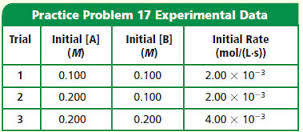


What is the rate law for the reaction?
The rate of a reaction is dependent on the concentration of the reactants
True
False
1 decreasing the concentration of hydrochloric acid
2 decreasing the particle size of calcium carbonate
3 decreasing the temperature


Pick the TWO (2) options that will INCREASE the rate of a reaction.
Reducing Heat
Adding Catalyst
Adding Heat
Removing Catalyst
Encouraging words, moral support, and a positive attitude

Which of the following graphs would confirm that the decomposition of hydrogen peroxide was first order with respect to the concentration of hydrogen peroxide?
A
B
C
D

Given the data for: F2(g) + 2ClO2(g) -> 2FClO2(g)
What is the initial rate law?
r=k[F2][ClO2]
r=k[F2]2[ClO2]
r=k[F2][ClO2]2
r=k[F2]2[ClO2]2
Given r = k[BrO3-] [Br-] [H+]2; what is the overall order of reaction?
0
1
2
3
4

Using this data, what is the order of reaction with regards to chlorine?
0
1
2
3

What is the order of reactant with respect to H2?
0
1
2
3
Camel
What is the order of reactant with respect to P4?
0
1
2
3
Camel
What is the order rate law constant (k) for this experiment?
1
34.4
3.88
.0291
.0427
What is the rate law for a reaction with only zero order reactants?
r=k[A]
r=k
r=k[A]2
r=k[A][B]
60 mph

