
NEW
Font size
 Worksheets
Natural Selection, Mutations, and Phylogenetic Trees
Total questions: 20
Worksheet time: 34mins
Which statement is NOT part of the concept of natural
selection?
Individuals that possess the most favorable variations will have the best chance of reproducing.
Variation occurs among individuals in a population.
More individuals are produced than will survive.
If an organism has a bad trait, it will grow the new
one and be ok. This way everything can survive.
The females of certain species of turtles will sneak into a nest of alligator eggs to lay their own eggs and then leave, never to return. When the baby turtles hatch, they automatically hide from the mother alligator guarding the nest and go to the nearest body of water when it is safe to do so. Which statement best explains the behavior of these baby turtles?
More of the turtles' ancestors who acted in this way survived to reproduce, passing this behavioral trait to their offspring.
The baby turtles are genetically identical, so they behave the same way.
Turtles are not capable of evolving, so they repeat the same behaviors generation after generation.
The baby turtles' ancestors who learned to behave this way taught the behaviors to their offspring
Certain insects resemble the bark of the trees on which they live. Which statement provides a possible biological explanation for this resemblance?
The insects needed camouflage so they developed protective coloration.
Natural selection played a role in the development of this protective coloration.
The lack of mutations resulted in the protective coloration.
The trees caused mutations in the insects that resulted in protective coloration.
The teeth of carnivores are pointed and are good for puncturing and ripping flesh. The teeth of herbivores are flat and are good for grinding and chewing. Which statement best explains these observations?
Herbivores have evolved from carnivores.
Carnivores have evolved from herbivores.
The two types of teeth most likely evolved as a result of natural selection.
The two types of teeth most likely evolved as a result of the needs of an organism.
Natural selection and its evolutionary consequences provide a scientific explanation for each of the following except
the fossil record
protein and DNA similarities between different
organisms
similar structures among different organisms
a stable physical environment

The graph shows the percent of variation for a
given trait in four different populations of the same
species. The populations inhabit similar environments.
In which population will the greatest number of
individuals most likely survive if a significant
environmental change related to this trait occurs?
1
2
3
4

The illustration shows an insect resting on
some green leaves.
The size, shape, and green color of this insect are
adaptations that would most likely help the insect to
compete successfully with all birds
make its own food
hide from predators
avoid toxic waste materials

The diagram shows the effect of spraying a pesticide on a population of insects over three generations.
Which concept is represented in the diagram?
survival of the fittest
dynamic equilibrium
succession
extinction

The diagram represents four different species of wild birds. Each species has feet with different structural adaptations.
The development of these adaptations can best be explained by the concept of
inheritance of resistance to diseases that affect all these species
inheritance of characteristics acquired after the birds hatched from the egg
natural selection
selective breeding
Mutations are a change in what?
DNA
tRNA
protein
rRNA
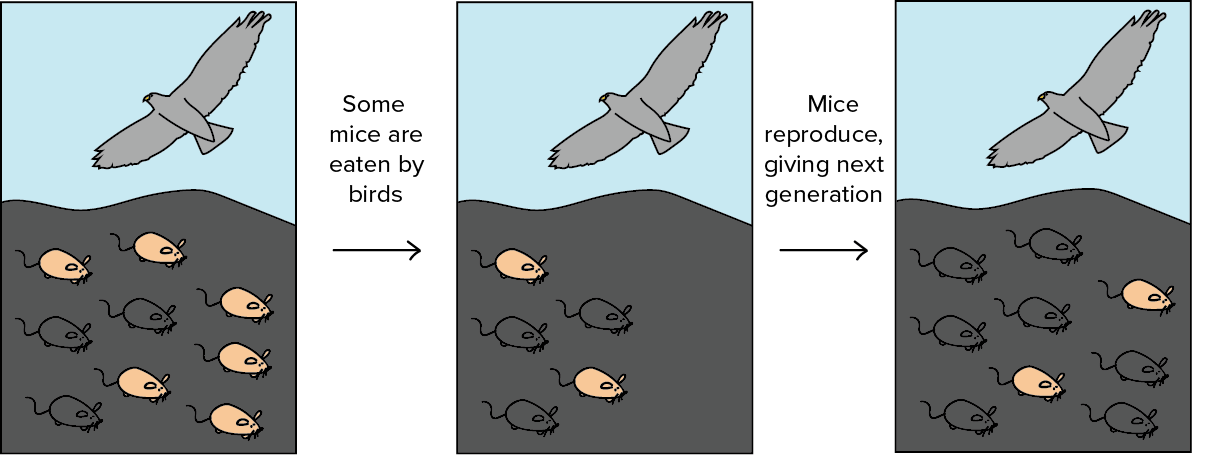
Which best describes the role of mutations in natural selection?
Mutations help an organism to better survive in their environment
An organism may acquire a helpful mutation by interacting with the environment
A mutation may result in a beneficial trait that makes an organism more likely to survive and reproduce
Organisms with certain traits are more likely to win competitions for mutations
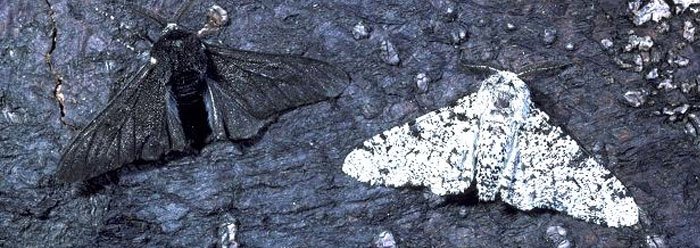
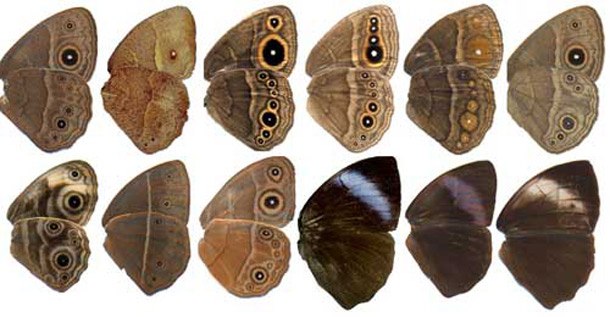

Which group of animals on this tree are most closely related to birds?
Saurischian dinosaurs
Ornithischian dinosaurs
Crocodiles
None of these are related to birds

What number is the common ancestor of C and D
1
2
3
4
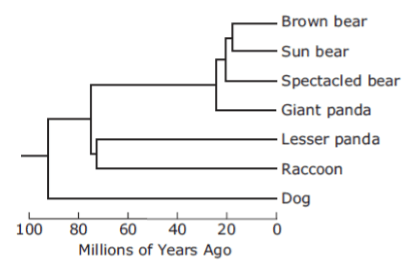
Who is the closest relative to the brown bear?
Giant panda
Dog
Lesser panda
Sun bear
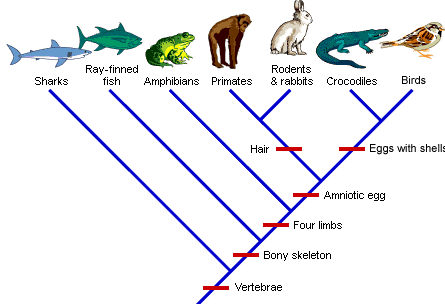
According to this cladogram, primates are most closely related to....
Amphibians
Rodents & rabbits
Crocodiles
Birds
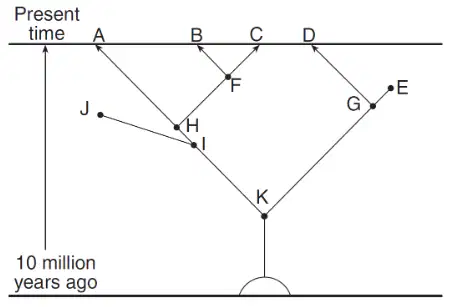
Which species are least likely to be vital parts of a present-day ecosystem?
A and E
C and D
E and J
B and F

