wayground logo

Free Printable Worksheets

NEW

Font size

S
M
L
XL
Worksheets

Enzymes GCSE

Total questions: 17

Worksheet time: 15mins

Name
Class
Date
1.

Enzymes are an example of

a)

Lipids

b)

Carbohydrate

c)

Protein

d)

Nucleic Acid

2.
What is the purpose  of an enzyme?
a)
give permission for the reaction
b)
raise activation energy
c)
speed up reactions
d)
control how many reactions occur
3.
Each enzyme only has 1 substrate that will fit its active site.  What is this called?
a)
reusable
b)
catalyst
c)
specific
d)
fragile
4.
Any substance that is acted upon by an enzyme is called a(n)?
a)
Coenzyme
b)
Substrate
c)
Vitamin
d)
Polypeptide
5.
After the enzyme and substrate bind together and perform the reaction, what does the substrate become?
a)
a substrate
b)
an enzyme
c)
a product
d)
an active site
6.
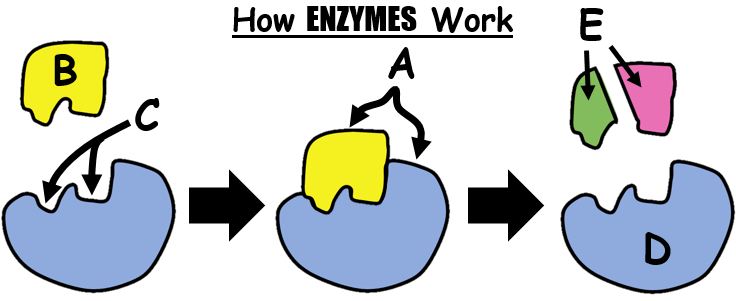
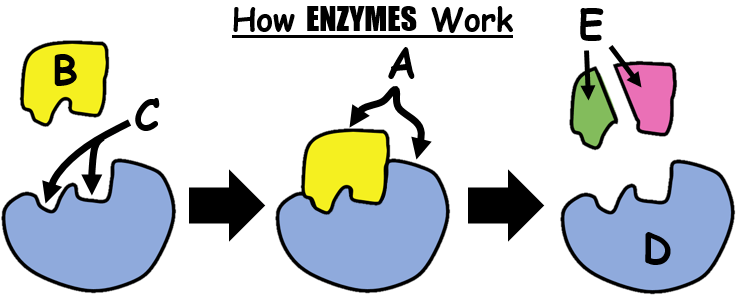
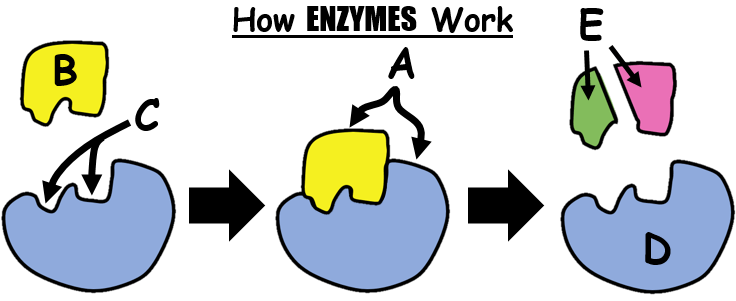
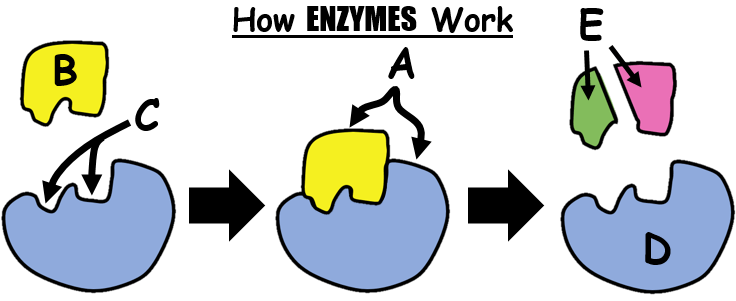
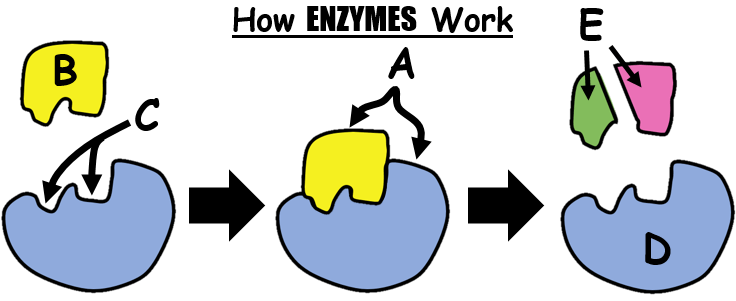
In the diagram, what is letter A? 
a)
product
b)
substrate
c)
enzyme-substrate complex
d)
active site
7.
Letter D...
a)
active site
b)
enzyme
c)
substrate
d)
products
8.
Letter B...
a)
active site
b)
enzyme
c)
substrate
d)
products
9.
Letter C...
a)
active site
b)
enzymes
c)
substrate
d)
products
10.
Letter E...
a)
active site
b)
enzyme
c)
substrate
d)
products
11.
Enzymes provide a site where reactants called substrates can be brought together in an enzyme-catalyzed reaction. The site is called the
a)
enzyme substrate complex.
b)
reaction site.
c)
active site.
d)
lock and key.
12.
An enzyme speeds up a chemical reaction in the cell but can only be used once.  True or False? 
a)
true
b)
false
13.

Which of the following best explains why enzymes are necessary for reactions in our cells?

a)

The reactions are too slow to meet the needs of the cell if enzymes are missing.

b)

Enzymes supply the oxygen necessary for the reactions.

c)

Enzymes change reactants from solid to liquid during the reactions.

d)

The reactions take up too much space in the cell if enzymes are missing.

14.

The ____________________ mechanism describes how each substrate must fit into the enzyme.

a)

lock and key

b)

hammer and nail

c)

jigsaw puzzle

d)

seesaw

15.

What is the purpose of an enzyme?

a)

control how many reactions occur

b)

raise activation energy

c)

give permission for the reaction

d)

speed up chemical reactions

16.

Once a new product leaves an enzyme, the enzyme is unchanged and ready for the next substrate. What is this called?

a)

fragile

b)

reusable

c)

specific

d)

catalyst

17.

Enzymes are _______________ that _____________________ chemical reactions by ____________ the amount of activation energy required to start the reaction.

a)

carbohydrates, slow down, lowering

b)

proteins, speed up, increasing

c)

lipids, speed up, lowering

d)

proteins, speed up, lowering