wayground logo

Free Printable Worksheets

Font size

S
M
L
XL
Worksheets

Evolution and Speciation

Total questions: 17

Worksheet time: 13mins

Name
Class
Date
1.
A flash flood carried a raft of Amazon ants away from their original population. There is enough distance between the two groups, that they will never meet in nature again. What type of reproductive barrier is this?
a)
behavioral isolation
b)
temporal isolation 
c)
gametic isolation
d)
geographic isolation 
2.
The term for the formation of new and distinct species over the course of evolution is...
a)
speciation
b)
biological species concept
c)
reproductive barrier
d)
natural selection
3.
What is a species? 
a)
A group of organisms that can mate with each other and produce fertile offspring. 
b)
A group of organisms that can mate and produce offspring even if those offspring are infertile.
c)
A group of organisms that genetically are very different from each other. 
d)
Indivual organisms that live in the same environment. 
4.
When reproductive barriers separate a population of a species in nature, the species no longer share a... 
a)
taxa
b)
gene pool 
c)
phylogenetic tree
d)
species 
5.
What evidence does speciation provide for the theory of evolution by natural selection?
a)
Speciation can show us that new species don't choose to adapt, but have changed due to diverging from an original species due to reproductive barriers.
b)
Speciation can show us that new biological species can come from divergence (separating) due to reproductive barriers.
c)
Speciation can show us that environmental changes & genetic variation play a role in the process of a new species diverging from an original species due to reproductive barriers. 
d)
All of the above fit!
6.
When has speciation occurred?
a)
When populations no longer look the same
b)
When populations no longer have the same frequency of alleles
c)
When populations are living in different environments
d)
When populations can no longer interbreed
7.

Evolution is best defined as:

a)

the process which organisms die.

b)

the process which organisms change over time.

c)

the process which organisms that are extinct become revived.

d)

the process which non-living things fossilize.

8.

The solidified remain or imprint of a once living thing are called:

a)

Fossils

b)

Homologous Structures

c)

Vestigial Structures

d)

DNA

9.

Adaptations are:

a)

physical or behavioral tendencies.

b)

physical or behavioral characteristics that help an organisms survive and reproduce.

c)

physical or behavioral characteristics that do not help the organism in any way.

d)

genetic mutations that have gone wrong.

10.
The diagram shows fossils in different rock layers. Which of these statements about the age of these fossils is most likely correct?
a)
Fossil A and C are the same age
b)
Fossil B is older than fossil C
c)
Fossils A is older than fossil B
d)
Fossil D is older than fossil C
11.
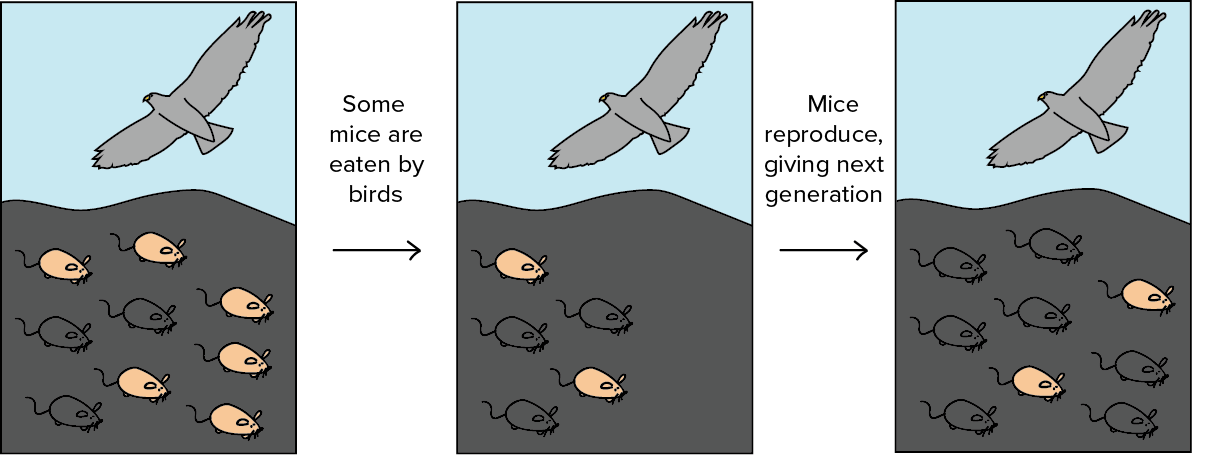
What process is being shown in this image?
a)
Variation
b)
Natural Selection
c)
Selective Breeding
d)
Homeostasis
12.
Why is the mouse population changing over time?
a)
The light mice can reproduce more successfully than the dark mice
b)
The hawks eat more dark mice than light mice because the dark mice taste better
c)
The hawks eat more light mice than dark mice because they can see the light mice more easily
d)
The hawks eat more dark mice than light mice because they can see the dark mice more easily
13.

What statement is true regarding why natural selection can be easily seen in insects and bacteria?

a)

Natural selection only occurs in prokaryotic cells

b)

Insects and bacteria can reproduce faster than more complex organisms and pass on selected traits quicker

c)

Insects were the first multi-cellular organism to live on land

d)

Bacteria have directly evolved from insect traits.

14.

Natural selection results in change in a population's _____________ traits over time.

a)

inherited

b)

acquired

15.

Which of the following is NOT an example of natural selection?

a)

People selectively breeding hamsters for size.

b)

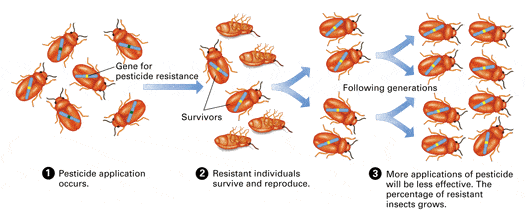
Insect populations developing resistance to certain pesticides.

c)

Bacteria becoming resistant to antibiotics.

d)

Male birds of certain species inheriting colorful feathers that are more attractive to females.

16.

How confident are you with this topic?

a)

Easy peasy, but more exam questions would be good!

b)

Its okay, but I need more practice with exam questions and Century.

c)

I haven't got a clue what is going on

17.

I am struggling with.....

4 lines