wayground logo

Free Printable Worksheets

NEW

Font size

S
M
L
XL
Worksheets

Unit 7: Waves Review Game

Total questions: 40

Worksheet time: 58mins

Name
Class
Date
1.
Waves that require a medium are called 
a)
mechanical waves
b)
transverse waves
c)
light waves
d)
gamma rays
2.
What happens when you increase the amplitude of a sound?
a)
it makes the sound louder
b)
it makes the sound travel faster
c)
it increases the wavelength of the sound
d)
it increases the frequency of the sound
3.

What kind of wave is pictured below?

a)

compressional wave

b)

transverse wave

c)

sound wave

d)

mechanical wave

4.
What can electromagnetic waves travel through?
a)
mediums
b)
empty space
c)
solely solids
d)
both mediums and empty space
5.
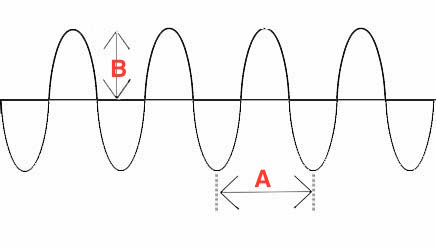
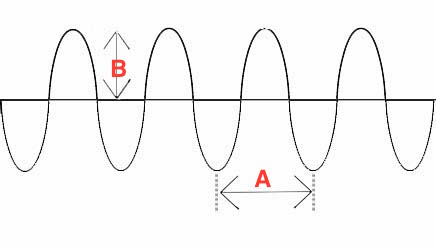
What property of this wave is represented by the letter "A"
a)
amplitude
b)
crest
c)
trough
d)
wavelength
6.
What property of the wave is represented by the letter "B"?
a)
amplitude
b)
crest
c)
trough
d)
wavelength
7.
What do waves carry from place to place?
a)
Energy, but not matter or particles
b)
Energy and matter or particles
c)
Matter or particles but not energy
d)
Neither energy nor matter or particles
8.
Which wave is pictured?
a)
Transverse
b)
Longitudinal
c)
Both
d)
Neither
9.
A wave carries...?
a)
energy only
b)
matter only
c)
energy and matter
d)
neither
10.
Which vocabulary term is used to identify the distance between points C & G?
a)
Amplitude
b)
Crest
c)
Frequency
d)
Wavelength
11.
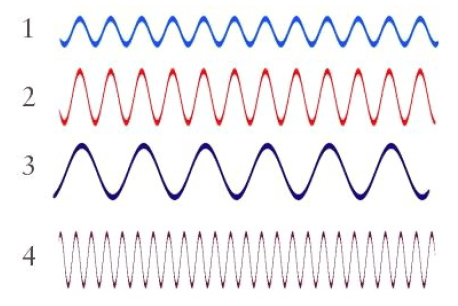
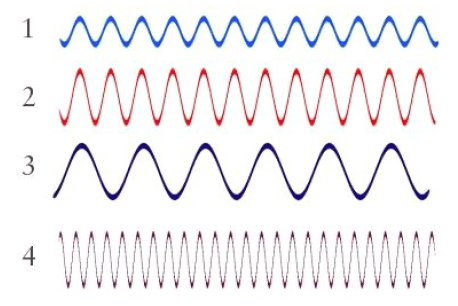
Which wave in the diagram has the greatest frequency?
a)
1
b)
2
c)
3
d)
4
12.
Which wave in the diagram has the greatest wavelength?
a)
1
b)
2
c)
3
d)
4
13.
Which of the following can sound travel through?
a)
solid
b)
liquid
c)
gas
d)
all of the above
14.
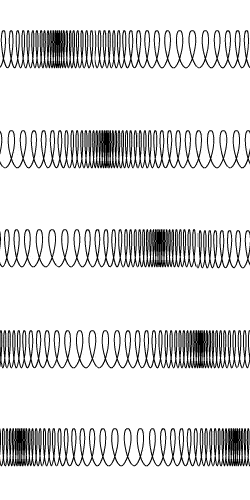
What type of wave is this?
a)
Longitudinal
b)
Transverse
15.

The highest point on a wave is:

a)

the crest

b)

the trough

c)

the top

d)

the coast

16.

You can't hear sounds in outer space because there is no

a)

medium

b)

light

c)

energy

d)

heat

17.
Which answer best explains what causes a wave?
a)
Shaking
b)
Potential energy
c)
Light
d)
Vibrations
18.

What is a wavelength?

a)

How many waves pass a certain point

b)

The distance from one wave crest to another

c)

The entire length of a wave

19.

Amplitude is the distance between

a)

the crest and the trough

b)

each wave

c)

the middle point of a wave and the clouds

d)

the crest or trough and the middle point of the wave

20.

What is the unit for frequency?

a)

Meters

b)

Hertz

c)

Decibels

d)

Meters/Second

21.
In what type of wave does the medium vibrate parallel to the direction of the wave?
a)
surface wave
b)
longitudinal wave
c)
transverse wave
d)
electromagnetic wave
22.
In what type of wave does the medium move perpendicular to the movement of the wave?
a)
Transverse
b)
Longitudinal
c)
Electromagnetic
d)
Radio
23.
Distance from an 'x' to an 'x' is a________
a)
wavelength
b)
amplitude
c)
rarefaction
d)
compression
24.
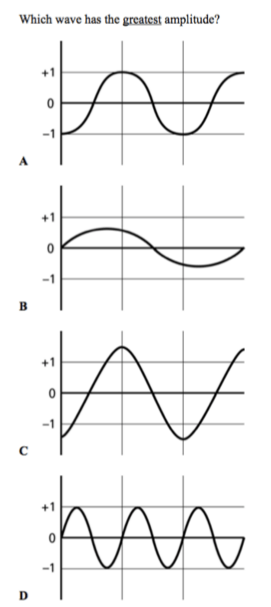
Which wave has the greatest amplitude?
a)
A
b)
B
c)
C
d)
D
25.

What is the amplitude of this wave?

a)

4

b)

8

c)

2

d)

6.3

26.
What is a medium?
a)
something between a small and a large?
b)
the substance through which a wave can travel
c)
a pattern of vibration that simulates when a wave is standing still
d)
the distance from any point on a wave to an identical point on the next wave
27.

High frequency waves make

a)

high pitch sounds

b)

low pitch sounds

c)

loud sounds

d)

soft sounds

28.

Birds chirping would be a _________________ sound.

a)

low pitch

b)

high pitch

c)

low frequency

d)

tall amplitude

29.

Amplitude tells you how much ______________ a wave is carrying.

a)

baggage

b)

weight

c)

energy

30.

Low frequency waves make

a)

high pitch sounds

b)

low pitch sounds

c)

loud sounds

d)

soft sounds

31.

Waves with tall amplitudes make

a)

high pitch sounds

b)

low pitch sounds

c)

loud sounds

d)

soft sounds

32.

Waves with tall amplitudes have ______________ than short waves.

a)

more energy

b)

less energy

c)

less volume

d)

more pitch

33.

A mouse squeaking would be a ________________ sound.

a)

low pitch

b)

high energy

c)

low energy

d)

tall amplitude

34.

Wave frequency affects

a)

the volume of a sound

b)

the loudness of a sound

c)

the pitch of a sound

d)

the amplitude of a sound

35.

Sound waves at a rock concert would have

a)

short amplitudes

b)

tall amplitudes

36.

Frequency is

a)

the height of a wave

b)

the length of a wave

c)

the number of waves in a given time

d)

the lowest point of a wave

37.

Sounds in a library would have

a)

high frequencies

b)

tall amplitudes

c)

short amplitudes

d)

big volumes

38.

When you increase the amplitude, you are

a)

increasing the volume

b)

decreasing the volume

c)

increasing the pitch

d)

increasing the frequency

39.

Sound waves are

a)

transverse

b)

longitudinal

c)

electromagnetic

40.
The type of waves that require medium to pass:
a)
Mechanical Waves
b)
Electromagnetic Waves