
 Worksheets
electrochemistry and corrosion
Total questions: 40
Worksheet time: 28mins
What is reduction?
It is the gain of electrons.
It is the loss of electrons.
It is the creation of electrons.
It is the destruction of electrons.
What is oxidation?
It is the gain of electrons.
It is the loss of electrons.
It is the creation of electrons.
It is the destruction of electrons.
What is an anode?
It is the electrode where oxidation takes place.
It is the electrode where reduction takes place.
It is an aqueous solution containing an electrode.
It is the salt bridge that connects half-cells.
What is a cathode?
It is the electrode where oxidation takes place.
It is the electrode where reduction takes place.
It is an aqueous solution containing an electrode.
It is the salt bridge that connects half-cells.


What conditions are required for rusting?
water only
oxygen only
water and oxygen
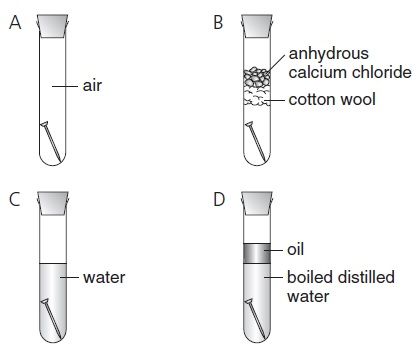
In which test tube would you expect the nail to rust the most?
A
B
C
D
Which of the following is true about an electrolyte?
I Electrolyte conducts electricity in molten state.
II Electrolyte conducts electricity in solid state.
III Electrolyte is soluble in water.
IV Electrolyte undergoes chemical decomposition when it conducts electricity.
I and II only
II and III only
II and IV only
I and IV only
Which of the following is not an electrolyte?
Molten glucose
Aqueous ammonia
Molten lead (II) bromide
Molten potassium iodide
Naphthalene does not conduct electricity because it
contains freely moving electrons.
has very low melting points.
consists of molecules which are uncharged particles.
contains ionic compounds which can dissolve in water.

What is formed at carbon electrode Q?
Hydrogen gas
Oxygen gas
Iron metal
Nitrogen gas
The electrolysis of aqueous sodium nitrate using carbon electrode was carried out in a lab. Which of the following is true about this experiment?
The sodium ions are discharged at the cathode.
The nitrate ions are discharged at the anode.
Hydrogen gas is produced in the anode
Oxygen gas is produced in the anode.

Diagram 4 shows the set-up of the apparatus used to electroplate an iron key with silver. What is the observation after 30 minutes?
I At anode, silver foil become thinner.
II At anode, shinny grey deposits are formed.
III At cathode, gas bubbles are released.
IV At cathode, shinny grey deposits are formed.
I and II only
II and III only
II and IV only
I and IV only

Which of the following is true about electroplating an iron key with copper?
A
B
C
D

Which of the following is true about the voltaic cell?
I The copper plate dissolves gradually.
II The zinc plate acts as negative terminal.
III The zinc plate become thinner.
IV Electrons flow from zinc plate to copper plate.
I, II and III only
I, II and IV only
I, III and IV only
II, III and IV only
Jenny wants to make her ring more beautiful and prevent corrosion. What is the best way to achieve this?
Dip the ring in oil.
Wash the ring with soap.
Plate the ring with gold.
Polished the ring with water.
Which of the following is not the example of electrochemical industries in our daily life?
Voltaic cells are used in different devices such as radio, hand phones, and others.
Electroplating of iron can prevent it from corrosion.
Chemical substance such as chlorine is used to produce toxic solution.
Extraction of useful metals such as aluminium using electrolysis.

Kind of cell in the picture
galvanic
electrolytic
Using iron as a cathode to prevent corrosion
cathodic protection
passivation
galvanization
coating
Salinity favors corrosion.
True
False

Kind of cell in the picture
electrochemical
voltaic
electrolytic
galvanic
Alkaline battery is an example of
primary cells
secondary cells
fuel cells
electrolytic cells
Name the two general classifications of corrosion.
Direct chemical attack and Electrochemical attack.
Fretting corrosion and Galvanic attack.
Rusting is a _____________ process.
Mechanical
Chemical
Physical
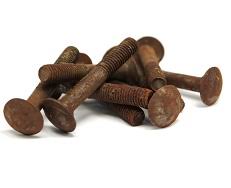
What two things cause Iron to Rust ?
Air and Oxygen
Oxygen and Water
Water and Carbon dioxide
Carbon dioxide and Air
Coating of Zn, Al and Cd on steel are _________ , because their electrode potentials are lower
Cathodic
Anodic
Not affecting
Expensive

What is the chemical formula for rust?
Fe2O5
FeO
Fe3O4
Fe2O3.H2O

When a vessel is exposed to moist air, it forms green coating on the surface. The vessel must be made of:
Zinc
Copper
Magnesium
Iron

Which of the following is NOT a method to prevent corrosion?
Electroplating
Crystallization
Alloying
Galvanization
The condition produced by aerial oxidation of fats and oils in foods marked by unpleasant smell and taste is called:
Antioxidation
Reduction
Corrosion
Rancidity

A substance added to food containing fats and oils to prevent rancidity is called:
Oxidant
Rancid
Codant
Antioxiant

Why potato chips manufacturers fill the packets of chips with nitrogen gas? (CBSE 2011)
To prevent chips from growing in size
To prevent insects from entering the packets of chips
To prevent chips from oxidation
To keep the chips crisp
Keeping food in .................. helps to slow down oxidation.
Wooden boxes
Air tight containers
Glass containers
None of these
Why does the voltage from a chemical cell that is connected in a circuit with a lamp eventually reach zero?
The lamp breaks
One of the reactants is used up
The circuit becomes broken
What happens to oxygen molecules in a hydrogen-oxygen fuel cell?
They react with electrons to form oxide ions, O2-
They react with hydrogen ions to form hydroxide ions, OH-
They react with hydrogen ions and electrons to form water
Who was the Father of Fuel Cells?
Thomas Grubb
William Grove
William Nicholson
William Jacques
Which type of fuel cell has electrolyte made of a liquid solution of lithium, sodium and potassium carbonates?
Molten-Carbonate
Solid Oxide
Phosphoric Acid
Direct methanol

Which one of the following would occur at the negative electrode of the cell as it generates electricity?

