
NEW
Font size
 Worksheets
KS4 Chemistry - Rates of Reaction
Total questions: 20
Worksheet time: 11mins
How does a catalyst work in speeding up a reaction?
By lowering the activation energy or reaction
by giving them more energy
by making them more available

Why does a higher concentration increase the rate of reaction?
it increases the amount of reactants
it lowers the activation energy
it increases the energy of particle collisions
it increases the frequency of particle collisions
Why does a higher temperature increase the rate of a reaction?
it increases both the frequency and energy of particle collisions
it only increases the frequency of particle collisions
it only increases the energy of particle collisions
it reduces the activation energy of the reaction
The minimum amount of energy needed for colliding particles to react is called
Chemical Energy
Kinetic Energy
Activation Energy
Potential Energy
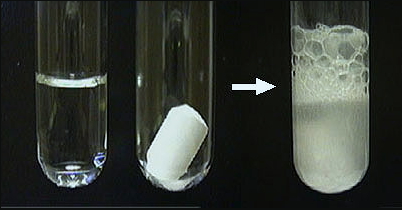
How could we make this reaction happen more quickly?
Decrease the concentration of the acid
crush the chalk to increase the surface area
Put the test tube in an ice bath
When surface area is decreased the rate of reaction...
Decreases, because there are LESS possible sites for correct collisions
Increases, because there are LESS possible sites for correct collisions
Decreases, because there are MORE possible sites for correct collisions
Increases, because there are MORE possible sites for correct collisions
Why does a higher concentration increase the rate of reaction?
it increases the amount of reactants
it lowers the activation energy
it increases the energy of reactant particles
it increases the frequency of collision
Increasing pressure causes the reacting particles
to bond together
to repel from each other
gain more kinetic energy
to move closer together
What is a catalyst?
A very fast moggie
A substance that increases the rate of a reaction and is used up
A substance that increases the rate of a reaction but is not used up
A substance that decreases the rate of a reaction and is not used up

On the diagram, which letter represents the activation energy for the reaction?
A
B
C

Which of the two reaction profiles shows the catalysed reaction?
A
B

Which of the curves indicates the fastest reaction?
A
B
C

Which of the curves indicates the slowest reaction?
A
B
C

