wayground logo

Free Printable Worksheets

NEW

Font size

S
M
L
XL
Worksheets

Chemistry Unit Test Review

Total questions: 35

Worksheet time: 12mins

Name
Class
Date
1.
The Periodic Table is arranged by _______ ____________.
a)
 Atomic Mass
b)
 Atomic Number
c)
  Atomic Volume
d)
  Atomic Symbol
2.

____________________ are substances formed from 2 or more different elements chemically combined.

a)

Electrons

b)

Atoms

c)

Mixtures

d)

Compounds

3.
_______________ are combinations of 2 or more atoms.
a)
Molecules 
b)
 Mixtures
c)
Solutions 
d)
Elements
4.
Which of the following is an example of a physical change?
a)
Metal Rusting 
b)
Toast Burning
c)
Ice Melting
d)
All are examples
5.
Which of the following provide evidence to support a chemical change?
a)
 Gas Production
b)
Color Change
c)
 Temperature Change
d)
 All are provide evidence  
6.
 What type of energy is the energy of motion?
a)
Thermal
b)
Kinetic 
c)
Nuclear
d)
Chemical
7.
Which of the following is an example of a chemical change?
a)
 Toast Burning 
b)
Ice Melting
c)
 Cutting Wood
d)
All are examples
8.
Which of the following is an example of a mixture?
a)
Trail Mix
b)
Baking Soda and Vinegar 
9.
 A ______________ has a definite volume and a definite shape.
a)
Solid
b)
Liquid
c)
Gas
10.
 A _____________can change volume very easily. Its particles move at high speeds in all directions. 
a)
Solid
b)
Liquid
c)
Gas
11.
 A _________________ has no shape of its own, but has a definite volume. 
a)
Solid
b)
Liquid
c)
Gas
12.
Anything that has mass and takes up space
a)
Element
b)
Pressure
c)
Matter
d)
Atom
13.
 You add or remove _________________________ to change the element. 
a)
Electrons
b)
Neutrons
c)
Atoms
d)
Protons
14.

The faster the particles move the more _________________________is generated.

a)

Cold

b)

Heat

c)

Sound

d)

Concentration

15.

What is sublimation?

a)

Gas---> Solid

b)

Solid---> Gas

c)

Solid---> Liquid

16.

Living and nonliving things are matter and are made of?

a)

Parts

b)

Carbon

c)

Elements

17.

The molecules of a _________ are the farthest apart.

a)

Gas

b)

Solid

c)

Liquid

18.

What is the smallest unit of an element that would still have all the properties of the element?

a)

Particle

b)

Molecule

c)

Atom

19.

When you heat them up, what happens to the space between particles

a)

The space decreases

b)

The space increases

c)

The space stays the same

20.

Particles of a liquid cannot be easily compressed like gases because they are already close together.

a)

True

b)

False

21.

Boiling is when_______

a)

Liquid becomes gas

b)

Gas becomes solid

c)

Solid becomes liquid

22.

Sugar dissolving in water is a

a)

Chemical Change

b)

Physical Change

23.

Which of the following is NOT an indicator of chemical changes?

a)

Unexpected color change

b)

Dissolving

c)

Light production

d)

Gas formation

24.
What are the 3 particles that make-up the atom?
a)
protons, neutrons, and isotopes
b)
neutrons, isotopes, and electrons
c)
positives, negatives, and electrons
d)
protons, neutrons, and electrons
25.

This diagram represents...

a)

An element

b)

A molecule

c)

A compound

d)

A mixture of elements and compounds

26.

To change from one state of matter to another state of matter is called?

a)

phase change

b)

potential change

c)

kinetic change

d)

thermal change

27.
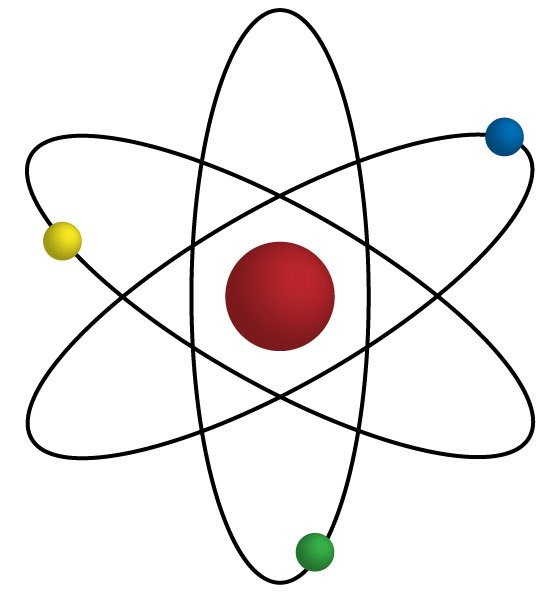
What does this image represent?
a)
Atom
b)
Element
c)
Molecule
d)
Marshmallows
28.

When the temperature of matter increases, the particles...

a)

speed up and move closer

b)

speed up and move farther apart

c)

slow down and move closer together

d)

slow down and move farther apart

29.
What is the total number of atoms in an ammonia (NH3) molecule?
a)
1
b)
2
c)
3
d)
4
30.

If there are 4 H atoms on the reactant side, how many H atoms will be on the product side?

a)

2

b)

4

c)

6

d)

8

31.
What is the left part of a chemical equation called?
2H2 + O2 --> 2H2O
a)
Reactants
b)
Products 
c)
Yields 
d)
Chemical Equation 
32.

What is the right part of a chemical equation called?

2H2 + O2 --> 2H2O

a)

Reactants

b)

Products

c)

Yields

d)

Chemical Equation

33.
The positive particles of an atom are 
a)
electrons 
b)
positrons 
c)
neutrons 
d)
protons 
34.

The central region of an atom where its neutrons and protons are is the...

a)

nucleus

b)

electron cloud

c)

core

d)

center

35.

What is the relationship between temperature and the kinetic energy (movement) of particles?

a)

As temperature increases, movement increases.

b)

As temperature increases, movement decreases.

c)

There is no relationship.