

wayground logo

Free Printable Worksheets

NEW

Font size

S
M
L
XL
Worksheets

化石复习 Fossils Review

Total questions: 30

Worksheet time: 24mins
Name
Class
Date
1.
The hardened remains of a living thing that died long ago.
a)
extinct
b)
cast
c)
fossil
d)
bone
2.
Which of the following is NOT an example of a fossil?
a)
a petrified dinosaur bone
b)
a footprint captured in mud
c)
a seashell found on the beach
d)
an insect stuck in amber
3.
In which kind of rock do we usually find a fossil?
a)
sedimentary  rock
b)
metamorphic rock
c)
igneous rock
d)
rock and roll
4.
In order for a fossil to form, which of the following events must happen FIRST?
a)
Slowly, minerals in the water replace the bone.
b)
Sediment covers the bone.
c)
An animal dies.
d)
The bone is no longer a bone, but a rock copy.
5.
A fossil animal has a mouth full of sharp, pointed teeth.  What can you infer about the animal?
a)
The animal ate fruits and vegetables.
b)
The animal is closely related to a shark.
c)
The animal did not live on land.
d)
The animal ate meat.
6.
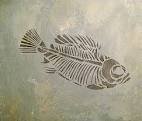
If scientists found this fossil, what could they infer?
a)
what fish are like today
b)
that this fish lacked oxygen
c)
what kind of animal ate this fish
d)
that water once covered the area
7.
Why do bones and teeth remain as part of some fossils?
a)
they are white
b)
bones are large
c)
the parts are hard 
d)
bones decay easily
8.
Fossils give us evidence about which of the following?
a)
plants and animals that lived long ago
b)
how weathering and erosion break down rocks
c)
the other planets in our solar system
d)
the transfer of energy from one form  to another
9.
How are fossils created?
a)
Traces of organisms get turned into stone.
b)
Dead organisms are quickly buried for millions of years.
c)
Animals get trapped.
d)
All of the above
10.
Which animal part would MOST LIKELY form a fossil?
a)
fur
b)
lung
c)
bone
d)
muscle
11.
Fossils can provide evidence of how life has changed over time, how Earth's surface has changed, and clues about what past environments were like.
a)
True
b)
False
12.
Because of all the trilobite fossils found in much of Utah we can infer that those areas were once coved by what?
a)
A volcano
b)
red rock
c)
A large shallow ocean
d)
ferns
13.
On top of Mt. Everest, there are fossilized remains of sea life; this tells us that the rocks at the top of world's highest mountain 
a)
used to be above sea level.
b)
used to be below sea level.
c)
came from an asteroid.
14.
Several wooly mammoth fossils have been found. Mammoths, which lived hundreds of thousands of years ago, were covered with thick fur.  Based on the evidence, mammoth fossils tell us that the area in which they are found - 
a)
has too many humans 
b)
no longer has large animals 
c)
was, at one time, very cold
d)
receives more rain that it used to 
15.

Petrified wood deposits found in Utah teach us that....

a)

Indians used wood to cook.

b)

Utah used to be a swampland.

c)

There was a big fire in the forest.

d)

Dinosaurs ate wood for dinner.

16.

How should the pictures be ordered to show a fossil forming in sedimentary rock?

a)

X, Z, W, Y

b)

X, Y, Z, W

c)

W, Y, Z, X

d)

W, X, Y, Z

17.

A student finds a fossil of a dinosaur bone. How did the dinosaur bone become a fossil?

a)

It was frozen in ice.

b)

It was preserved in amber.

c)

It was replaced by minerals.

d)

It left an impression in the sand.

18.

Fossil dinosaur tracks were found in Utah. Which sentence BEST describes how these fossils were formed?

a)

The dinosaurs left tracks in the mud that later hardened into rock.

b)

The dinosaurs' feet turned into rock over a long period of time.

c)

The dinosaurs were so heavy that they left tracks in the solid rock.

d)

The dinosaurs' feet were preserved in amber over time.

19.

Which conclusion is supported by the information in the table?

a)

Trilobite fossils are found in wetlands.

b)

Iron County was a coniferous forest in ancient times.

c)

Millard County was s hallow sea in prehistoric times.

d)

Tooele County had lots of trees with leaves in the past.

20.

In which box does "tropical and swampy" belong?

a)

Box 1, because Uintah County was tropical and swampy.

b)

Box 3, because swamps came before shallow seas.

c)

Box 4, because ferns lived in tropical, swampy environments.

d)

Box 2, because trilobites lived in tropical, swampy environments.

21.

In which counties would fossils of dinosaur footprints MOST LIKELY be found?

a)

Millard and Tooele

b)

Sanpete and Washington

c)

Summit and Uintah

d)

Uintah and Washington

22.

Which step completes the process of forming a fish fossil?

a)

The fish's bones are heated.

b)

The fish's bones are replaced by minerals.

c)

The fish's whole body is preserved by the mud.

d)

The fish's whole body freezes when the mud gets cold.

23.

The events are out of order. What is the sequence of events that would form dinosaur footprint in sandstone?

a)

3, 2, 1, 4

b)

2, 4, 1, 3

c)

2, 1, 4, 3

d)

4, 3, 2, 1

24.

Which picture of a fossil shows evidence of how an organism moved when it was alive?

a)
b)
c)
d)
25.

Which statement describes what is happening to the organism's remains?

a)

The remains leave no trace of the organism.

b)

The remains are transformed into soft tissues.

c)

The remains are fully preserved int eh organism's environment.

d)

The remains become rock as the sediments containing the organism are buried.
26.
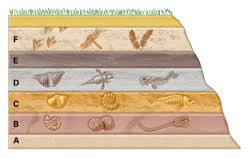
Which rock layer contains the newest fossils?
a)
F
b)
E
c)
B
d)
C
27.

Which of the following statements is correct about the image?

a)

The fossil in layer 3 is older than the fossil in layer 2.

b)

The fossil in layer 2 is younger than the fossil in layer 1.

c)

The fossil in layer 3 is older than the fossil in layer 1.

d)

The fossil in layer 1 is younger than both fossils in layers 2 and 3.

28.

Which layer is the oldest?

a)

siltstone

b)

conglomerate

c)

limestone

d)

mudstone

29.
A scientist says that layers Y and M are the same age. How does he know this?
a)
They are found in the same type of rock.
b)
They are the lowest layers.
c)
They have the same type of fossil.
d)
They are near each other.
30.
According to this fossil record. What type of environment was there first?
a)
land
b)
lava
c)
ocean
d)
forest
