Wayground logo

Free Printable Worksheets

Font size

S
M
L
XL
Worksheets

Unit 7 Waves Review

Total questions: 32

Worksheet time: 1hrs 4mins

Name
Class
Date
1.
All waves carry 
a)
energy
b)
water
c)
sound
d)
matter
2.
A period is
a)
Amount of time it takes a wavelength to complete one cycle.
b)
How many wave lengths happen in a second.
c)
An indication of the amount of energy in a wave.
d)
The distance between two crests or two troughs.
3.

The number of wave cycles that pass a point per second:
a)
frequency
b)
period
c)
longitudinal 
d)
transverse wave 
4.
Frequency is measured in
a)
Newtons
b)
Joules
c)
Hertz
d)
Decibels
5.
The highest point on a wave is:
a)
the crest
b)
the trough
c)
the top
d)
the coast 
6.
The lowest point on a wave is the:
a)
Amplitude
b)
Crest
c)
Trough
d)
Wavelength
7.

The distance between crest to crest or trough to trough is called?

a)
Wavelength
b)
Amplitude
c)
Wave Speed
d)
Frequency
8.

Diagram below shows a displacement-time graph of an oscillating spring.

The spring undergoes …

a)

damping

b)

resonance

c)

interference

d)

force oscillation

9.

When the disturbance of the wave is in the same direction as the path of the wave it is called a

a)

Transverse wave

b)

X ray

c)

Longitudinal wave

d)

Sound wave

10.

Which type of wave is being described? The particles move perpendicular to the direction of the wave.

a)

Microwave

b)

Longitudinal wave

c)

Transverse wave

d)

Light wave

11.
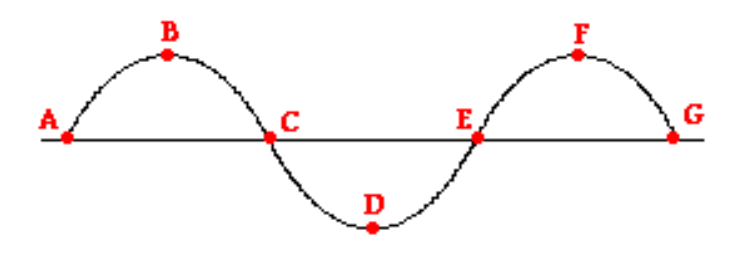
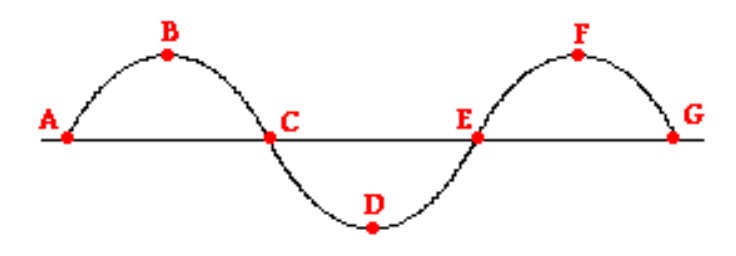
Which letter(s) represent the crest of the wave?
a)
A
b)
B & D
c)
B & F
d)
F
12.
Which letter(s) represent the trough of the wave?
a)
A
b)
B & D
c)
D
d)
C & G
13.
Which letter represents amplitude?
a)
A
b)
B
c)
C
d)
D
14.

What is the amplitude of the wave?

a)

3 cm

b)

8 cm

c)

16 cm

d)

24 cm

15.

What is the wavelength of the wave?

a)

3 cm

b)

8 cm

c)

16 cm

d)

24 cm

16.

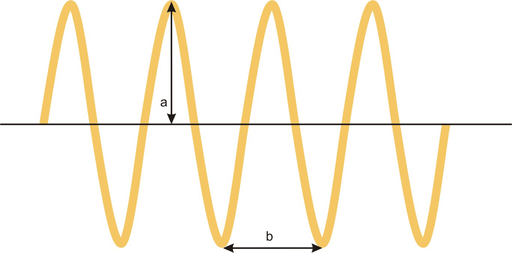
Which wave has the shortest wavelength?

a)

1

b)

2

c)

3

d)

4

17.
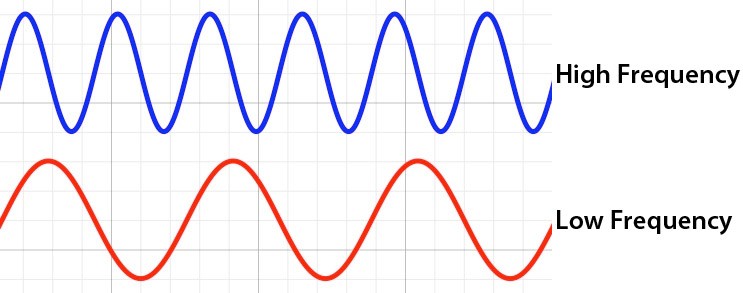
Which wave has a greater frequency?
a)
A
b)
B
18.

How many wavelengths are in this wave chain?

a)

8

b)

2

c)
4
d)

6

19.

†If 10 waves pass one point every 16.0 seconds, what is the period of the wave?

a)
10 Hz
b)

1.6 s

c)

0.625 s

d)

160 s

20.

The period of a wave is 4 seconds. What is the frequency?

a)

1/4 Hz

b)

1/4 sec

c)

4 Hz

d)

2 Hz

21.
When the frequency of a wave increases, what happens to the wavelength?
a)
The wavelength is not directly affected by the frequency of a wave.
b)
The wavelength increases.
c)
The wavelength decreases.
d)
More specific information is needed to form a conclusion about the wavelength.
22.

If you have low frequency waves, what that tell you about the wave energy?

a)

It is high.

b)

It is medium.

c)

It is low.

d)

Nothing

23.

A guitar string vibrates with a frequency of 320 hz. If the wavelength of the vibration is 0.23 meters what is the speed of the wave?

a)

320.23 m/s

b)

1391.3 hz

c)

73.6 m/hz

d)

73.6 m/s

24.

If a wave has a frequency of 0.4 Hz and a wavelength of 15 m what is its speed?

a)

0.2 m/s

b)

6 m/s

c)

32 m/s

d)

60 m/s

25.
A wave has wavelength of 10 m and a speed of 340 m/s. What is the frequency of the wave?
a)
34 m/s
b)
3400 Hz
c)
3400 m/s
d)
34 Hz
26.

A wave has frequency of 5 Hz and a speed of 25 m/s. What is the wavelength of the wave?

a)

25 m

b)

125 m

c)

5 m

d)

25 m/s

27.

A wave has a frequency of 4.0 Hz, if it is travelling at a speed of 20 m/s what is the wavelength of the wave?

a)

80 m

b)

16 m

c)

5 m

d)

0.2 m

28.
When two waves combine to form a new wave with a larger amplitude, it is called 
a)
Diffraction
b)
Destructive Interference
c)
Resonance
d)
Constructive Interference
29.
What phenomenon does this image demonstrate?
a)
Constructive interference
b)
Destructive interference
c)
Increasing frequency
d)
Increasing period
30.

The action of a wave bouncing off a surface is called _________.

a)

rarefaction

b)

refraction

c)

reflection

d)

diffraction

31.

When a wave bends as it passes through at an angle from one medium to another (example: pencil in a glass of water).

a)

medium

b)

refraction

c)

reflection

d)

interference

32.

The action of a wave bending around a barrier is called _________.

a)

reflection

b)

diffraction

c)

refraction

d)

rarefaction