
 Worksheets
Review of Waves
Total questions: 103
Worksheet time: 1hrs 25mins

absorption
diffraction
reflection
refraction
transmission

This image depicts which of the following wave behaviors?
Reflection
Refraction
Diffraction
Resonance

The two blue and purple waves will undergo _________________ when they meet.
Constructive interference
Destructive interference

Look at the diagram. At which positions will the overlapping waves have the most constructive interference?
Positions #1 & #5
Positions #2 & #3
Positions #3 & #4
Positions #4 & #5

What will be the result after these two waves overlap?
A taller wave
A shorter wave
A wave with no amplitude
3 waves

The distance traveled by a wave in one period is called?
Frequency
Period
Speed of wave
Wavelength
Amplitude
Which of the following is the speed of a wave traveling with a wavelength λ, frequency f, and period T?
v=fλ
v=λf
v=λ⋅f
v=f⋅T
v=Tf
The frequency of a wave is doubled when the wavelength remains the same. What happens to the speed of the wave?
It doubles
It quadruples
Remains unchanged
It is cut to one-half
It is cut to one-fourth
The frequency of a wave increases when the speed remains the same. What happens to the distance between two consecutive crests?
It increases
It decreases
Stays unchaged
It increases first and then decreases
It decreases first and then increases
Which of the following statements is true about transverse waves?
They always have the same frequencies
They always have the same velocities
They always have the same wavelengths
They always travel through a dense medium
The particles vibrate in perpendicular direction with respect to the wave motion
Which of the following statements is true about longitudinal waves?
They always have the same frequencies
They always have the same velocities
They always have the same wavelengths
They always travel through a dense medium
The particles vibrate along the same direction as the wave motion
A wave travels on a string of length L, linear density µ, and tension T. Which of the following is true?
The wave speed is inversely proportional to the tension T
The wave speed is directly proportional the linear density µ
The wave speed increases with increasing tension T
The wave speed increases with increasing linear density
The wave speed only depends on the length of the string

A wave pulse travels a long a thin part of a horizontal cord and reaches another part of the cord which is much thicker and heavier. Which of the following is true about the reflected and transmitted pulse by the boundary in the cord
Reflected Pulse: Upright; Transmitted Pulse: Upright
Reflected Pulse: Inverted; Transmitted Pulse: Inverted
Reflected Pulse: Upright; Transmitted Pulse: Inverted
Reflected Pulse: Inverted; Transmitted Pulse: Upright
Reflected Pulse: Zero Amplitude; Transmitted Pulse: Zero Amplitude

A wave pulse travels a long a heavy part of a horizontal cord and reaches another part of the cord which is much thinner and lighter. Which of the following is true about the reflected and transmitted pulse by the boundary in the cord
Reflected Pulse: Upright; Transmitted Pulse: Upright
Reflected Pulse: Inverted; Transmitted Pulse: Inverted
Reflected Pulse: Upright; Transmitted Pulse: Inverted
Reflected Pulse: Inverted; Transmitted Pulse: Upright
Reflected Pulse: Zero Amplitude; Transmitted Pulse: Zero Amplitude

Two wave pulses with equal positive amplitudes travel on a cord approaching each other. What is the result of the oscillations when the pulses reach the same point?
It is constructive interference with twice the amplitude
It is destructive interference with zero amplitude
It is constructive interference with slightly greater amplitude
It is constructive interference with the negative amplitude
The standing wave is produced

Two wave pulses one with a positive amplitude the other with equal negative amplitude travel on a cord approaching each other. What is the result of the oscillations when the pulses reach the same point?
It is constructive interference with twice the amplitude
It is destructive interference with zero amplitude
It is constructive interference with slightly greater amplitude
It is constructive interference with the negative amplitude
The standing wave is produced

What is the amplitude of oscillations?
0.5 cm
1 cm
2 cm
5 cm
20 cm
What is the wavelength of the wave?
0.5 cm
1 cm
2 cm
5 cm
20 cm

What is the amplitude of oscillations?
1 cm
2 cm
4 cm
6 cm
8 cm
What is the amplitude of oscillations?
1 cm
2 cm
4 cm
6 cm
8 cm
What is the wavelength of the wave?
1 cm
2 cm
4 cm
6 cm
8 cm

A stretched string of length L = 2 m resonates in two loops. What is the wavelength of the wave?
1m
2m
3m
4m
6m

A stretched string of length L = 6 m resonates in three loops. What is the wavelength of the wave?
1m
2m
3m
4m
6m

A stretched string of length 8 m vibrates at a frequency of 50 Hz producing a standing wave pattern with 4 loops. What is the speed of wave?
50 m/s
100 m/s
150 m/s
200 m/s
250 m/s

A guitar string resonates at a frequency of 500 Hz forming a standing wave pattern with 5 loops. What is the fundamental frequency?
100 Hz
200 Hz
300 Hz
400 Hz
500 Hz
A guitar string resonates at a fundamental frequency of 300 Hz. Which of the following frequencies can set the string into resonance?
30 Hz
100 Hz
400 Hz
500 Hz
600 Hz
What is being transferred with a wave?
medium
energy
matter
Chicken
Longitudinal waves have:
crests and troughs
crests and compressions
compressions and rarefactions
troughs and rarefactions
Transverse waves have:
crests and troughs
troughs and rarefactions
compressions and contractions
rarefactions and crests
What happens to the frequency of a wave when the amplitude is tripled?
the frequency is tripled
the frequency is a third of what it was
amplitude does not affect frequency
What would happen to the wavelength if the frequency was doubled?
the wavelength would be halved
the wavelength would be doubled
the wavelength would stay the same
frequency does not affect wavelength
What would happen to the frequency is the wavelength was tripled?
the frequency would be a third of what it was
the frequency would be 3 times larger
the frequency would stay the same
the wavelength does not affect the frequency of a wave

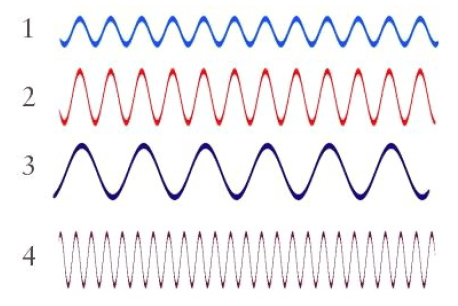
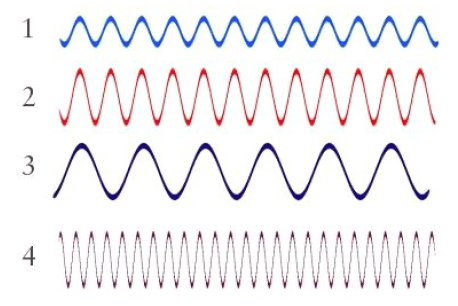

Standing waves are created by
Two identical waves reflecting off each other
Two identical waves being diffracted together
Two identical waves move through each other in opposite directions
Two identical waves are diffracted from two identical sources
In the diagram which letters represent the nodes
A B C
A C E
B D
B D E
A C D


How many antinodes does this standing wave have?
5
6
7
8
The first harmonic has
1 antinode
1 node
2 antinodes
no nodes
The second harmonic on a string fixed at both ends shows
A wavelength
Half a wavelength
Two wavelengths
The third harmonic on a string fixed at both ends shows
A wavelength and a half
Half a wavelength
Two wavelengths
A wavelength

The figure represents a string of length L, fixed at both ends, vibrating in several harmonics. Which string shows the 4th harmonic?
A
B
C
D
E

The figure represents a string of length L, fixed at both ends, vibrating in several harmonics. Which string shows the 3rd harmonic?
A
B
C
D
E

The figure shows several modes of vibration of a string fixed at both ends. The mode of vibration that represents the fifth harmonic is
1
2
3
4
None of these is correct.


How is the Electromagnetic Spectrum organized?
By Size and Power
Wavelength and Amplitude
Wavelength and Frequency
By Thermal Energy

What does the letter "V" represent on the wave.
Crest
Trough
Wavelength
Amplitude
What does the letter "U" represent on the wave.
Crest
Trough
Wavelength
Amplitude
What does the letter "M" represent on the wave.
Crest
Trough
Wavelength
Amplitude
What does the letter "N" represent on the wave.
Crest
Trough
Wavelength
Amplitude
A wave has frequency of 5 Hz and a speed of 25 m/s. What is the wavelength of the wave?
25 m
125 m
5 m
25 m/s


Which statement is correct about the wave shown in the diagram?
It is a transverse wave because the particles are moving perpendicular to the motion of the wave.
It is a transverse wave because the particles are moving parallel to the motion of the wave.
It is a longitudinal wave because the particles are moving perpendicular to the motion of the wave.
It is a longitudinal wave because the particles are moving parallel to the motion of the wave.
A guitar string vibrates with a frequency of 320 hz. If the wavelength of the vibration is 0.23 meters what is the speed of the wave?
320.23 m/s
1391.3 hz
73.6 m/hz
73.6 m/s


Compared to wave A, which wave has the same wavelength but a smaller amplitude?
only B
only C
only D
both B & C
Compared to wave A, which wave has a shorter wavelength but the same amplitude?
only B
only C
only D
both B & C
Which wave has the same frequency as wave A?
only B
only C
only D
both B & C
Compared to wave A, which waves have greater frequencies?
B & C
B & D
C & D
all three waves

If the time for the wave train shown is 1 second, the period of the wave would be
¼ s
⅓ s
½ s
⅔ s
What is the wavelength of a wave that has a frequency of 3.7 Hz and a speed of 22 m/s?
0.2 meters
5.9 meters
81.4 meters
0.3 meters
The speed of sound at room temperature is 346 m/s. A sound wave has a frequency of 925 Hz. What is its wavelength as it travels?
2.7 meters
0.4 meters
320,050 meters
1.5 meters



