
 Worksheets
Lenses
Total questions: 100
Worksheet time: 5hrs 54mins

What type of image is formed?
virtual and inverted
virtual and upright
real and upright
real and inverted
How does a concave lens differ from a convex lens?
A convex lens is another way to describe a plane mirror; a concave lens is curved
A concave lens is curved inward on both sides; a convex lens is on only one side
A convex lens has a thick center and thin edges, a concave lens has a thin center and thicker edges
A convex lens has a thin center and thick edges. a concave lens has a thick center and thinner edges

A concave lens has an inward curved shape. It refracts light outward from the lens. They light rays spread apart as they exit the lens. Which represents a concave lens?
A
B
A and B
neither A or B
A ____ lens is sometimes called a converging lens because it_____.
convex; makes parallel light rays curve outward or diverge
concave; makes parallel light rays travel at a faster speed than before they encountered the lens
convex, makes parallel light rays passing through it bend inward and meet (converge) at a spot just beyond the lens known as the focal point.
concave; makes parallel light rays passing through it bend inward and meet (converge) at a spot just beyond the lend known as the focal point.

When light waves move from passing through air to passing through a glass lens when happens to them?
They slow down and change direction
They speed up and change direction
They maintain the same speed and change direction
They maintain their same speed and direction

A thin converging lens is used to produce, on a screen, a focused image of a candle:
The screen and the lens are moved back and forth and various focused images are produced on the screen.
Which statement is always true?
The image is at the principal focus (focal point) of the lens.
The image is bigger than the object.
The image is closer to the lens than the object is.
The image is inverted.

A parallel beam of light falls on a converging lens. Which diagram shows what happens to the beam of light?
A
B
C
D

In the diagram, the distance OP is the focal length of the lens. Through which point will the ray shown pass, after refraction by the lens?
A
B
C
D

An object is placed in front of a converging lens. The lens has a focal length f. The lens produces a real, enlarged image of the object. In which labelled position is the object placed?
A
B
C
D

A student draws a diagram representing three rays of light from point P passing through a converging lens. Each point labelled F is a principal focus of the lens:
Which of the rays has the student drawn correctly?
Ray X and ray Y
ray X and ray Z
ray Y only
ray Z only

The diagram shows a converging lens forming an image of an object:
Which statement about the image is correct?
It is real and can be seen by an eye at X.
It is real and can be seen by an eye at Y.
It is virtual and can be seen by an eye at X.
It is virtual and can be seen by an eye at Y.

A student starts to draw a ray diagram for an object at O, near a thin convex lens, but is not sure
whether the image is formed at X or at F:
The correctly drawn image is
real and formed at F
real and formed at X
virtual and formed at F
virtual and formed at X

Which letter represents the angle of incidence?
A
B
C
D

What is the angle of reflection?
650
500
250
400
What type of image is formed?
virtual and inverted
virtual and upright
real and upright
real and inverted
How does a concave lens differ from a convex lens?
A convex lens is another way to describe a plane mirror; a concave lens is curved
A concave lens is curved inward on both sides; a convex lens is on only one side
A convex lens has a thick center and thin edges, a concave lens has a thin center and thicker edges
A convex lens has a thin center and thick edges. a concave lens has a thick center and thinner edges
A concave lens has an inward curved shape. It refracts light outward from the lens. They light rays spread apart as they exit the lens. Which represents a concave lens?
A
B
A and B
neither A or B
What do a prism, a magnifying glass, a microscope, and eyeglasses ALL have in common.
They are opaque
They refract light
They reflect light
That are translucent
A ____ lens is sometimes called a converging lens because it_____.
convex; makes parallel light rays curve outward or diverge
concave; makes parallel light rays travel at a faster speed than before they encountered the lens
convex, makes parallel light rays passing through it bend inward and meet (converge) at a spot just beyond the lens known as the focal point.
concave; makes parallel light rays passing through it bend inward and meet (converge) at a spot just beyond the lend known as the focal point.

An object is located 35.0 cm from a convex lens. The lens forms a real image at a distance of 15.0 cm. What is the focal length?
0.0953 cm
10.5 cm
26.2 cm
0.0678 cm
An object 8.5 cm high is placed 28 cm from a converging lens. The focal length of the lens is 12 cm. Determine the height of the image.
*Hint: find di first
6.38 cm
8.5 cm
12cm
21 cm


What type of lens do you have in your eye?
Concave
Prismatic
Objective
Convex
A concave lens has an inward curved shape. It refracts light outward from the lens. They light rays spread apart as they exit the lens. Which represents a concave lens?
A
B
A and B
neither A or B
How does a concave lens differ from a convex lens?
A convex lens is another way to describe a plane mirror; a concave lens is curved
A concave lens is curved inward on both sides; a convex lens is on only one side
A convex lens has a thick center and thin edges, a concave lens has a thin center and thicker edges
A convex lens has a thin center and thick edges. a concave lens has a thick center and thinner edges
When light waves move from passing through air to passing through a glass lens when happens to them?
They slow down and change direction
They speed up and change direction
They maintain the same speed and change direction
They maintain their same speed and direction

Which is the focal point?
A
B
C
D
The focal length is...
the distance from the light source to the image.
the distance from the object to the centre of the lens.
the distance from the image to the centre of the lens.
the distance from the focal point to the centre of the lens.
Which of the following is true?
The image distance obtained from a far away object is the focal length of the convex lens.
The images obtained from a convex lens always lie on the focal point.
The images obtained by a convex lens are always real.
The images obtained by a convex lens are always inverted.

What are the characteristics of the image produced?
virtual
enlarged
inverted
upright
real

What are the characteristics of the image produced?
real, inverted and diminished
real, inverted and enlarged
virtual, upright and enlarged
no image formed

What are the characteristics of the image produced?
(a)

Where is the position of the converging lens?
A
B
C
D
A camera uses a converging lens to produce an image on the film. If the focal length of the lens is 10 cm, where should an object be placed from the camera for photo taking?
10 cm
15 cm
20 cm
100 cm
A photocopy machine uses a converging lens to focus images for printing on papers. If the focal length of the lens is 6 cm, what is the distance from the original copy to the lens during photocopying?
2 cm
6 cm
10 cm
12 cm
A converging lens is used to magnify a virtual image to four times its original size. Given that the focal length of the converging lens is 20 cm, what is the object distance?
5 cm
10 cm
15 cm
25 cm
A student determine the focal length of a device ‘X’ by focusing the image of a distant object on a screen placed 20 cm from the device on the same side as the object. The device ‘X’ is
concave lens of focal length 10 cm
convex lens of focal length 20 cm
concave mirror of focal length 10 cm
concave mirror of focal length 20 cm
In which of the following, the image of an object placed at infinity will be highly diminished and point sized?
Concave mirror only
Convex mirror only
Convex lens only
Concave mirror, convex mirror, concave lens and convex lens

Which of the following ray diagrams is correct for the ray of light incident on a lens shown in Fig. 10.7?
Figure A
Figure B
Figure C
Figure D
If the magnification of a lens has negative value, the image is:
A) virtual B) real C) inverted D) erect
Both A & C
Both B & D
Both A & D
Both B & C
Express the power of a concave lens of focal length 20cm with its sign.
5 D
-0.5 D
-5 D
0.5 D
If an object of size 5 cm is placed 20 cm from a lens and its image of same size is formed 20 cm from lens on other side, lens is :
Convex
Concave
Prism
Glass Slab
A lens of power 6 D is put in contact with a lens of power -4 D. The combination will behave like a:
Divergent lens of focal length 25 cm
Convergent lens of focal length 50 cm
Divergent lens of focal length 20 cm
Convergent lens of focal length 100 cm
If image formed by a lens is always diminished and between F and O then the lens is:
Concave
Convex
Both A and B
None of these
A spherical mirror and a thin spherical lens have each a focal length -15 cm. The mirror and the lens are likely to be
the mirror is concave and the lens is convex
both concave
the mirror is convex but the lens is concave
both convex.
An object is placed 25 cm away from a convex lens of focal length 20 cm. Where will the image be formed?
Same side as the object
Between 20 cm and 40 cm on the other side of the lens
At a distance more than 40 cm on the other side of the lens
At 40 cm on the other side of the lens
Is a convex lens thicker or thinner in the middle?
Thicker
Thinner
A diverging lens is also known as a ____lens.
refracted
diffracted
convex
concave
What does the word "diverging" mean?
to spread apart
to come together
parallel
perpendicular
A converging lens is also known as a ____ lens.
convex
concave
double
refracted
What does the word "converging" mean?
to separate
to come together
parallel
perpendicular
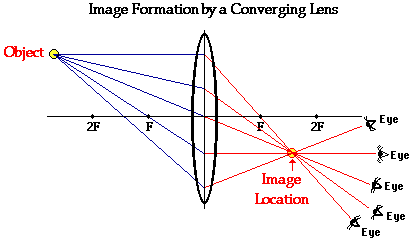
This image is.....
inverted and smaller
inverted and larger
not inverted and smaller
not inverted and larger
When an object is placed between the focal point and the convex lens, the image produced is ___.
real, reduced, and inverted
real, enlarged, and inverted
virtual, enlarged, and upright
virtual, reduced, and upright
An object is placed 20 cm from a convex lens of focal length 15 cm. What is the image distance and the nature of the image?
60 cm, real image
30 cm, real image
Image not formed
15 cm, virtual image
An object is located 35.0 cm from a converging lens. The lens forms a real image at a distance of 15.0 cm. What is the focal length?
0.0953 cm
10.5 cm
26.2 cm
0.0678 cm
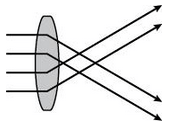
Which lens represents the path light takes through a diverging lens?


Which figure represents the path light takes through a converging lens?
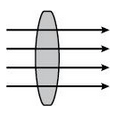
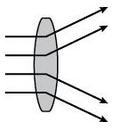
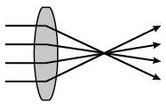

If an object is placed at a point 2F infront of a converging lens, Which of the following will describe the image correctly ?
Real
Inverted
Same Size
Beyond 2F

The diagram represents a converging lens forming an image of an object. Which of the following lines show the focal length of the lens?
PQ
PR
QR
QS

Which ray diagram shows a real image?


None of the above
A tree 20 m high is located 40 m from the converging lens of focal length 0.08 m.Calculate the distance from the lens to the image.
0.08 m
0.01 m
0.10 m
0.20 m
An object is located 35.0 cm from a converging lens. The lens forms a real image at a distance of 15.0 cm. What is the focal length?
0.0953 cm
10.5 cm
26.2 cm
0.0678 cm
An object is located 35.0 cm from a diverging lens. The lens forms an image at a distance of 15.0 cm. What is the focal length?
26.25 cm
10.5 cm
-26.25 cm
-10.5 cm

A person standing in front of a lens creates an image that is both smaller than the original and closer to the lens. Classify the image formed in this scenario.
real, inverted
real, upright
virtual, inverted
virtual, upright

The focal length of this lens is _______.
negative because it can form real images
positive because it can form real images
negative because it can form virtual images
could be positive or negative depending on the image formed

The above image is an example of a ____________. They happen because cool and hot air have a different ___________________________.
Mirage; angle of incidence
Optical fibre; refractive index
Lateral inversion; angle of reflection
Mirage; refractive index
When will total internal reflection occur?
When light travels from a less dense to a more dense medium
When the angle of incidence is smaller than the critical angle
When the angle of incidence is greater than the critical angle
When the light cannot pass through a medium

