wayground logo

Free Printable Worksheets

Font size

S
M
L
XL
Worksheets

Unit 10 & 11 Heat, Gas Laws

Total questions: 103

Worksheet time: 2hrs 3mins
Name
Class
Date
1.
Boyle's PV law : When _______ is held constant, the pressure and volume of a gas are ________  proportional
a)
temperature,  equally
b)
mass, inversely
c)
temperature, inversely
d)
mass, equally
2.
According to Boyle's law of PV, at constant temperature, as the pressure of a given sample of gas is increased, the volume will –
a)
Increase
b)
Decrease
c)
Remains the same
3.
If a balloon is cooled what will happen to the volume?
a)
Volume will increase
b)
Volume will decrease
c)
Volume will not change
4.
Which of the following would increase the (gas) pressure of a system?
a)
Increase the Temperature
b)
Pump in more gas
c)
Decrease the volume
d)
All of these
5.
Gases have...
a)
A definite shape and volume
b)
A definite shape but no definite volume
c)
No definite shape but a definite volume
d)
No definite shape or volume
6.
When the temperature of matter increases the particles...
a)
speed up and move closer
b)
speed up and move farther apart
c)
slow down and move closer together
d)
slow down and move farther apart
7.
Definite shape and a definite volume.
a)
Gas
b)
Liquid
c)
Solid
8.
In which state are the particles least able to move?  (Which is the solid?)
a)
State A
b)
State B
c)
State C
d)
None
9.
You have a gas that has a pressure of 2 ATM and a volume of 10L.  What would be the new volume if the pressure was changed to 1 ATM?
a)
5 L
b)
20 L
c)
It would stay at 10L
d)
1 L
10.
With pressure constant, the temperature of a gas is increased from 30oC to 90oC.  The volume will _____. (Be sure to convert to Kelvin first.)  
a)
 increase by about 20%
b)
 triple
c)
decrease by 1/2 
d)
remain the same
11.
A gas of volume V is placed in a balloon. The absolute (Kelvin) temperature is tripled. The volume will be _____ what it was originally. 
a)
1/3
b)
1/6
c)
3 times
d)
6 times
12.
Charles's law shows the relationship between which two factors of a gas ?
a)
volume and temperature 
b)
volume and pressure 
c)
pressure and volume
d)
volume and mass
13.
Boyle's Law shows the relationship between between which two factors of a gas?
a)
volume and pressure 
b)
temperature and pressure 
c)
pressure and temperature 
d)
Volume and mass
14.
Inversely proportional means as one value increases the other............. 
a)
increases 
b)
decreases 
c)
stays the same 
d)
goes to zero
15.
The word inverse means.......
a)
the same
b)
opposite 
16.
Boyle's law shows the volume and pressure of a gas are always ........
a)
inversely proportional 
b)
directly proportional 
17.
Charles's law shows that the temperature and volume of a gas are always........
a)
inversely proportional 
b)
directly proportional 
18.
Temperature describes  the ______________ of particles.
a)
volume
b)
mass
c)
motion
d)
conductivity
19.
When a basketball is left outside in the cold it goes flat because the volume of air inside the ball has been reduced. What  gas law does this represent?
a)
Boyle's Law
b)
Charles's Law
20.
a)
this is a graph representing Boyle's law
b)
this is a graph representing Charles's law
21.
a)
This is an example of Charles's law
b)
This is an example of Boyle's law
22.
Boyle's law :  The pressure and volume of a gas show a _____ relationship. 
a)
No relationship 
b)
Direct 
c)
Inverse 
d)
Equal
23.

What is the pressure of a car tire that had an initial pressure of 1.8 atm but was heated from 38°C to 123°C?

a)

0.9 atm

b)

2.1 atm

c)

1.6 atm

d)

3.4 atm

24.

If a hairspray can is heated, what can be expected of the pressure of the gas inside the can?

a)

The pressure will increase

b)

The pressure will decrease

c)

The pressure will remain constant

d)

The pressure will equalize

25.
In order to convert to Kelvin, you add ______ to the Celsius measurement.
a)
372
b)
273
c)
237
d)
732
26.
What is 50 °C in Kelvin?
a)
223
b)
323
c)
100
d)
50
27.
Charles' Law States...
a)
As Pressure goes up volume goes down
b)
As Pressure goes up temperature goes up
c)
As Volume goes up temperature goes up 
d)
As Pressure goes down volume goes down 
28.

Absolute zero is

a)

0 K

b)

where there is no molecular movement

c)

the coldest temperature possible

d)

all of these

29.

A sample of gas with a volume of 30.0 mL at 25.0oC is heated to 50.0oC. What is the new volume of the gas?

a)

60.0 mL

b)

15.0 mL

c)

27.5 mL

d)

32.5 mL

30.
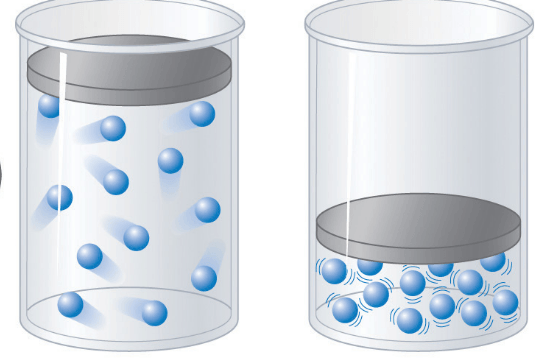
Which container will have lower pressure?
a)
left
b)
right
c)
they both have the same pressure
31.

What describes the motion of a Gas Molecule?

a)

Molecules are far apart

b)

Move in constant, random motion

c)

It will travel in a straight path

d)

All of the above

32.
The following graph shows ____ relationship. 
a)
Direct
b)
Inverse
33.
Boyle's law :  The pressure and volume of a gas show a _____ relationship. 
a)
Inverse 
b)
Direct 
34.

Calculate the new temperature when 6.00 L at 20.0 °C is compressed to 4.00 L.

a)

195

b)

0.00512

c)

440

d)

0.00228

35.

A container containing 5.00 L of a gas is collected at 100 K and then allowed to expand to 20.0 L. What must the new temperature be in order to maintain the same pressure (as required by Charles' Law)?

a)

400

b)

1492

c)

25

d)

1

36.

A gas occupies 900.0 mL at a temperature of 27.0°C. What is the volume at 132.0°C?

a)

1215

b)

667

c)

135

d)

4400

37.

If 15.0 liters of neon at 25.0°C is allowed to expand to 45.0 liters, what must the new temperature be to maintain constant pressure?

a)

894

b)

99.3

c)

2.27

d)

75

38.

A sealed container has a pressure of 1.5 atm at 25°C. If the temperature is raised to 125°C, what will be the new pressure?

a)

2

b)

1.12

c)

7.5

d)

0.3

39.

Calculate the new temperature when a container of gas has a pressure of 795 mm Hg at 273 K and the pressure is lowered to 358 mm Hg.

a)

123

b)

606

c)

0.00165

d)

246

40.

A gas exerts a pressure of 145 kPa at 65°C. What will the new pressure be at 130°C?

a)

173

b)

122

c)

290

d)

72.5

41.

Which graph shows the correct relationship between the volume of a gas (V) and its absolute temperature (T), when pressure is held constant?

a)
b)
c)
d)
42.

The diagram below shows a gas with an initial pressure of 4.0 atm and a volume of 0.520L in a cylinder at a constant temperature. The gas expands inside the cylinder and pushes the piston up to a volume of 2.03L. What is the final pressure of the gas after the expansion?

a)

0.72 atm

b)

1.02 atm

c)

2.41 atm

d)

8.17 atm

43.

As the temperature of a gas is increased, the average kinetic energy of its molecules

a)

Decreases

b)

Increases

c)

Remains the same

44.

A rigid cylinder with a movable piston contains 50.0 liters of Hydrogen gas at 30.0° C with a pressure of 1.00 atmosphere. What is the volume of the gas in the cylinder at STP?

a)

45.05 L

b)

45.55 L

c)

54.09 L

d)

55.51 L

45.

Which state of matter has the least compressibility?

a)

Solid

b)

Liquid

c)

Gas

46.

A gas occupies a volume of 0.025 L at STP. At what temperature would the gas occupy a volume of 0.035 L if the pressure is held constant?

a)

195.0K

b)

312.2K

c)

320.5K

d)

382.2K

47.

Which graph represents the relationship between pressure and volume for a sample of an ideal gas at constant temperature?

a)
b)
c)
d)
48.

Which of the statements below are true of the substance represented in the diagram?

a)

The kinetic energy between the particles in container B is greater than the kinetic energy in container C.

b)

The substance in container C exhibits a greater amount of kinetic energy than the substance in container A.

c)

Container B has the highest number of particles.

d)

The particles in container B are moving at a greater speed than the particles in container C.

49.

The kinetic molecular theory assumes that the particles of an ideal gas

a)

are in random, constant, straight-line motion

b)

are arranged in a regular geometric pattern

c)

have strong attractive forces between them

d)

have collisions that result in the system losing energy

50.
When heat is added, particles in a solid, liquid or gas...
a)
Are not affected
b)
Move faster
c)
Move slower
d)
None of the above
51.
If the atoms of an object are moving fast, the temperature would be...
a)
High
b)
Low
52.
If you place a balloon in a freezer what happens to the size of the balloon?
a)
Doubles
b)
increases
c)
decreases
d)
stays still
53.
What is the equation for Charles' Law?
a)
P1V1=P2V2
b)
V1/T1=V2/T2
c)
V1/n1=V2/n2
d)
P1/T1=P2/T2
54.
What is the equation for Boyle's Law?
a)
P1V1=P2V2
b)
V1/T1=V2/T2
c)
V1/n1=V2/n2
d)
P1/T1=P2/T2
55.

Absolute zero is

a)

0 K

b)

where there is no molecular movement

c)

the coldest temperature possible

d)

all of these

56.
A balloon will pop in the atmosphere because..
a)
Pressure goes down volume goes up
b)
Pressure goes up volume goes down
c)
temperature goes down volume goes up
d)
volume goes down temperature goes down
57.
What type of relationship to pressure and volume have?
a)
direct
b)
inverse
c)
no relationship
d)
I don't know
58.
Which container will have a lower pressure?
a)
left
b)
right
c)
they both have the same pressure
d)
I don't know
59.
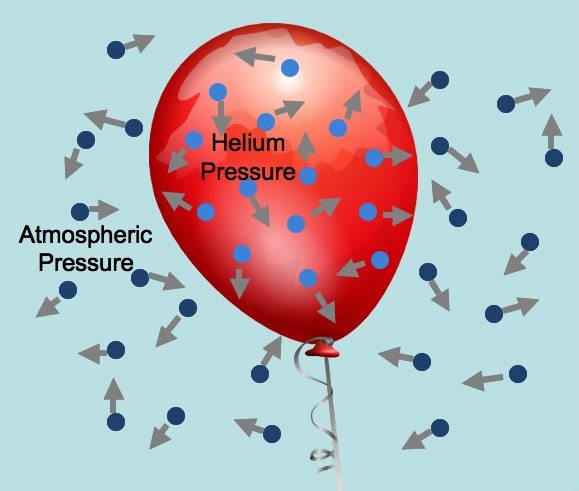
What causes pressure?
a)
The walls of the container
b)
The vacuum in the container
c)
The collisions of the particles
d)
Atmospheric pressure acting on the outside walls
60.
In Charles' Law the pressure remains constant.
a)
True
b)
False
61.
What does Boyle's law relate to?
a)
Temperature and Volume
b)
Volume and Pressure
c)
Temperature and Pressure
62.
What will happen to the volume of a gas if the pressure increases, with constant temperature ?
a)
Increase
b)
Decrease
c)
Nothing
d)
Explosion!
63.
What is 50 C in Kelvin?
a)
223
b)
323
c)
100
d)
50
64.
Gas laws involve what three variables?
a)
Solid Liquid Gas 
b)
Speed Velocity Acceleration 
c)
Elements Compounds Mixtures 
d)
Pressure Temperature Volume 
65.
The energy of an object as it is in motion is defined as
a)
Kinetic Theory
b)
Kinetic energy
c)
Potential energy
d)
Electric energy
66.

If you add gas particles to the container, what happens to the volume when the pressure and temperature is held constant.

a)

Increase

b)

Decrease

67.

Which of the following is NOT a unit of Pressure?

a)

mmHg

b)

atm

c)

kelvin

d)

psi

68.

Which Gas Law does this graph represent?

a)

Boyle's Law

b)

Charles' Law

c)

Avagodro's Law

d)

Combined Gas Las

69.

What is the formula for Boyle's Law?

a)

P1V1=P2V2

b)

P1V1/P2V2

c)

P1V2=P2V1

d)

P1/V1=P2/V2

70.
When Volume increases then Pressure must...
a)
Increase
b)
Decrease
71.

If a gas is measured to have a volume of 0.5atm at 273K, what would happen to the pressure if the temp increased to 300K?

a)

increase

b)

decrease

c)

remain the same

72.
What is the formula for Boyle's Law?
a)
P1V1=P2V2
b)
P1V1/P2V2
c)
P1V2=P2V1
d)
P1/V1=P2/V2
73.
Charles' Law States...
a)
As Pressure goes up volume goes down
b)
As Pressure goes up temperature goes up
c)
As Volume goes up temperature goes up 
d)
As Pressure goes down volume goes down 
74.
When a basketball is left outside in the cold it goes flat because the volume of air inside the ball has been reduced. What  gas law does this represent?
a)
Boyle's Law
b)
Charles's Law
75.
When the temperature of matter increases the particles...
a)
speed up and move closer
b)
speed up and move farther apart
c)
slow down and move closer together
d)
slow down and move farther apart
76.
What is the formula for Boyle's Law?
a)
P1V1=P2V2
b)
P1V1/P2V2
c)
P1V2=P2V1
d)
P1/V1=P2/V2
77.
What is the formula Charles' Law?
a)
V = T
b)
VT = VT
c)
T1 / V1 = T2 / V2
d)
V1 / T1 = V2 / T2
78.
What is the definition of CONDUCTION?
a)
When heat is transferred from objects like rays of light or electromagnetically.
b)
a  hot liquid or air that  expands, becomes less dense, and rises or becomes more dense, and sinks.
c)
When heat transfers from objects that are touching.
d)
When heat transfers through the heater or AC in your house.
79.
Thermal energy always moves from ___________ to __________.
a)
Hot to Hot
b)
Cold to hot
c)
Warmer to cooler
d)
Cooler to warmer
80.
The transfer of thermal energy between objects of different temperatures is called...
a)
temperature
b)
heat 
c)
none of these
81.
The faster molecules move, 
a)
the higher the temperature
b)
the less temperature
c)
the same temperature
d)
I don't know
82.

What is heat?

a)

a form of light

b)

a form of energy

c)

a measure of how old or cold something is

83.
What does temperature measure?
a)
Heat of Molecules
b)
ºC
c)
Average Kinetic Energy of Molecules
d)
Thermal Energy
84.
Specific heat is....
a)
The measure of kinetic energy of an objects particles
b)
A measure of the energy needed to increase the average kinetic energy of the particles
c)
The heating caused by the motion of flluid due to temperature difference
d)
The transfer of energy by electromagnetic radiation
85.
How does heat flow?
a)
Always from cold to warm
b)
Always from warm to cold
c)
Both warm to cold & cold to warm
d)
It depends on the temperature
86.
The amount of energy required to raise the temperature 1ºC for every kilogram is called____?
a)
Thermal Energy
b)
Specific Heat
c)
Temperature
d)
Kinetic Energy
87.
There are four cups of hot cocoa. The cup sizes are shown. The temperature of the cocoa in each cup is 25 degrees celsius. Which cup has the MOST thermal energy?
a)
Large cup (Trenta)
b)
Small cup (Tall)
c)
Medium cup (Venti)
d)
All three are the same temperature so they have the same thermal energy
88.
lowest possible temperature on the Kelvin scale
a)
boiling point
b)
insulation
c)
absolute zero
d)
heat
89.
Which of the following would be the best insulator?
a)
air
b)
aluminum
c)
copper
d)
silver
90.

Which will heat up slower?

a)

water

b)

lead

c)

granite

d)

iron

91.

Which will heat up faster?

a)

copper

b)

granite

c)

iron

d)

basalt

92.
If I heat up 2 pans of water one has 100 mL in it and one has 1000mL. Which one heats up the fastest?
a)
100 mL
b)
1000 mL
c)
They both heat up at the same speed
d)
They cool down.
93.

Which of the following best explains why the sand at the beach is hotter than the water?

a)

Sand has a higher specific heat than water.

b)

Sand has a lower specific heat than water.

c)

There is more water than sand at the beach.

d)

There is more sand than water at the beach.

94.
When a  piece of aluminum foil is taken out of the oven and cools from 100° to 50°, What is the change in temperature?
a)
50°
b)
c)
100°
d)
150°
95.
What would be the effect on the particles if more heat is supplied to the system?
a)
They would slow down
b)
They would stop moving
c)
They would speed up
d)
There would be no effect
96.
Copper, Stainless Steel, Carbon Steel, and Zinc were all heated using the same thermal energy.  What material would be the coolest after being heated?
a)
Copper
b)
Carbon Steel
c)
Zinc
d)
Stainless Steel
97.

Which material heats up slowest?

a)

Aluminium

b)

Concrete

c)

Diamond

d)

Glass

e)

Water

98.

Which will heat up faster?

a)

copper

b)

granite

c)

iron

d)

basalt

99.

Which will heat up slower?

a)

water

b)

lead

c)

granite

d)

iron

100.
How does heat flow?
a)
Always from cold to warm
b)
Always from warm to cold
c)
Both warm to cold & cold to warm
d)
It depends on the temperature
101.

The amount of energy required to raise the temperature 1ºC for every gram is called____?

a)

Thermal Energy

b)

Specific Heat

c)

Temperature

d)

Kinetic Energy

102.

The slower the particles move

a)

the lower the temperature

b)

the higher the temperature

c)

the greater the number of particles

d)

the lower the number of particles

103.

The average kinetic energy of the particles in an object.

a)

thermal energy

b)

temperature

c)

heat

d)

specific heat