wayground logo

Free Printable Worksheets

Font size

S
M
L
XL
Worksheets

Physics Regents

Total questions: 101

Worksheet time: 1hrs 16mins

Name
Class
Date
1.
Peanut ran 50 meters in 10 seconds.  What was Peanut's average speed?
a)
2 m/s
b)
5 km/h
c)
5 m/s
d)
5 m/s North
2.
If we drop a steel sphere and a ping pong ball, the steel sphere will...
a)
hit the ground first because it has more mass
b)
hit the ground second because it takes longer to accelerate 
c)
hit the ground at the same time as the ping pong ball 
3.
The force of __________________ is a type of friction that works against the motion of falling objects.
a)
Terminal Velocity
b)
Gravity
c)
Free Fall
d)
Air Resistance
4.

The greater the mass of an object,

a)

the easier the object starts moving.

b)

the greater its inertia.

c)

the more balanced it is.

d)

the more space it takes up.

5.

The momentum of an object is in the same direction as its

a)

force.

b)

velocity.

c)

acceleration.

d)

inertia.

6.

The overall force on an object after all the forces are added together is called the

a)

balanced force

b)

unbalanced force

c)

net force

d)

centripetal force

7.

The force of gravity between you and Earth is greater than the force of gravity between you and a car because Earth has more ____________________ than the car.

a)

mass

b)

density

c)

force

d)

friciton

8.

A skydiver with a mass of 70 kg accelerates to Earth at a rate of 9.8 m/s2 due to gravity. What is the force on the skydiver?

a)

79.8 Newtons

b)

7.14 Newtons

c)

0.14 Newtons

d)

68.60 Newtons

9.

The acceleration during the whole trip, on the horizontal component, is always...

a)

0 m/s2

b)

3.6 m/s2

c)

5 m/s2

d)

-9.8 m/s2

10.

In a projectile motion like the shown on the picture, the velocity with which the projectile hits the ground is...

a)

0 m/s

b)

the same as the initial velocity

c)

unknown

d)

9.8 m/s

11.
In the absence of air friction, the vertical component of a projectile's velocity doesn't change as the projectile moves. 
a)
True
b)
False
c)
Sometimes true
d)
Sometimes false
12.
At the instant a ball is thrown horizontally with a large force, an identical ball is dropped from the same height. Which ball hits the ground first? 
a)
Neither- they hit at the same time
b)
the horizontally thrown ball
c)
the dropped ball
d)
None of these
13.
If you throw a baseball straight up, what is its acceleration at the highest point?
a)
-9.8 m/s2
b)
-9.8 m/s
c)
0 m/s2
d)
0 m/s
14.

At what point is vy= 0 m/s?

a)

A

b)

B

c)

C

d)

D

e)

None of these points

15.

Which vector pair (arrow pair) correctly represents the acceleration and velocity at point P?

a)
b)
c)
d)
16.
A horse gallops around a circular arena.  The centripetal force on the horse is ___.
a)
directed outward
b)
tension
c)
directed toward the center of the arena
d)
9.8 N
17.
How much work is being done with 200 N of force over 426 meters?
a)
85,200 J
b)
45,620 J
c)
90,480 J
d)
62,329 J
18.
If 150 Joules of work is needed to move a box 10 meters, what force was used? 
a)
1500 N
b)
15 N
c)
1.5 N
d)
150 N
19.
What is the kinetic energy of a 9 kg book that has a speed of 4 m/s?
a)
18 J
b)
36 J
c)
72 J
d)
144 J
20.
What is the potential energy done in lifting a 50 kg barbell 6 m above the floor?
a)
150 J
b)
300 J
c)
1470 J
d)
2940 J
21.
At which point is potential energy greatest?
a)
W
b)
X
c)
Y
d)
Z
22.
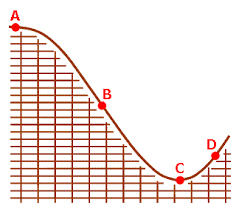
At which point(s) on the roller coaster is the kinetic energy at its maximum?
a)
A
b)
B
c)
C
d)
D
23.

All of these are forces except

a)

friction

b)

mass

c)

gravity

d)

inertia

24.

If an object changes its speed and direction it is

a)

changing

b)

moving

c)

accelerating

25.

What is Newton's 3rd Law?

a)

an object at rest stays at rest unless acted upon by an outside force and an object in motion will stay in motion unless acted upon by an outside force

b)

Force = mass x acceleration

c)

For every action there is an equal and opposite reaction

26.

The type of friction occurring when an object is not moving

a)

Static Friction

b)

Rolling Friction

c)

Air Friction

d)

Sliding Friction

27.
Heat always transfers from hot to cold. 
a)
True
b)
False
28.
The following number in scientific notation is
 0.0005621 = _____
a)
5.621 x 10⁴
b)
5.621 x 10⁻⁵
c)
5.621 x 10⁻⁴
d)
56.21 x 10²
29.

If two charges have an electric force F between them and one of the charges is doubled, the force will be:

a)

Halved

b)

The same.

c)

Doubled

d)

Quadrupled.

30.

If two charges have an electric force F between them and the distance between them is halved, the force will be:

a)

Halved

b)

The same.

c)

Doubled

d)

Quadrupled

31.

Definition: Crest

a)

The highest point of a transverse wave

b)

The lowest point of a transverse wave

c)

The center of a transverse wave

d)

The distance between two points on a wave

32.

What is the frequency of a wave?

a)

# of oscillations produced in a certain amount of time

b)

The distance the wave oscillates from it's resting position

c)

The lowest point of a transverse wave

d)

Resting point of a wave - no wave movement

33.

Definition: Wave

a)

Matter through which a wave travels

b)

A disturbance that transfers energy from one place to another

c)

The distance between two corresponding parts of a wave

d)

The lowest point of a transverse wave

34.

What type of matter can waves travel through?

a)

Solid

b)

Liquid

c)

Gas

d)

All of the Above

35.

There are two types of mechanical waves:

a)

EM and Compressional

b)

Compressional and Longitudinal

c)

Transverse and Longitudinal

d)

Transverse and Electromagnetic

36.

E/M is short for:

a)

Electromagician

b)

Electromatter

c)

Electromagnetic

d)

Electromagnificent

37.

Light waves are ____________ waves.

a)

Transverse

b)

Compressional

c)

Longitudinal

d)

Electromagnetic

38.

What is the only type of EM waves the human eye can see?

a)

Radio waves

b)

Light waves

c)

Visible light

d)

Gamma ray waves

39.

What is the Equation for Force applied to a Spring?

a)

Force applied to a Spring = Spring Constant x Extension

b)

Force applied to a Spring = Spring Constant / Extension

c)

Force applied to a Spring = Extension / Spring Constant

40.

What is the Equation for Wave Speed?

a)

Wave Speed = Wave Length x Frequency

b)

Wave Speed = Wave Length / Frequency

c)

Wave Speed = Frequency / Wave Length

41.

What is another Equation for Power?

a)

Power = Potential Difference x Current

b)

Power = Potential Difference / Current

c)

Power = Current / Potential Difference

42.
What is the energy equivalent of a mass of 0.026 kilogram? 
a)
2.34 x 10^ 15 J
b)
2.3 x 10^15 J 
c)
2.3 x 10^17 J
d)
2.34 X 10^17 J 
43.
A 500. Newton girl lifts a 10. newton box vertically upward a distance of 0.50 meter. The work done on the box.
a)
50. J
b)
5.0 J
c)
250 J
d)
2500 J 
44.
A 100.-kilogram cart accelerates at 0.50 meter per second squared west as a horse exerts a force of 60. newtons west on the cart. What is the magnitude of the force that the cart exerts on the horse?
a)
60. N
b)
50. N
c)
100 N 
d)
70 N 
45.
The effect produced when two or more sound waves pass through the same point simultaneously is called
a)
diffraction
b)
reflection
c)
refraction
d)
interference
46.
A gamma ray photon and a microwave photon are traveling in a vacuum. Compared to the wavelength and energy of the gamma ray photon, the microwave photon has a
a)
shorter wavelength and less energy
b)
shorter wavelength and more energy
c)
longer wavelength and less energy
d)
longer wavelength and more energy 
47.
An alpha particle consists of two protons and two neutrons. The alpha particles charge of +2 elementary charges is equivalent to 
a)
3.2 x 10^-19 C
b)
3.2 x 10^19 C
c)
8.0 x 10^-20 C
d)
1.2 x 10^19C 
48.
How much current flows through a 12 ohm flashlight bulb operating at 3 volts? 
a)
4.0 A
b)
3.0 A 
c)
.75 A
d)
.25A 
49.
a)
6 nodes and 5 antinodes
b)
4 nodes and 5 antinodes
c)
5 nodes and 6 antinodes
d)
6 nodes and 10 antinodes
50.
What is sued to measure voltage across a component?
a)
Resistor
b)
Ammeter
c)
Voltmeter
51.
As wire length gets longer, what happens to resistance?
a)
Increases
b)
Decreases
c)
It is not affected
52.
What is the net force?
a)
4.2 N left
b)
4.2 N right
c)
2.2 N left
d)
2.2 N right
53.
Which of these is evidence that a force has acted on an object?
a)
Change in the object's mass.
b)
A stationary object lying on the ground.
c)
Change in the direction of the object's motion.
d)
The object moving in a straight line at constant velocity.
54.
In which direction will the box accelerate?
a)
Down and to the left
b)
Up and to the right
c)
Up and to the left
d)
Down and to the right
55.
If there are two forces going in the same direction how would you find the net force?
a)
Subtract
b)
Add
c)
Neither
d)
Multiply
56.
We often say that g = -9.8 m/s2. The lowercase g represents:
a)
the speed of gravity
b)
the velocity of gravity
c)
the acceleration of gravity
d)
the force of gravity
57.
Fill in the blanks: _____ does not change from place to place, but _____ can change because of differences in the strength of gravitational pull.
a)
acceleration, weight
b)
weight, acceleration
c)
mass, weight
d)
weight, mass
58.
Gravity pulls an object down with 49 N of force and a rope pulls the object up with 50 N of force. What is the net force?
a)
1 N upward
b)
1 N downward
c)
0.98 N upward
d)
0.98 N downward
59.
There is a small amount of friction as the sled shown is pulled to the left. The friction points:
a)
up
b)
down
c)
left
d)
right
60.
What is the acceleration of a 50 kg object pushed with a force of 500 newtons?
a)
100 m/s2
b)
25,000 m/s2
c)
10 m/s2
d)
25 m/s2
61.
Newtons 1st law of motion states:
a)
An object in motion will stay in motion and an object in rest will stay in rest unless acted upon by and unbalance force.
b)
For every action there is an equal and opposite reaction. 
c)
Acceleration is produced when a force. acts on a mass. 
d)
The greater the mass  the greater the amount of force needed to change its motion. 
62.

A 75-kg wagon is being pulled in the horizontal direction by a 225-N force. There is a frictional force acting on the wagon of 38-N. What is the net force on this wagon?

a)

187-N

b)

112-N

c)

225-N

d)

38-N

63.

What does it mean for an object to be in equilibrium? Select ALL correct answers.

a)

It has no net force acting on it.

b)

The forces acting on the object all cancel out.

c)

The forces acting on an object balance out.

d)

The sum of all the forces acting on an object is 0.

e)

The object is ONLY at rest.

64.
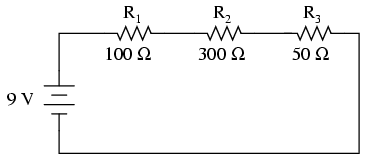
The picture shows an electrical circuit. This circuit is a series circuit because: 
a)
It has 3 light bulbs.
b)
The same current flows through all three light bulbs.
c)
It uses a single battery.
d)
The electrical current is divided between the three light bulbs.
65.
The total resistance in this circuit is 
a)
100 ohms
b)
450 ohms
c)
400 ohms
d)
30 ohms
66.
As the resistance of a circuit increases, the current will...
a)
increase
b)
decrease
c)
stay the same
67.
In a parallel circuit which of the following is the same value throughout the circuit?
a)
Voltage
b)
Current
c)
Resistance
d)
Charge
68.
What will happen if one light bulb is removed from this circuit?
a)
The other bulbs will go out.
b)
The other bulbs will stay on
c)
The other bulbs will get dimmer.
d)
The battery will become stronger.
69.

Are the magnetic field lines in the picture correct?

a)

Yes, because they point from north to south.

b)

No, because they point from north to south (they're supposed to go the other way).

c)

Yes, because the North pole is on the left in all pictures.

d)

No, because the North pole is on the left in all pictures (it's supposed to be on the right).

70.
Which of the following converts chemical potential energy to kinetic (mechanical) energy?
a)
human body
b)
car
c)
airplane
d)
all of the above
71.
What would happen if I move a bar magnet in and out of a coil of copper wire?
a)
Electric current would disappear 
b)
The magnet would explode 
c)
Electric current will flow through the wire
d)
It would produce a gravitational field
72.
What is created when a magnet moves through a coil of wire?
a)
A. an electromagnet
b)
B. a ferromagnet
c)
C. a solenoid
d)
D. an electric current
73.
Which of these has the highest energy?
a)
X-rays
b)
Gamma rays
c)
microwaves
d)
radio waves
74.
Which of these types of radiation moves the fastest?
a)
X-rays
b)
gamma rays
c)
visible light
d)
(all light moves at the same velocity)
75.

To calculate the frequency of an electromagnetic wave, you need to know the speed of the wave and its

a)

wavelength.

b)

intensity.

c)

refraction.

d)

amplitude.

76.

The full range of frequencies of electromagnetic radiation is called

a)

visible light.

b)

radio waves.

c)

the electromagnetic spectrum.

d)

invisible radiation.

77.

Light in the form of a particle that has discrete amount of energy is called a

a)

Charm

b)

Photon

c)

Exciton

d)

Muon

78.

How many quarks make up a proton?

a)

1

b)

2

c)

3

79.

Which particle has electric charge of - 1/3?

a)

a. top quark

b)

b.bottom quark

c)

c.gluon

d)

d.graviton

80.

Name given for the particles that have the same mass but all other properties are opposite.

a)

a.anti-matter

b)

b.anti-particle

c)

c.annihilate

d)

d.dark matter

81.

A particle that is made out of quarks is

a)

a. boson

b)

b. hadron

c)

c.lepton

d)

d.meson

82.

A baryon made out of two d quarks and one u quark (udd).

a)

a.proton

b)

b. neutron

c)

c. lambda

d)

d.omega

83.

Light acts like

a)

a wave.

b)

a particle.

c)

Both a wave and a particle

d)

neither a wave nor a particle.

84.

What is the longest wavelength in visible light?

a)

red

b)

orange

c)

blue

d)

violet

85.
A car travels 90 meters due north in 15 seconds. Then the car turns around and travels 40 meters due south.  What is the magnitude and direction  of the car's resultant displacement?  
a)
40 metres, South
b)
50 metres, South
c)
50 metres, North
d)
40 metres, North 
86.
In practice B of the figure, which displacement is the horizontal component?
a)
30 km, East
b)
30 km, West
c)
40 km, North
d)
40 km, South
87.
Which of these is not a vector quantity? 
a)
displacement 
b)
time
c)
velocity 
d)
acceleration
88.
A vector, 25 m/s at 113 degrees, will have a ___ horizontal velocity.
a)
positive
b)
negative
c)
zero
89.
Equal in magnitude, but 180 degrees opposite in direction to the resultant vector is the _____ vector.
a)
total horizontal component
b)
total vertical component
c)
equilibrant
90.
The time that a force acts on an object.
a)
Momentum
b)
Impulse
c)
Direct Relationship
d)
Indirect Relationship
91.
As one variable increases, so does another.
a)
Momentum
b)
Impulse
c)
Direct Relationship
d)
Indirect Relationship
92.
As one variable increases, the other decreases.
a)
Momentum
b)
Impulse
c)
Direct Relationship
d)
Indirect Relationship
93.

The coefficient of kinetic friction is ______ the coefficient of static friction

a)

Less than

b)

More than

c)

Equal to

d)

Unrelated to

94.

Which force acts along the inclined plane?

a)

parallel

b)

perpendicular

95.

What is the equilibrant vector for the arrows pictured

a)
b)
c)
d)
96.

What is the coefficient of kinetic friction for a box that is 215 kg being pushed with a force of 400 N at a constant velocity?

a)

0.2

b)

2

c)

5

d)

0.5

97.

If no forces are acting on an object, its motion will:

a)

continue in the same direction with the same speed.

b)

slow down and eventually stop.

c)

continue at the same speed but could change direction.

d)

continue in the same direction but could change speed.

98.

The graph shows the motion of a an object moving in a straight line. From the graph, you may conclude that:

a)

the object is accelerating at a constant rate of 3.5 m/sec2.

b)

the object is moving from left to right.

c)

the object is weightless as if it were in outer space.

d)

the total force acting on the object is zero.

99.

A 5 N force is applied to a 3 kg ball to change its velocity from +9 m/s to +3 m/s. The impulse on the ball is ______ N s.

a)

-2.5

b)

-10

c)

-18

d)

-45

100.
The difference between a car hitting a wall vs. a car hitting a hay stack is
a)
the Impulse on the car hitting the wall is greater
b)
the change in momentum of the car hitting the wall is greater
c)
the force on the car hitting the hay stack is greater
d)
the collision time of the car hitting the hay stack is greater
101.
The impulse-momentum theorem states that
a)
the impulse on an object is equal to the change in momentum it causes 
b)
the force on a moving object is equal to the magnitude of the impulse.
c)
the impulse on an object is greater than the change in momentum it causes 
d)
the impulse on an object is less than the change in momentum it causes