wayground logo

Free Printable Worksheets

Font size

S
M
L
XL
Worksheets

Cycle 5 Assessment

Total questions: 100

Worksheet time: 2hrs 36mins

Name
Class
Date
1.

1. Which of the following lists the order in which light waves travel SLOWEST to FASTEST?

a)

solid < liquid < gas

b)

gas < liquid < solid

c)

solid < liquid < gas < vacuum

d)

vacuum < gas < liquid < solid

2.

You jump into a pool and begin yelling underwater. As the sound wave passes from the water to the air, the sound wave will…

a)

Slow down

b)

Speed up

c)

stay the same speed

d)

the sound wave will not transfer to the air

3.

Review the diagram to answer the question.

What is the amplitude of the wave?

a)

2 cm

b)

3 cm

c)

4 cm

d)

6 cm

4.

Review the diagram to answer the question.

What is the period of the wave?

a)

0.1 s

b)

0.2 s

c)

1 s

d)

4 s

5.

Review the diagram to answer the question.

What is the speed of the wave?

a)

1.4 cm/s

b)

0.8 cm/s

c)

1 cm/s

d)

20 cm/s

6.

In order to change the speed of a wave, you must change the…

a)

wavelenght

b)

amplidude

c)

frequency

d)

medium in which the wave is traveling

7.

A musical note has a frequency of 512 Hz. If the wave is traveling with a speed of 351 m/s, what is its wavelength?

a)

179712 m

b)

1.45 m

c)

0.69 m

d)

863 m

8.

A wave is sent through a medium so that its particles vibrate at a 90˚ angle to the direction of wave propagation. The wave is a…

a)

a longitudinal wave

b)

either transverse or longitudinal

c)

a transverse wave

d)

none of the above

9.

Which of the following statements is correct about waves?

a)

electromagnetic waves can travel in matter but not in vacuum

b)

mechanical wave can travel in vacuum but not in matter.

c)

electromagnetic waves can travel both in matter and in vacuum

d)

mechanical waves can travel both in matter and in a vacuum.

10.

A train passes a stationary observer. Based on the Doppler Effect, the ________________ of the sound wave produced by the passing train appears to _________________ as the train moves AWAY from the observer.

a)

frequency; decreases

b)

amplitude; increases

c)

wavelength; decreases

d)

period; decreases

11.

Changing the frequency of a sound wave will affect the _____ while changing the amplitude will affect the _____.

a)

volume; pitch

b)

intensity; loudness

c)

pitch; volume

d)

energy; wavelength

12.

Which of the following best describes the path of light as it passes from diamond to air?

a)

light will continue along the same path

b)

light will slow down and bend away from the normal

c)

light will speed up and bend away from the normal

d)

light will speed up and bend towards the normal

13.

Which of the following BEST describes refraction?

a)

a wave bouncing off of a barrier in its path

b)

a wave bending around barriers in its path

c)

a wave changing frequency as it encounters a new material

d)

a wave bending as it travels at different speeds in materials of different densities

14.

Light passes from water (n=1.3) at an angle of 30˚ to the normal to glass (n=1.5). At what angle will light pass through the glass?

a)

26˚

b)

35˚

c)

43˚

d)

57˚

15.

Review the picture and answer Which of the following sets of wave behaviors of light is described by the figure?

a)

reflection & refraction

b)

interference & polarization

c)

interference & diffraction

d)

reflection & interference

16.

Which of the following is NOT an example of resonance?

a)

a tuning fork causing a second tuning fork of the same natural frequency to vibrate

b)

an opera singer causing a glass cup to break

c)

blowing air inside a trumpet to produce a sound

d)

water waves bending around a barrier

17.

Review the diagram and determine which of the following correctly shows the interference

between the two slinky waves to the right?

a)
b)
c)
d)
18.

When a light wave interferes constructively with another light wave the result is _____

a)

Light with longer wavelength

b)

Light with higher frequency

c)

Light with greater energy

d)

Light with faster speed

19.

Which of the pictures best represents diffraction?

a)
b)
c)
d)
20.

A plane mirror will produce an image that is ___.

a)

upside down, enlarged, and real

b)

reduced, virtual, and same size as object

c)

upright, same size as object, and virtual

d)

enlarged, real, and upside down

21.

Complete the statement: Mirrors _____ light, while lenses ______light.

a)

reflect, diffract

b)

reflect, refract

c)

refract, reflect

d)

interfere, diffract

22.

Which of the following figures best describes the bending of light waves in a converging lens?

a)
b)
c)
d)
23.

A beam of light is allowed to pass through a thin convex lens. An object that is located far away from the lens will have an image that is ______.

a)

enlarged, upright, and virtual

b)

reduced, upside down, and real

c)

same size, upside down and real

d)

no image will be created by this lens

24.

A ray of light travelling in air is incident on a plane mirror at an angle of 30⁰ as shown in the diagram. The angle of reflection for the ray of light is ___.

a)

90⁰

b)

60⁰

c)

30⁰

d)

15⁰

25.
Materials that do not allow light to pass through?
a)
clear
b)
opaque
c)
transparent
d)
transluce
26.
The bouncing of light off an object
a)
basketball
b)
refraction
c)
reflection
d)
echo
27.
The change in ________ of light causes it to bend
a)
speed
b)
distance
c)
length
d)
color
28.
Materials that let some of the light pass through is?
a)
transparent
b)
opaque
c)
clear
d)
translucent
29.
A form of energy that can travel through space  is?
a)
rain
b)
lighting
c)
thunder
d)
light
30.

Sun emits these rays—they cause the sunburn you get at the beach

a)

X-Ray

b)

Gamma Ray

c)

Ultraviolet

d)

Infared

31.

Can pass through skin and flesh, but not through bone, so they are used to examine bones

a)

X-Ray

b)

Gamma Ray

c)

Ultraviolet

d)

Infared

32.

How many wave peaks pass a point per each second measured in Hertz (Hz).

a)

Wavelength

b)

Reflected Ray

c)

Electromagnetic Waves

d)

Frequency

33.

A form of energy that can move through the vacuum of space.

a)

Wavelength

b)

Reflected Ray

c)

Electromagnetic Waves

d)

Frequency

34.

A lens that curves outward and brings light together, making images appear larger

a)

Wavelength

b)

Concave

c)

Convex

d)

Frequency

35.

light ray bent from its original path after entering a new interface (medium)

a)

Refracted Ray

b)

Concave

c)

Convex

d)

Incident Ray

36.

The incoming ray that strikes an object. usually coming from some kind of light source.

a)

Refracted Ray

b)

Concave

c)

Convex

d)

Incident Ray

37.

The change in speed and direction of light when it passes from one kind of material (medium) to another.

a)

X-Ray

b)

Reflection

c)

Refraction

d)

Infared

38.
Light has the lowest velocity in which medium?
flint glass n=1.70
barium glass n=1.60
crown glass n=1.523
water n=1.33
diamond n=2.45
a)
diamond
b)
water
c)
flint glass
d)
barium glass
39.
If a pulse of red light and a pulse of blue light travel in vacuum
a)
The red pulse travels faster because its index of refraction is smaller
b)
The blue pulse travels faster
c)
The two pulses travel at the same speed
d)
The relative speed depends on the exact wavelengths of the red and blue pulses
40.
According to Willebord Snell, light passing from air to glass will cause the light to
a)
maintain its original speed 
b)
accelerate while it is in glass
c)
increase its speed
d)
reduce its speed
41.
A ray of light traveling from air into crown glass strikes the surface at an angle of 30 degrees. What is the angle of refraction? (air n=1, crown glass n=1.532)
a)
39.7 degrees
b)
19.2 degrees
c)
59.1 degrees
d)
12.3 degrees
42.
According to the Law of reflection, a light ray striking a mirror
a)
continues moving through the mirror in the same direction
b)
moves into the mirror at a slightly different angle
c)
bounces off the mirror toward the direction it came from
d)
bounces off the mirror at the same angle it hits.
43.
Glass has a _____________ index of refraction than air.
a)
Equal
b)
Greater
c)
Less
d)
Impossible to say
44.
The fact the two angles are the same is an example of....
a)
Refraction
b)
Angle of Incidence
c)
Law of reflection
d)
Magnification
45.
This shows the phenomenon known as....
a)
reflection
b)
refraction
c)
mirrors
d)
focal point
46.
The velocity of light in vacuum is _______ m/s.
a)
3x10⁸
b)
3x10¹²
c)
3x10⁶
d)
3x10¹⁰
47.
The formula to calculate the refractive index is
a)
n=cv
b)
n=v/c
c)
n=c/v
d)
v=nc
48.
Light travels through a liquid at 2.25 EE 8 m/s. What is the index of the liquid?
a)
1.33
b)
1.0
c)
1.523
d)
2.45
49.
Light travels at 1.76 EE 8 m/s through an optical medium.  What is the medium?
diamond n=2.45
flint glass n=1.70
barium glass n=1.60
crown glass n=1.523
a)
Crown Glass
b)
Barium Glass
c)
Flint Glass
d)
Diamond
50.
When a red light ray travels from air into a glass block, its
a)
velocity increases and its wavelength decreases 
b)
velocity decreases and its frequency stays the same
c)
velocity decreases and its frequency increases
d)
velocity remains the same and its wavelength decreases
51.
How does light travel from a source?
a)
Around corners
b)
In circles
c)
Very slowly
d)
In a straight line
52.
straight lines that represent light waves
a)
rays
b)
image
c)
reflection
d)
visible light
53.
A real image is formed in plane mirror.
a)
True
b)
False
54.
Image formation by a plane mirror is
a)
Real and errect
b)
Real and inverted
c)
Virtual and errect
d)
Virtual and inverted
55.
Which English capital letter's image will be same in plane mirror?
a)
P
b)
R
c)
Z
d)
W
56.
An image that you can see , but does not really exist is called which of the following?
a)
Real Image
b)
Fake Image
c)
Virtual Image
d)
Digital Image
57.
Concave mirrors can create virtual and real images.
a)
True
b)
False
58.
Concave mirrors will produce...
a)
Real, erect images
b)
Virtual, inverted images
c)
Real, inverted images
d)
no images form
59.
a mirror with a surface that curves inward like the inside of a bowl
a)
concave mirror
b)
convex mirror
c)
plane mirror
d)
flat mirror
60.
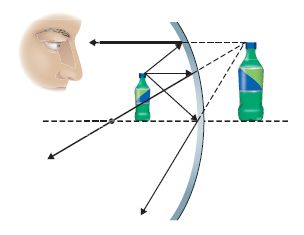
Which terms describe the reflection seen in this image?
a)
virtual, upright
b)
virtual, inverted
c)
real, upright
d)
real, inverted
61.
The distance between the focal point and the mirror is
a)
raduis
b)
diameter
c)
focal point
d)
focal length
62.
All rays that are parallel to the principle axis in a concave mirror reflects 
a)
Towards the focal point
b)
Away from the focal point
c)
Towards the center of curvature
d)
Away from the center of curvature
63.

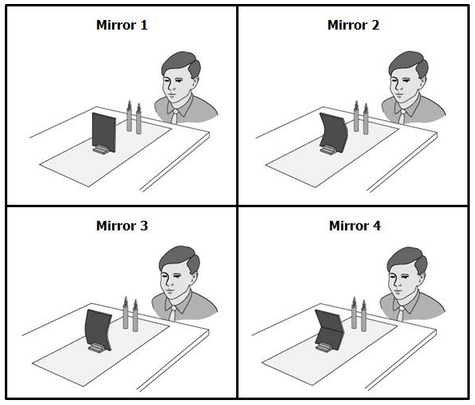
A student is conducting an experiment with four different types of mirrors. Which mirror in the experiment converges light and UP CLOSE, produces an upright, magnified image of the candles? (hint: no two mirrors are the same)

a)

mirror 1

b)

mirror 2

c)

mirror 3

d)

mirror 4

64.

The above lens is a type of ___.

a)

diverging lens

b)

converging lens

c)

divergent lens

d)

convergent lens

65.

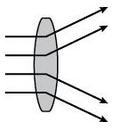
Which lens represents the path light takes through a diverging lens?

a)
b)
c)
d)
66.

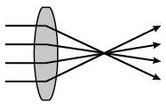
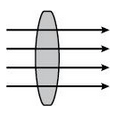
Which figure represents the path light takes through a converging lens?
a)
b)
c)
d)
67.

The image of an object, which is placed one foot in front of a plane mirror, will be ___.

a)

behind the mirror and reversed, left to right.

b)

behind the mirror.

c)

in front of the mirror and reversed, left to right.

d)

in front of the mirror.

68.

What type of lens creates the image seen in the eyeglasses?

a)

convex

b)

concave

c)

reflection

d)

plane

69.

A student is conducting an experiment with four different types of mirrors. Which mirror in the experiment is a plane mirror?

a)

mirror 1

b)

mirror 2

c)

mirror 3

d)

mirror 4

70.
Unlike mechanical waves, EM waves can travel through
a)
a vacuum
b)
water
c)
the ground
d)
air
71.
On AM broadcasts, what remains constant?  
a)
the amplitude
b)
the music
c)
the frequency of the wave
d)
the loudness of the wave
72.
FM signals travel as changes in 
a)
the speed of the wave
b)
the amplitude of the waves
c)
the frequency of the wave
d)
the loudness of the wave
73.
What kind of waves do cellular telephones use to transmit and receive signals? 
a)
gamma rays
b)
microwaves
c)
ultraviolet rays
d)
infrared rays
74.
______ is a lens that is thicker on its edges and makes an object appear smaller?
a)
mirror
b)
convex lens
c)
concave lens
d)
prism
75.
_____ is a lens that is thicker in the middle and makes an object appear bigger.
a)
prism
b)
convex lens
c)
concave lens
d)
mirror
76.
an image that forms when light rays actually meet
a)
virtual image
b)
real image
c)
diffuse reflection
d)
regular reflection
77.
The line that passes through the center of a curved mirror is called
a)
focal point
b)
center of curvature 
c)
principle axis
d)
light ray
78.
The point in the middle way between a curved mirror and the center of curvature is the
a)
principle point
b)
focal point
c)
center of curvature
d)
principle axis
79.
The distance between the focal point and the mirror is
a)
raduis
b)
diameter
c)
focal point
d)
focal length
80.
The inside of a spoon is same as 
a)
concave mirror
b)
convex mirror
c)
plane mirror
d)
non of the above
81.
This image is.....
a)
inverted and smaller
b)
inverted and larger
c)
not inverted and smaller
d)
not inverted and larger
82.
Convex lenses can produce...
a)
Real, erect images
b)
Virtual, inverted images
c)
Real, inverted images
d)
no images form
83.
Is a convex lens thicker or thinner in the middle?
a)
Thicker 
b)
Thinner 
84.
What type of lens do humans have in their eyes? 
a)
Concave Lens 
b)
Convex Lens 
85.
Which lens is used to magnify objects and refract light.  This type of lens is curved outward.
a)
convex
b)
concave
86.
A converging lens is also known as a ____ lens.
a)
convex
b)
concave
c)
double
d)
refracted
87.
What does the word "diverging" mean?
a)
to spread apart
b)
to come together
c)
parallel
d)
perpendicular
88.

When an object is placed between the focal point and the convex lens, the image produced is ___.

a)

real, reduced, and inverted

b)

real, enlarged, and inverted

c)

virtual, enlarged, and RSU

d)

virtual, reduced, and RSU

89.
What does the word "converging" mean?
a)
to separate
b)
to come together
c)
parallel 
d)
perpendicular
90.
A diverging lens is also known as a ____lens.
a)
refracted
b)
diffracted
c)
convex
d)
concave
91.

This image is...

a)

Inverted and smaller

b)

Inverted and larger

c)

RSU and smaller

d)

RSU and larger

92.
This image is...
a)
Inverted and smaller
b)
inverted and bigger
c)
not inverted and smaller
d)
not inverted and bigger
93.

This image is.....

a)

inverted and smaller

b)

inverted and larger

c)

not inverted and smaller

d)

not inverted and larger

94.

If you are nearsighted you need ______ lenses to correct your vision.

a)

concave

b)

convex

95.

If you are farsighted you need ______ lenses to correct your vision.

a)

concave

b)

convex

96.
When redshift occurs, the perceived frequency of the wave would...
a)
Increase
b)
Decrease
c)
Stay the same
d)
Make bird sounds
97.
When redshift occurs, the perceived WAVELENGTH of the wave would...
a)
Increase
b)
Decrease
c)
Stay the same
d)
Make squirrell sounds
98.
When blueshift occurs, the perceived frequency of the wave would...
a)
Increase
b)
Decrease
c)
Stay the same
d)
Make duck sounds
99.
When blueshift occurs, the perceived WAVELENGTH of the wave would...
a)
Increase
b)
Decrease
c)
Stay the same
d)
Make frog sounds
100.
_______ carry the greatest amount of energy. 
a)
x-rays
b)
gamma rays
c)
infrared rays
d)
visible light