
 Worksheets
Semester 2 Final Exam -- Physics
Total questions: 100
Worksheet time: 8hrs 20mins
Which of the following questions cannot be answered by science?
What is the age of planet Earth?
Which of Earth’s natural resources is the most efficient source of energy?
What is the maximum speed of a cheetah?
Are humans entitled to use all the natural resources of Earth?
Scientific theories are well-established explanations, and hypotheses are much narrower, tentative, and testable explanations for an observation. Identify the following statement as a theory or a hypothesis.
"All objects that have mass also have gravity."
Hypothesis
Theory
Scientific theories are well-established explanations, and hypotheses are much narrower, tentative, and testable explanations for an observation. Identify the following statement as a theory or a hypothesis.
"New tennis balls bounce higher than old tennis balls."
Hypothesis
Theory
Which of the following phrases apply to a scientific theory, but not to a scientific hypothesis?
not supported by observational evidence
tentative and testable
well-established and highly reliable
based on probability and bias

The student in the picture is performing an experiment. Which statement below would be a possible hypothesis for her experiment?
The object falls to the floor in 1.02 seconds.
If the mass of the object is increased, it will fall at the same rate.
If the object floats, its density is less than water.
The distance between the floor and the student’s hand is 2.15 meters.
What is the fundamental dimension of volume?
length cubed
length, mass, and volume
mass and density
What does length measure?
the amount of matter in a measured space
space
motion
volume
What is the property of matter that resists changes in motion?
force
momentum
inertia
acceleration
Mass produces the effects of weight and inertia. What is weight?
inertia
the force that opposes motion
the momentum of mass and velocity
the force of gravity acting on mass
Which term refers to a fixed reference point?
inertia
origin
mass
scalar
Which of the following includes information about direction?
distance
vectors
scalars
mass
The speedometer on a car reads which type of value?
speed
velocity
acceleration
vector
The change in position divided by the change in time is the ____.
velocity
acceleration
gravity
force
If the value of velocity does not change over time, it is referred to as __.
constant velocity
the reference point
force constant
continuous displacement
What does acceleration describe?
negative motion
changes in velocity
a displacement
constant velocity

The graph illustrates what type of motion?
constant positive velocity
decreasing velocity
constant negative velocity
negative acceleration

The graph illustrates what type of motion?
constant negative velocity
constant negative acceleration
constant positive acceleration
constant positive velocity
(true/false) Objects in free fall are always moving down.
True
False
When do the conditions of free fall apply?
when objects have maximum friction due to air resistance
when objects move with negative acceleration
when objects move under the sole influence of gravity
when objects have zero initial acceleration
In problems involving objects in free fall, the variable g substitutes for which variable in motion equations?
F
t
v
a
The force that results from gravity acting on mass.
friction
momentum
volume
weight
A geometric sketch of an object isolated from everything else except the forces acting on it.
velocity graph
an object in free fall
free body diagram
reference point
Newton's First Law is described as ___.
the action-reaction
the law relating force and acceleration
the law of inertia
How does acceleration relate to force in Newton's Second Law?
they are always in the same direction
they are not proportional
they are a scalar relationship
they are constant
Action-Reaction forces always act on ___ objects
weightless
different
the same
The trajectory of a projectile is ___.
a parabola
in the negative direction
within the range
outside of the range
What is the range of a projectile?
the velocity over the distance traveled
the horizontal distance it covers before landing
the maximum height reached after being launched
the acceleration during free fall
To analyze the motion of an object moving in a circle, what variables are used?
radius, velocity, time
meters, velocity, trajectory
length cubed, origin, parabola

In the diagram, a ball is moving in a circle with a velocity of 2.3 m/s. What is providing the centripetal force keeping the ball moving in a circular path?
the mass of the ball
the gravity of Earth
the string
the velocity

Which direction would the pink object go if the disc suddenly stopped turning?
vector D
vector C
vector B
vector A

Which color line represents the radius?
black
blue
pink
green
A force ____ to the motion causes the object to change its path from a straight line to a circle.
perpendicular
faster
slower
stronger

The gravitational constant in this equation is represented by which symbol?
F
G
m
r
What two things does the force of gravity depend on?
mass and acceleration
velocity and acceleration
mass and distance between two objects
acceleration and orbiting

How is this equation interpreted?
Force depends on the sum of two masses divided by the distance between them.
Force depends on the product of two masses divided by the square of the distance between them.
Force is multiplied by the masses and the distance between them.

What is the direction of gravity?
in the opposite direction as the opposing force
directed in a line between the center of masses
in the direction of the opposite force

The symbol for momentum is ___.
M
m
v
p
The law of conservation of momentum applies to closed systems. What does the term "closed system" mean in this context?
no net force can act upon the objects in the system from outside the system
no force of any kind can act within the system
no net force of any kind can act on objects within the system after the collision
What are the units of momentum?
m/s/s
kg m/s
m v
p
An oscillation that travels is a ___.
wave
particle
frequency
hertz
the distance a wave travels before it repeats itself
amplitude
wavelength
frequency
velocity
Which wave property determines the pitch of sound waves?
amplitude
speed
frequency
oscillation
Which wave property depends on the medium it travels through?
wave amplitude
wave speed
wave frequency
wave particles

What variable is represented by the greek letter lambda (upside-down y)?
wave length
frequency
wave speed
amplitude
The energy of a wave ----- with increasing frequency.
increases
decreases

Which type of wave?
transverse
longitudinal
What is the symbol that represents period?
T
p
P
.
The time it takes for one complete cycle.
frequency
period

What does this formula help you calculate?
frequency
period
What units measure frequency?
meters per second
Hertz
seconds
joules

What is the period of the cycle indicated on this graph?
T = 4 s
T = 8 s
T = 20 s

What is the amplitude of this motion graph?
-30 cm
60 cm
12 cm
At equilibrium, the restoring force is ____.
upward
downward
zero
Damping is caused by ___
friction
mechanical energy
amplitude
restoring force
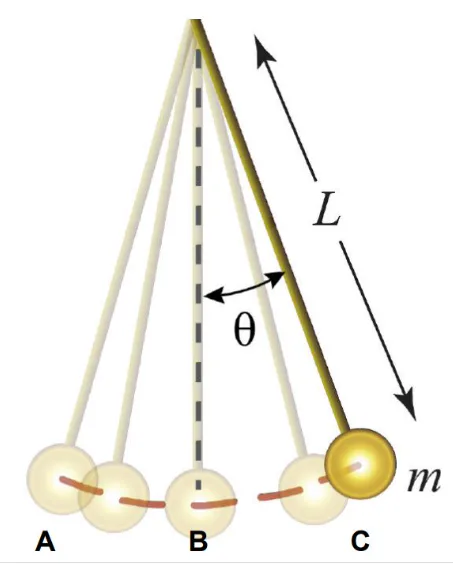
At which point does the pendulum have maximum kinetic energy?
A
B
C
L
Magnetic objects are generally grouped into which 2 categories?
Ferromagnetic and paramagnetic
magnetic forces and magnetic fields
permanent magnets and objects that can become magnetized
north poles and south poles
What can destroy a magnet?
breaking it in half
Heat
Extreme cold temperatures
Electricity
What is the fundamental difference between magnetic poles and electric charges?
magnets are are always opposite
charges can be separated, but poles cannot
electric charges are always the same
they are always attracted to each other
Condition of a system that describes opposing physical characteristics.
equilibrium
asymmetry
polarity
magnetism
A force that causes an object to twist or rotate.
Torque
Pressure
Friction
Momentum
What is the speed of a gravitational field?
The speed of sound
The speed of light
The rotational speed of Earth
Molecular speed

What force exists between these 2 magnets?
Attraction
Repulsion
None
On Earth, where is Magnetic North approximately located?
The Equator
The North Pole
The South Pole
Earth's core
The south pole of a magnet is placed next to the south pole of a second magnet. How will they interact?
the magnets will move toward each other
the magnets will stay in place
the magnets will move away from each other
the magnets will become polarized


Is this circuit open or closed?
open
closed
If the resistance in a circuit is 45 ohms and the electric potential is 12 V, what is the quantity of the current?
0.27 A
0.27 volts
540 A
3.75 ohms
What is the voltage for a circuit with 6 amps and 370 ohms of resistance?
0.016 ohms
0.016 amps
2220 V
61.6 V
What units measure resistance?
Ω (Ohms)
V (Volts)
A (Amps)
W (Watts)
Any device that uses electric current through multiple loops of wire to create a magnetic field.
Permanent magnet
Solenoid
Generator
Transformer

What information can you find by using this equation?
the electric force between two charges
the resistance in a wire
the amount of charge that passes a given point in a specific amount of time
the voltage of a power source
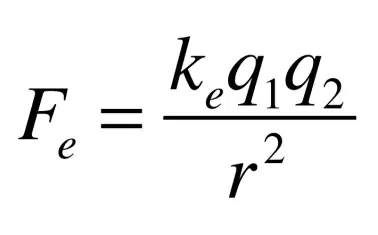
Which symbol will always be the value of 9.0 x 10⁹ ?
Fe
q1
r2
ke
Which temperature quantity is impossible?
-300o F
212o F
0o C
-58 K
What is Absolute Zero?
the temperature at which all forms of matter freeze solid
the temperature at which everything stops
the temperature at which gases become solids
In which phase of matter do the molecules have enough thermal energy to temporarily break away from attractive forces, but are not separated?
solids
liquids
gases
In which phase of matter do molecules vibrate in place?
solids
liquids
gases
Because heat is energy, the SI units for heat are ---
Watts
Celsius
joules
Newtons

Water and Aluminum have very different specific heats. What do these numbers tell you?
Aluminum heats water much faster than other substances
It takes more water to heat a pot made of aluminum
It takes much more energy to heat water than aluminum

What does the cp represent in the equation?
the mass
the total thermal energy of the substance
the change in temperature
the specific heat

How much heat energy is needed to raise the temperature of 10.0 g of aluminum from 18°C to 45°C? The specific heat capacity of aluminum is 0.90 J/g°C.
0.90 J
0.005 J
243 J
210 J/g°C
Heating water to turn it into steam causes which process in a steam engine?
compression
expansion

In a heat engine, the gas inside the cylinder is the ---.
System
Surroundings
Heat will not flow between two objects in thermal equilibrium.
zeroth law of thermodynamics
first law of thermodynamics
The first law of thermodynamics is based on what essential idea?
Thermal equilibrium is reached between two or more objects in direct contact
Energy is conserved in thermodynamic systems
No engine can be 100% efficient
A system can have zero energy if it is cooled to 0 K.

Adding heat to the System ____ the energy of the Surroundings.
increases
decreases
Which type of substance has the least entropy?
a solid at 0oC
a solid at 0oF
a solid at 0 K
Which law of thermodynamics can be referred to as "the arrow of time"?
1st law
2nd law
3rd law
Zeroth law
Which law of thermodynamics establishes absolute zero as the temperature at which the entropy of a system is zero?
1st law
2nd law
3rd law
Zeroth law
Which scientist is not known for contributions to the development of the laws of thermodynamics?
Newton
Carnot
Liebniz
Boltzmann

How much current flows through a bulb that draws 100 W of power from a 120 V outlet?
12,000 W
0.83 A
0.83 W

