
 Worksheets
PES - Fall Semester Review
Total questions: 101
Worksheet time: 3hrs 20mins
Which of the following questions CANNOT be answered by science?
How do birds fly?
B) Is this a good song?
C) What is an atom?
D) How does a clock work?
What is the symbol for deciliter?
dL
dkL
dcL
Ld
What quantity does the kilogram measure?
time
distance
force
mass
Of the following, the unit that cannot be used to express volume is _____.
kg
L
cm3
mL


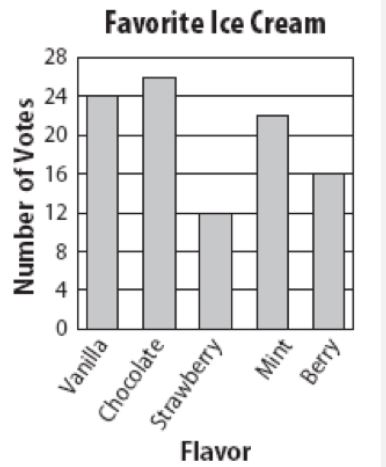
What would make the best title for this graph?
Colors I like best
Candy colors
Comparison Graph
# of Colors in Smarties Candies
What is the purpose of the scientific method?
To solve problems and create experiments
To research new information
To practice safety
To become a scientist
What is the main reason scientists have constants?
So scientists know their results came only from the independent variable and nothing else
So scientists stay safe
So scientists can record data easier
So the experiment is clear and easy to understand

648 g = ____ mg
6,480
64,800
648,000
64.8
An object is _____ if its position changes relative to the reference point.
in motion
at reset
a frame of reference
magical


Speed =
Distance/Time
Time/Distance
Velocity/Time
Time/Velocity
Acceleration: is the rate of change in
velocity
speed
displacement
direction
A man walks 5 miles forwards, 6 miles backwards and then 2 miles forwards. What is his displacement?
1 mile forward
13 miles
3 miles forward
1 mile
The change in an objects position from the final position to initial position.
displacement
distance
motion
reference point

What is motion?
the stopping of an object to a frame of reference
a change in position relative to a frame of reference
the middle ground between light and shadow, between science and superstition, and it lies between the pit of man's fears and the summit of his knowledge
a change in the time in which it takes to get an office referral

Velocity is speed with __________________________.
a unicycle helmet
direction
fight
As an object travels through the air, its vertical velocity
changes continuously due to gravity
remains the same
Acceleration: is the rate of change in
velocity
speed
displacement
direction
An object in motion tends to stay in motion and an object at rest tends to stay at rest until acted on by an unbalanced force is which of Newton's laws?
1st
2nd
3rd
4th
For every action there is an equal and opposite reaction is which of Newton's laws?
1st
2nd
3rd
4th

What is the term for when two forces are acting in opposite directions on an object and are equal in size and the object stays still
net force
balanced force
accelerated force
unbalanced force

Calculate the net force
20
10
0
30

Calculate the net force
25
65
20
15
the sum of all forces acting on an object is called the
net force
balanced force
motion force
accelerated force

If you INCREASE the force applied to a 50 kg crate, what happens to the ACCELERATION of the crate
acceleration increases
acceleration decreases
force increases
this cannot be determined
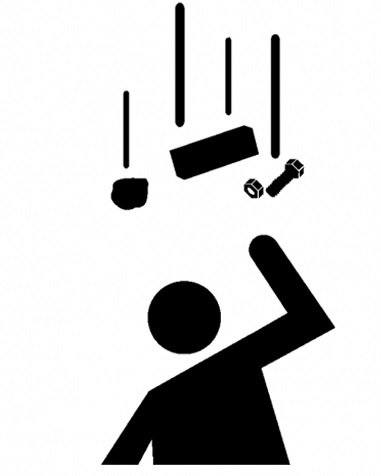
An object is falling downward through Earth's atmosphere. In which direction is the air resistance force?
Down
Up
Around the object
Through the object
If you jump out of an airplane, which two forces are acting on you?
Gravity and friction
Force and gravity
Gravity and Air Resistance
Which form of energy is involved in a pencil falling from a desk?
kinetic
nonmechanical
gravitational potential
elastic potential
A device that changes the force or increases the motion from work is a
computer
engineer
automobile
machine
The equation for force is
W= fd
W= fN
W=mv
W=wh
500 J of work is done by a person who uses a force of 50N to move a box, how far does it go?
10 m
0.1 m
25,000 m
10 J

A cheetah can run briefly with a speed of 31.0 m/s. Suppose a cheetah with a mass of 47.0 kg runs at this speed. What is the cheetah’s kinetic energy?
1457 Joules
22,584 Joules
15 Joules
45,167Joules
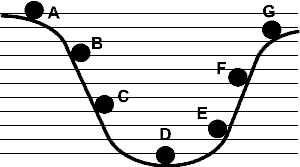
At which point does the ball has the greatest gravitational potential energy (GPE)?
A
G
D
C
G
What are the three states of matter?
light
solid, liquid, gas
energy
plasma
What are the properties of liquids?
Liquids cannot flow and take the shape of their container
Liquids have a definite shape and volume
Liquids have a definite volume, but no definite shape; they can flow and take the shape of their container; they have a fixed density; and they can be compressed to a limited extent.
Liquids have a variable density
What is the process called when a substance changes from a liquid to a gas?
evaporation
condensation
sublimation
melting

State of matter that takes the shape of it's container and has a definite volume.
Solid state
Liquid state
Gas state
Plasma state
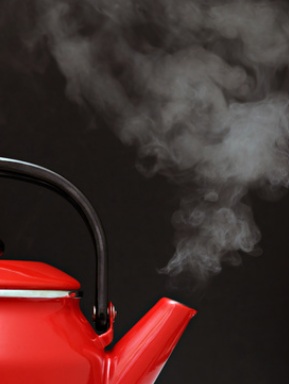
What change of state is taking place in this photograph?
Condensation
Freezing
Vaporization
Melting

The diagram shows the changes in state of water (H2O). What is the process Z called?
Condensation
Freezing
Vaporization
Melting

When a beaker of water is heated its volume increases a little. What is happening to the particles in the liquid?
They are getting bigger.
They are moving slower.
They are moving faster.
They are getting smaller.

When you place a bottle of water in the freezer its volume increases. What is happening to the particles in the liquid?
They are getting bigger.
They are moving slower.
They are moving faster.
They are getting smaller.

Which state of matter is represented in the following diagram?
Liquid
Liquid and gas
Gas
Solid

The melting point of the sample is
-60 ºC
-100 ºC
60 ºC
100 ºC

What phase of matter exists in part D of the graph?
Gas
Liquid
Solid
Plasma
How does heat move?
from a warmer to a cooler object
from a cooler to a warmer object
toward a hot object
away from a cold object

When you touch hot sand, heat is transferred by _________ to your skin.
conduction
convection
radiation

Two fluids, one warm and one cold, mix. The warm fluid rises and the cool fluid sinks
Conduction
Convection
Radiation

A series of loops that has been wound or gathered
Strings
Roller Coaster
Copper
Coils
As the distance between magnets increases-the attraction between them will
Decrease
Stay the Same
Increase

Students attached both ends of a long wire to the poles of a battery and wrapped the wire around a spoon. In this arrangement, the spoon is able to pick up five paper clips. The students wrap more wire around the spoon and want to determine if the strength of the magnetic force has increased. Which of the following observations would indicate that wrapping more wire has increased the strength of the electromagnet?
More wire was needed to wrap around the spoon.
The spoon now picks up seven paper clips.
Eventually, the battery runs out of energy.
The ends of the wire must touch the battery's poles.
What will happen as an electron (-) gets closer to a proton (+)?
The repulsion will be stronger.
The attraction will be stronger.
The attraction will be weaker.
Nothing will happen to the electric field.
A current flowing through a wire is surrounded by a
Electric Current
Magnetic Field
Electric Field
None of these
What will happen if the north ends of two magnets are placed near each other?
Both magnets will get weaker.
They will repulse (repel) each other.
They will attract each other.
Nothing will happen.

What is the device shown?
Electromagnet
Solenoid
Generator
Motor
Electromagnets can be
turned on and off
made stronger
made from iron
made weaker
The rule of charged particles states that
opposites attract
opposites repel
opposites don't interact
likes attract

Which position of the two magnets results in the greatest attraction between them?
A
B
C
D
The process of generating an electric current from the motion of a conductor through a magnetic field
electromagnetic induction
static electricity
electromagnetism
transformer
The relationship between electricity and magnetism
electromagnetism
static electricity
animal magnetism
transformer

Which has the LONGEST wavelength and therefore the lowest frequency/energy? These waves are used in broadcasting, wifi, and texting.
Gamma rays
Visible light
Radio waves
Infrared rays

Which section of the electromagnetic spectrum is the ONLY part humans can see?
X-Rays
Gamma Rays
Visible Light
Ultraviolet Rays
Which has the SHORTEST wavelength and therefore the highest frequency/most energy? Hint: These waves are also used in cancer treatments.
Gamma Rays
Radio Waves
Ultraviolet Rays
X-rays

Which wave has a low frequency, a long wavelength, and low energy?
A
B
Not enough information to determine


The number of waves that pass a given point every second
Frequency
Wavelength
Energy
Electromagnetic Spectrum
The distance between the crests of two waves
Frequency
Wavelength
Energy
Electromagnetic Spectrum

Describe the waves the arrow is pointing at.
long wavelength / low energy
long wavelength / high energy
short wavelength / low energy
short wavelength / high energy
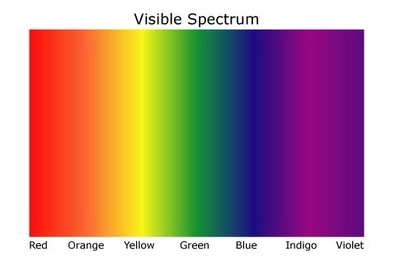
What color of light has the longest wavelength?
red
green
yellow
violet
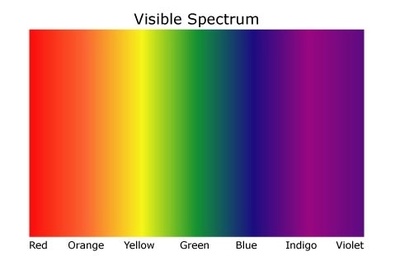
What color of light has the shortest wavelength?
red
indigo
yellow
violet
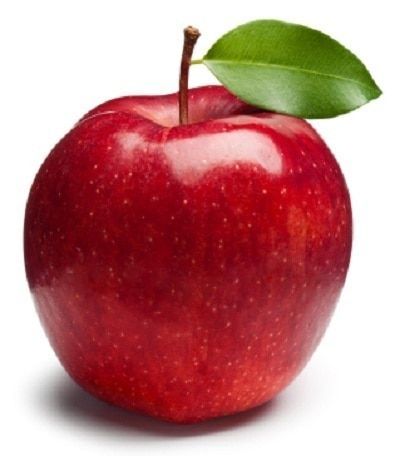
Why does this apple look red?
The apple reflects red light and absorbs all other colors
The apple absorbs red light and reflects all other colors
The apple reflects all the light shinning on it
The apple is red because we see that color.


What do all waves transfer?
Matter
Heat
Electricity
Energy

Which of the following can waves transfer energy through?
solid
liquid
gas
empty space
all of the above

What are the two types of waves?
longitudinal and transverse
sound and light

Period of a wave refers to...
how long it takes for the event to repeat.
how strong a wave is.
how long a wave is.
how much energy a wave has.

Which type of waves have the longest wavelength?
Visible light
Radio waves
X-rays
Gamma-Rays

Shorter wave lengths can carry more energy. Which of these probably carries the MOST energy:
Infrared light
Visible light
X-rays
UV light

What is the letter a showing?
crest
trough
wavelength
amplitude

What is the letter d showing?
crest
trough
wavelength
amplitude

What the letter b showing?
crest
trough
wavelength
amplitude

What is the red line showing?
crest
trough
wavelength
amplitude
What type of wave is sound?
transverse
longitudinal
As objects move in space, their wavelengths change. This phenomenon is called the...
Coriolis Effect
Doppler Effect
Movement Effect
Black Hole Effect

