wayground logo

Free Printable Worksheets

Font size

S
M
L
XL
Worksheets

Semester 1 Final Exam Review

Total questions: 96

Worksheet time: 2hrs 37mins
Name
Class
Date
1.

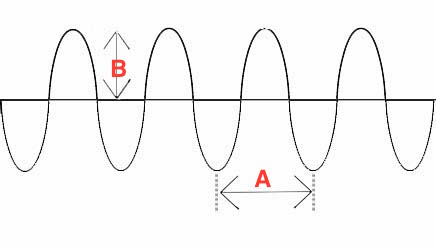
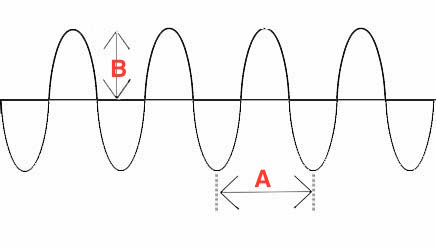
What property of this wave is represented by the letter "A"

a)

amplitude

b)

crest

c)

trough

d)

wavelength

2.
What property of the wave is represented by the letter "B"?
a)
amplitude
b)
crest
c)
trough
d)
wavelength
3.
The highest point on a wave is:
a)
the crest
b)
the trough
c)
the top
d)
the coast 
4.
The lowest point on a wave is the:
a)
Amplitude
b)
Crest
c)
Trough
d)
Wavelength
5.
The number of wavelengths that pass a point each per second is:
a)
frequency
b)
period
c)
longitudinal 
d)
transverse wave 
6.
A mechanical wave cannot travel through...
a)
a vacuum(empty space).
b)
water.
c)
air. 
d)
glass.
7.
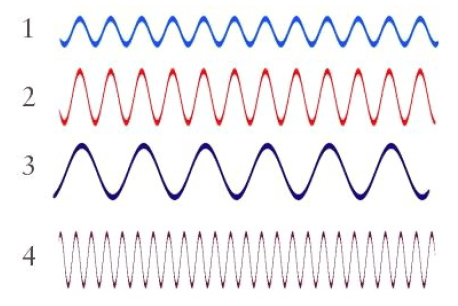
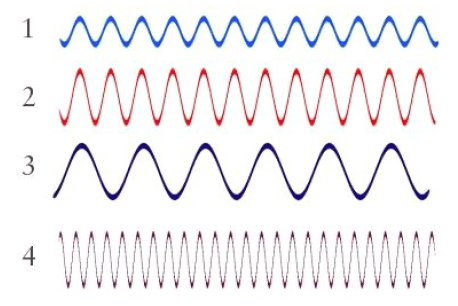
Which wave in the diagram has the greatest frequency?
a)
1
b)
2
c)
3
d)
4
8.
Which wave in the diagram has the greatest wavelength?
a)
1
b)
2
c)
3
d)
4
9.
Which of the following can sound travel through?
a)
solid
b)
liquid
c)
gas
d)
all of the above
10.
regular disturbances that carry energy through matter or space
a)
crest
b)
energy
c)
wave
d)
trough
11.
which material does sound travel the fastest?
a)
solid 
b)
liquid 
c)
gases
12.
Which statement about the length and energy of gamma-ray waves compared to other electromagnetic waves is true?
a)
Gamma-ray waves have the shortest wavelengths and carry the least amount of energy.
b)
Gamma-ray waves have the shortest wavelengths and carry the most amount of energy.
c)
Gamma-ray waves have the longest wavelengths and carry the least amount of energy.
d)
Gamma-ray waves have the longest wavelengths and carry the most amount of energy.
13.

Which statements correctly compare the sound waves experienced by observer A and observer B?

a)

Observer A experiences a wave with fewer crests.

b)

Observer A experiences a wave with lower energy.

c)

Observer A experiences a wave with a higher pitch.

d)

Observer A experiences a wave with a slower speed.

14.
How would the energy carried by an electromagnetic wave change if the wavelength were lengthened?
a)
The energy would increase
b)
the energy would fluctuate
c)
the energy would decrease
d)
the energy would stay the same
15.
A sound wave transfers energy by
a)
causing the air particles to vibrate.
b)
creating a vacuum between areas of air particles.
c)
creating high and low pressure areas that push and pull the air around them.
d)
filling the space left when a vibrating object moves in a direction opposite to the wave’s motion.
16.
When the particles of a medium are vibrating at right angles to the direction of energy transfer, then the wave is a
a)
Longitudinal wave
b)
Transverse wave
c)
sound wave
d)
Standing wave
17.
What happens to the amplitude of a sound wave when energy transfer is increased?
a)
As the transfer of energy is increased, the amplitude stops and no sound is made.
b)
As the transfer of energy is increased, the amplitude decreases causing the sound to get quieter.
c)
As the transfer of energy is increased, the amplitude increases causing the sound to get louder.
d)
As the transfer of energy is increased, the amplitude remains the same keeping the sound constant.
18.
What is one difference between an electromagnetic wave and a mechanical wave?
a)
A mechanical wave can travel through a vacuum. An electromagnetic wave must have a medium to travel through.
b)
An electromagnetic wave can travel through a vacuum. A mechanical wave must have a medium to travel through.
c)
An electromagnetic wave moves parallel to the direction of the wave's travel. A mechanical wave can move only perpendicular to the direction of the wave's travel.
d)
An electromagnetic wave moves perpendicular to the direction of the wave's travel. A mechanical wave can move only parallel to the direction of the wave's travel.
19.
Which of the following correctly describes sound waves?
a)
They are transverse waves.
b)
They are a part of the electromagnetic spectrum.
c)
They are longitudinal waves.
d)
They do not require a medium for transmission
20.
Which of the following best describes refraction?
a)
The bending of a wave as it reflects at an angle from a surface.
b)
The bending of a wave as it passes at an angle from one material to another.
c)
The bending of a wave it goes around, or passes through, openings in a barrier.
d)
The bending of one wave as two or more waves try to occupy the same space at the same time.
21.
Light travels fastest through which of the following?
a)
Air
b)
Gas
c)
Vacuum
d)
Water
22.
Why do we see lightning before we hear thunder?
a)
Sound travels slower than light can travel.
b)
Sound needs a medium to travel through.
c)
Sound cannot reflect off surfaces as easily as light.
d)
Sound is not processed by the brain as fast as light.
23.
When a sound wave hits a wall and echoes back, this is an example of what?
a)
Refraction
b)
Diffraction
c)
Reflection
d)
Interference
24.
When 2 waves meet and there amplitude increases it is known as what?
a)
Constructive Interference
b)
Amplitude Addition
c)
Positive Interference
d)
Destructive Interference
25.
This image is representing what wave interaction?
a)
Refraction
b)
Diffraction
c)
Reflection
d)
Interference
26.
This image is representing what wave interaction?
a)
Refraction
b)
Diffraction
c)
Reflection
d)
Interference
27.
a)
Constructive Interference
b)
Destructive Interference
28.
What is happening in this picture?
a)
Reflection
b)
Refraction
c)
Diffraction
d)
Absorption
29.
Heat is the movement of ______.
a)
radiation
b)
thermal energy
c)
cold
d)
fire
30.
Thermal energy ALWAYS moves from _____ to _____.
a)
solid to liquid
b)
ice to water
c)
hot to cold
d)
solid to gas
31.
Heat from the sun travels to Earth by _____.
a)
conduction
b)
convection
c)
insulation
d)
radiation
32.
The heat from a hot burner to a pot is transferred by ______.
a)
convection
b)
insulation
c)
radiation
d)
conduction
33.
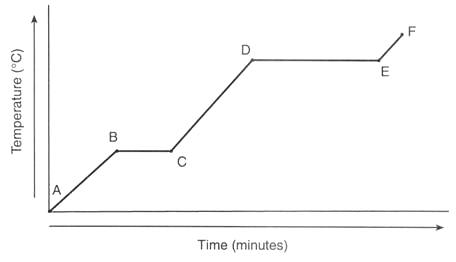
What line segment represents only the solid state?
a)
A-B
b)
B-C
c)
C-D
d)
D-E
34.
In which segment is the kinetic energy remaining constant?
a)
A-B
b)
B-C
c)
C-D
d)
E-F
35.
What state(s) of matter are present at D-E?
a)
Solid-liquid
b)
Liquid
c)
Liquid-gas
d)
Gas-Solid
36.
What state(s) of matter are present at D-E?
a)
Solid-liquid
b)
Liquid
c)
Liquid-gas
d)
Gas-Solid
37.
Between which points is the temperature of the substance remaining constant?
a)
A-B only. 
b)
A-B, C-D, E-F
c)
B-C only. 
d)
B-C, D-E
38.
Between which points is the temperature of the substance increasing?
a)
A-B only. 
b)
A-B, C-D, E-F
c)
B-C only. 
d)
B-C, D-E
39.
What state of matter is segment 5?
a)
Solid
b)
Liquid
c)
Gas
d)
Plasma
40.
A substance's heating curve is shown in the graph.  What is its boiling point?
a)
100 C
b)
60 C
c)
80 C
d)
20 C
41.
When the temperature of matter increases the particles...
a)
speed up and move closer
b)
speed up and move farther apart
c)
slow down and move closer together
d)
slow down and move farther apart
42.
What does temperature measure?
a)
Heat
b)
ºC
c)
Kinetic Energy
d)
Thermal Energy
43.
What would be the effect on the particles if more heat is supplied to the system?
a)
They would slow down
b)
They would stop moving
c)
They would speed up
d)
There would be no effect
44.
Copper, Stainless Steel, Carbon Steel, and Zinc were all heated using the same thermal energy.  What material would be the coolest after being heated?
a)
Copper
b)
Carbon Steel
c)
Zinc
d)
Stainless Steel
45.
When plants convert the sun's energy into food, which type of energy is it?
a)
kinetic
b)
chemical
c)
thermal
d)
radiant
46.
A battery converts what type of energy to another?
a)
sound to kinetic
b)
light to heat
c)
mechanical to electrical
d)
chemical to electrical
47.
According to which law of energy, energy can't be created or destroyed?
a)
First law of motion
b)
The law of tacos
c)
Laws of Energy
d)
law of conservation of energy
48.
Which of the following objects has the least acceleration?
a)
a. an empty shopping cart pushed with a hard force
b)
b. a full shopping cart pushed with a hard force
c)
c. an empty shopping cart pushed with a light force
d)
d. a full shopping cart pushed with a light force
49.
What happens when two forces act in the same direction?
a)
They cancel each other out.
b)
The stronger one prevails.
c)
Their strengths are added.
d)
Their sum divided by the two is the total force.
50.
8 N to the left , and 4 N to the right. Find the net force. Is this balanced 
a)
12 N Right  No
b)
4 N Left  No
c)
12 N Right  Yes
d)
4 N Left  Yes
51.
During which interval is the object speeding up?
a)
A to B
b)
B to C
c)
D to E
d)
E to F
52.
What is this graph showing?
a)
Constant Speed
b)
Acceleration (speeding up)
c)
Deceleration (slowing down)
d)
No motion
53.
Any time the forces are unbalanced, an object will remain at rest. True or false?
a)
true
b)
false
54.
When you tell the direction and speed of an object, you give its
a)
motion
b)
velocity
c)
acceleration
d)
mass
55.
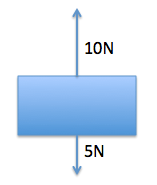
What is the net force on the block? (click on the words to view the picture)
a)
5 Newtons up
b)
5 Newtons down
c)
15 Newtons up
d)
15 Newtons down
56.
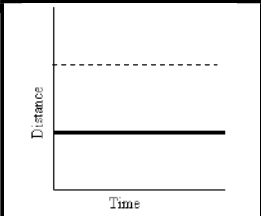
What does this graph represent?
a)
Constant speed
b)
Acceleration
c)
Not moving
57.

_______________ is how distance of an object changes over time.

a)

speed

b)

velocity

c)

momentum

d)

acceleration

58.
Which of the following statements is true? 
a)
Balanced forces cause a change in motion. 
b)
Unbalanced forces cause a change in motion. 
c)
Forces do not effect the change in motion. 
59.
What is a PUSH or PULL of an object?
a)
Motion
b)
Force
c)
Friction
d)
Gravity
60.
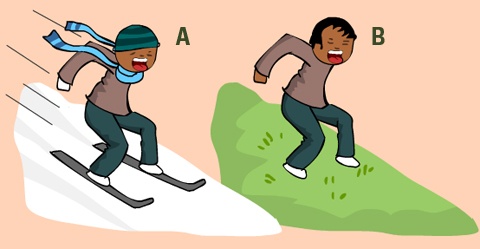
Why is it harder for the boy in Image B to get down the hill?
a)
Motion
b)
Friction
c)
Work
d)
Displacement
61.
Which force produces a change in motion?
a)
unbalanced force
b)
balanced force
c)
gravitational force
d)
frictional force
62.
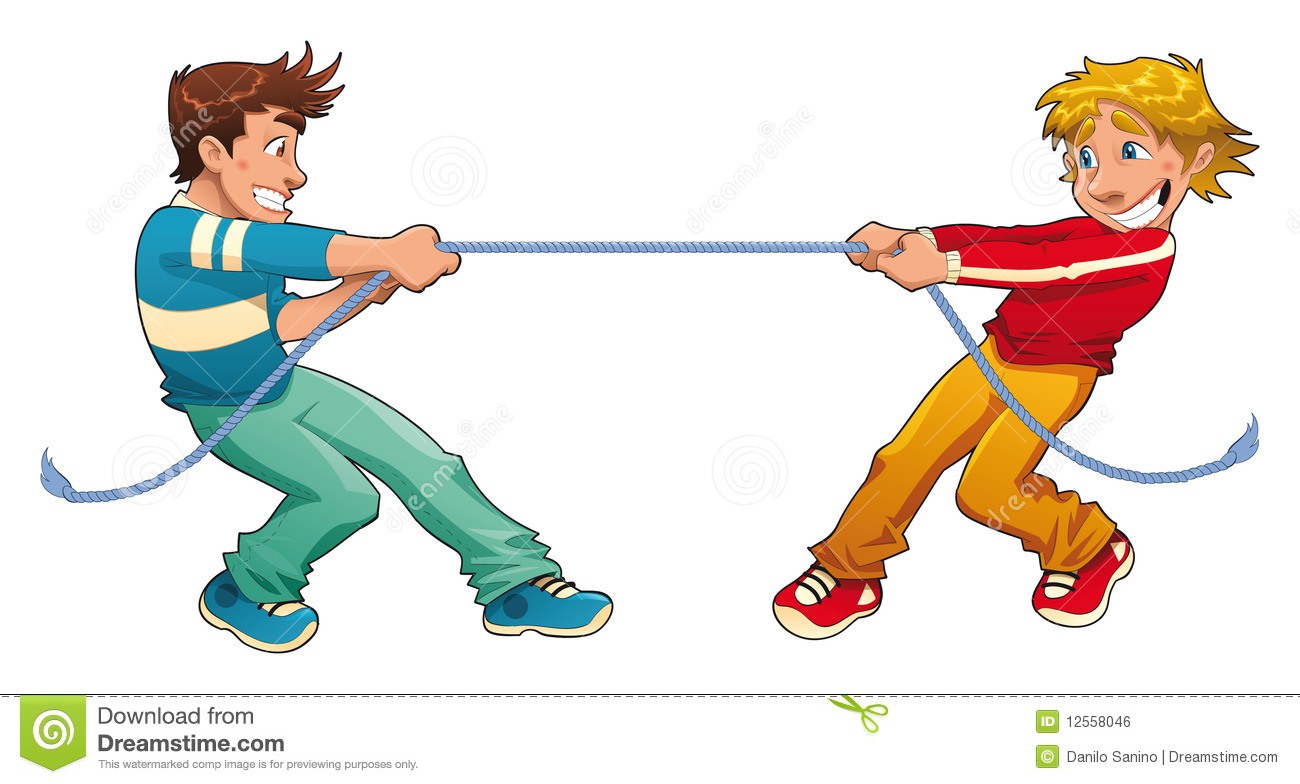
If these boys are pulling with the same amount of force.  What will happen?
a)
The boy in blue will win.
b)
They will not move at all.
c)
The boy in red will win.
d)
Both will fall down.
63.
Speed is equal to 
a)
Distance/Time
b)
Time/Distance
c)
Time x Distance
d)
Acceleration
64.
Speed is different from velocity because
a)
Velocity has a direction
b)
Speed uses Distance /Time
c)
Velocity doesn't include time
d)
Velocity doesn't include distance
65.

If a 10 kilogram object accelerates suddenly at 15 m/s2, how much force was applied to the object? (HINT: Newton's 2nd Law!)

a)

150 Newtons

b)

15 Newtons

c)

150 kilograms

d)

100 kilograms

66.
What is the formula for force?
a)
F=M/A
b)
F=A/M
c)
F=M*A
d)
F=M*F
67.
A baseball is thrown a distance of 50 meters. What is the speed if it takes 2 seconds to cover that distance?
a)
100 m/s2
b)
25 m/s2
c)
52 m/s2
d)
100 seconds
68.
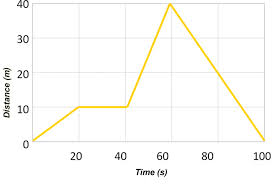
How long did it take this object to travel 10 m?
a)
0 s
b)
10 s
c)
15 s
d)
20 s
69.
How long did it take this object to travel back to its reference/starting point?
a)
20 s
b)
30 s
c)
60 s
d)
100 s
70.

In which of the following graphs below are both runners moving at the same speed?

a)
b)
c)
d)
71.

Match the description to the graph:

"The car is stopped."

a)
b)
c)
d)
72.
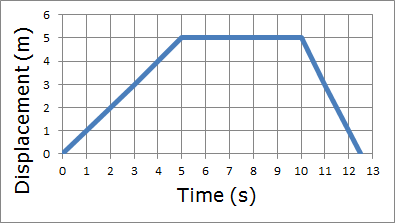
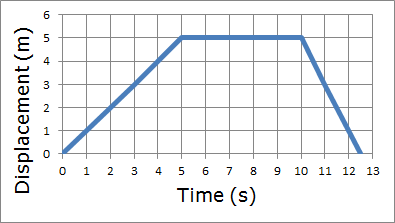
According to the graph how far does the person travel in the first 5 seconds?
a)
2 m
b)
10 m
c)
0 m
d)
5 m
73.
What is the person doing from 5 seconds to 10 seconds?
a)
Walking 
b)
Running
c)
Standing Still 
d)
Walking Fast
74.
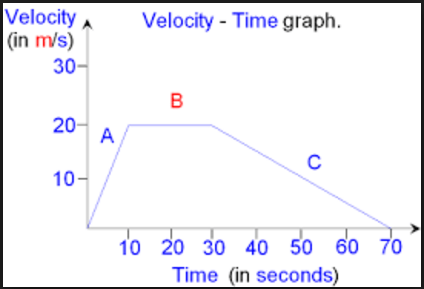
This is a velocity-time graph.  What is the object doing in segment B?
a)
Positive acceleration
b)
Negative acceleration
c)
Constant Velocity
d)
Not moving
75.
What kind of acceleration is shown here?
a)
positive
b)
negative
c)
none
d)
varies
76.
What is a conductor?
a)
A material that stops electric current from flowing
b)
A material that allows electric current to flow easily
77.
What is an insulator?
a)
A material that DOES NOT allow electric current to flow
b)
A material that DOES allow electric current to flow
78.
How is electricity a force?
a)
It is not a force
b)
Electrons are pushed through a circuit
c)
Protons are pushed through a circuit
d)
Neutrons are pushed through a circuit
79.
How do you increase the strength of an electromagnet?
a)
Decrease the number of batteries and increase the number of coils
b)
Increase the electric current and decrease the batteries
c)
You cannot strengthen an electromagnet
d)
Increase the electric current and increase the number of coils
80.
What will happen to the other bulbs in the circuit if one bulb goes out?
a)
The other bulbs will go out
b)
The other bulbs will get brighter
c)
The other bulbs will get dimmer
d)
They will flash on and off
81.
What will happen when a light bulb is removed from the circuit below?
a)
The remaining bulbs will go out
b)
The remaining bulbs will brighten
c)
The remaining bulbs will dim
d)
The brightness of the remaining bulbs will not change
82.
A continuous flow of electricity is called_____________
a)
series
b)
circuit
c)
static
d)
current
83.
A pathway for electricity to travel is called___________
a)
current
b)
static electrcity
c)
circuit
d)
circle
84.
What kind of circuit is this?
a)
series
b)
parallel
85.
What is this?
a)
magnet
b)
electromagnet
c)
series circuit
d)
parallel circuit
86.
How do you make an electromagnet stronger?
a)
Add a motor and/or lightbulbs
b)
Add more light bulbs and/or wire coils
c)
add more wire coils and/or a switch
d)
add more wire coils and/or batteries
87.
What is a switch's function in a circuit?
a)
to make the current hotter or colder
b)
turn on and off the flow of current
c)
the pathway that current flows
d)
to add more power to the circuit
88.
What is current measured in?
a)
Ω (Ohms)
b)
V (Volts)
c)
A (Amps)
d)
W (Watts)
89.
What is resistance measured in?
a)
Ω (Ohms)
b)
V (Volts)
c)
A (Amps)
d)
W (Watts)
90.
The mathematical relationship among Voltage, Current, and Resistance
a)
Faraday's Law
b)
Tesla's Law
c)
Edison's Law
d)
Ohm's Law
91.
If the Voltage is increased and the resistance stays the same, Current will
a)
Increase
b)
Decrease
c)
Stay the same
d)
X
92.
How many Volts would it take to push 1 Amp through a resistance of 1 Ohm
a)
10 volts
b)
1 volt
c)
48 volts
d)
5 volts
93.
What size resistor would produce a 3 Amp current flow with a 12 Volt battery
a)
1 Ohm
b)
3 Ohms
c)
4 Ohms
d)
12 Ohms
94.
A HID lighting circuit operates at 75 Volts what is the circuit current flow if the resistance is 5 Ohms
a)
375 Amps
b)
30 Amps
c)
15 Amps
d)
1.33 Amps
95.
How do you calculate voltage?
a)
Current X Resistance
b)
Resistance ÷ Current
c)
Current ÷ Resistance
d)
Measure it with a ruler
96.
What is the current through a 4V bulb with a power of 36W?
a)
9W
b)
9A
c)
60V
d)
60A