
 Worksheets
1st Semester Review 1
Total questions: 95
Worksheet time: 2hrs 20mins


A runner races in the 100 meter dash. It takes her 10 seconds to finish. What is her average speed?
10 m/s
1000 m/s
100 seconds
10 seconds
Which of the following is a unit of distance ?
miles/hr
m
s
min

Ryan can run 10 meters in 5 seconds. What is his speed?
5 meters/sec
2 meters/sec
5 miles/hour
2 miles/hour

Anne likes to walk 30 feet in 10 seconds. What is her speed?
3 feet/sec
6 feet/sec
10 feet/sec
2 feet/sec

Car A- distance: 4 meters, time: 2 sec
Car B- distance: 2 meters, time: 2 sec
Car C- distance: 8 meters, time: 2 sec
Car B= 2
Car C = 3
Car B= 1
Car C= 3
Car B= 1
Car C = 2
Car B= 2
Car C= 1
Motion is
a word that rhymes with ocean.
an object's change in its speed to a reference point.
an object's change in position to a reference point.
an object's change in position to its rate of speed.
What is the changing of position over time?
Distance
reference point
acceleration
speed
_______ is the length of the path between two points.
distance
reference
statistic
law
Choose the answer that best fits: Acceleration is the...
change of speed and/or direction over time
change of speed over time
change of direction over time
increase of speed
What is the SI unit for distance?
feet (ft)
meters (m)
meters per second (m/s)
meters per second per second (m/s/s or m/s2)
What is the SI unit for velocity?
feet (ft)
meters (m)
meters per second (m/s)
meters per second per second (m/s/s or m/s2)
What is the unit for acceleration?
feet (ft)
meters (m)
meters per second (m/s)
meters per second per second (m/s/s or m/s2)
In each of the following cases, determine where the car has no acceleration?
A car speeds up after a stoplight turns green.
A car slows down as it approaches a red light
A car with the cruise control set at 80 km/h going down a straight highway
A car turning a curve and slows down,
The SI unit for acceleration is
mph
ft/sec
m/s2
m/s
When are you undergoing an acceleration in a car? (Choose all that are correct)
speed up
slow down
stand still
constant speed
A positive acceleration means that your object is _____.
not accelerating
not moving
speeding up
slowing down

A ball rolling down an inclined plane attains a velocity of 27 m/s in 3 seconds from rest. Find the acceleration.
30 m/s
24 m/s2
9 m/s2
81 km/hr
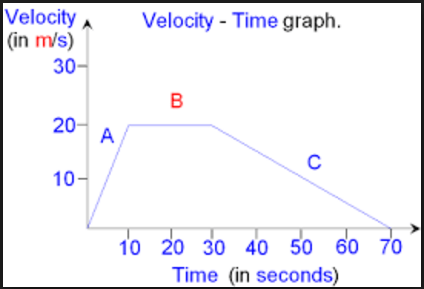
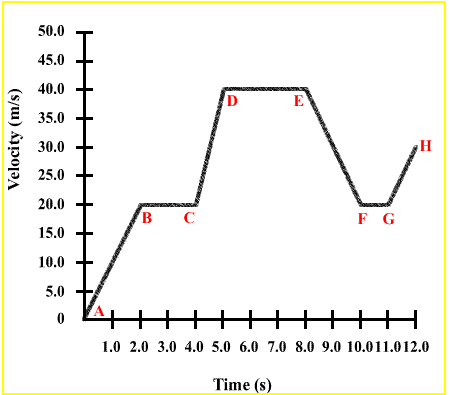
This is a velocity-time graph. What is the object doing in segment A?
Speeding up
Slowing down
Constant Velocity
Not moving

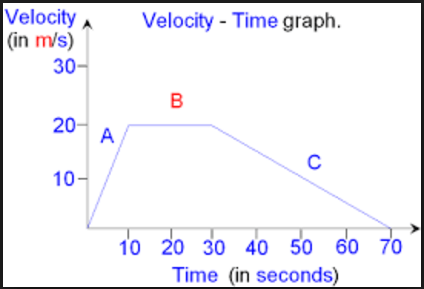
This is a velocity-time graph. What is the object doing in segment C?
Speeding up
Slowing down
Constant Velocity
Not moving
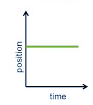
Describe the motion of the object in the graph
Moving with constant speed
Speeding up
Not moving
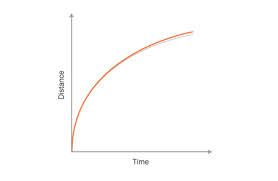


What is occurring on this graph?
speeding up in the positive direction
moving at a constant speed in the positive direction
not moving
moving at a constant speed in the negative direction

What is occurring on this graph?
Negative acceleration
moving at a constant speed in the positive direction
positive acceleration
negative net force
A cat walks 3 meters east toward a laser, then jumps 5 meters due south of the laser when it sees a thing. What is the displacement of the cat (to the nearest tenth)?
3.0m
5.0m
8.0m
5.8m
Which of the following objects is accelerating?
A car driving in a northwest at a constant speed of 35 mph.
A car driving southwest at a constant speed of 35 mph.
A car driving in a circle at a constant speed of 35 mph.
Back
A car driving south at a constant speed of 45 mph.

Which of the following choices is an example of VELOCITY?
35 mph
35 meters
35 mph EAST
35 minutes

Using the graph, which person finished the race first?
Biker
Runner
Walker
All of these finished at the same time.
A dog initially running at 4 m/s comes to a stop after travelling 10 meters. How long did it take for the dog to cover the distance?
9 seconds
3 seconds
12 seconds
5 seconds
What is the slope of a velocity versus time graph?
distance
displacement
velocity
acceleration
Emma jogs to the park at a constant rate of 1.5 m/s from her house. It takes her 15 minutes to arrive. How far is her house from the park?
22.5 meters
10 meters
600 meters
1,350 meters
What is Instantaneous Velocity?
The velocity calculated by taking the overall displacement divided by the overall time.
The velocity at a single instant or specific time.
The velocity at the end of given time period.
The Velocity at the beginning of a given time period.
A negative acceleration means that your object is
constant
speeding up
at rest
slowing down
Billy runs 400 meters to Andy's house, turns around, and runs 400 meters back home. What is Billy's displacement?
0 meters
400 meters
800 meters
1600 meters
Collecting information by using the senses.
observation
inference
prediction
What are the two kinds of observations?
quantitative and qualitative
quantitative and observations
inferences and predictions
qualitative observations
Which of the following best represents a quantitative observation?
number, amount, measurement
quality, characteristic, description
opinions and relative terms
subjective
The beaker contains 250 mL of vinegar.
qualitative observation
quantitative observation
inference
prediction
The liquid in the graduated cylinder is blue.
quantitative observation
qualitative observation
inference
prediction
The plant has grown 25 cm since the last time it was watered.
qualitative observation
quantitative observation
inference
prediction
What's the dependent variable?
Which unit is not used in the metric system?
meter
gram
pound
liter
A unit of length in the metric system is the:
liter
gram
meter
Newton
A unit of mass in the metric system is the:
centimeter
gram
liter
ounce
Which unit would be best to measure the length of a pencil?
meters
centimeters
kilometers
decimeters
Which of the following holds approximately 2 mL of water?
a small pail
a medicine dropper
a fish tank
a swimming pool

Choose the correct answer.
100.42 g
40.102 g
142 g
140.2 g

What is the correct measurement?
33 mL
39 mL
40 mL
38 mL

53 millimeters is represented by which letter?
D
C
B
E

G represents which of the following measurements?
15 millimeters
120 millimeters
12 millimeters
120 centimeters
Which of the following metric measurements would be used to measure the length of a football field?
centimeters
kilometers
meters
millimeters


The following graph is called a _______________
Circle Graph
Stem and Leaf Plot
Disk Looking Thingymabob
Cake Graph
The kind of observation that is made while measuring an object?
Direct Observation
Indirect Observation
The kind of observation made when you can't actually see/manipulate the object being observed.
Direct Observation
Indirect Observation


If an object is pushed with a force of 20N and moves with an acceleration of 2.0 m/s^2, what is the object's mass?
10 kg
40 kg
20 kg
0.1 kg
If an object with a mass of 30 kg is moving with an acceleration of 4 m/s^2 what was the force used to push the object.
7.5 N
0.13 N
120 N
34 N

Calculate the net force.
0 N
5 N
25 N
15 N

