wayground logo

Free Printable Worksheets

Font size

S
M
L
XL
Worksheets

Physical Science Sem.2 Final Exam

Total questions: 100

Worksheet time: 1hrs 22mins
Name
Class
Date
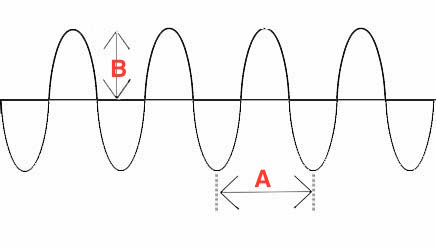
1.
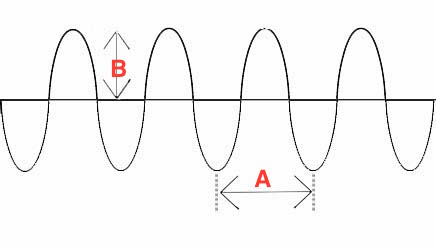
What property of this wave is represented by the letter "A"
a)
amplitude
b)
crest
c)
trough
d)
wavelength
2.
What property of the wave is represented by the letter "B"?
a)
amplitude
b)
crest
c)
trough
d)
wavelength
3.
The number of wavelengths that pass a point each per second is:
a)
frequency
b)
period
c)
longitudinal 
d)
transverse wave 
4.
A mechanical wave cannot travel through...
a)
a vacuum(empty space).
b)
water.
c)
air. 
d)
glass.
5.
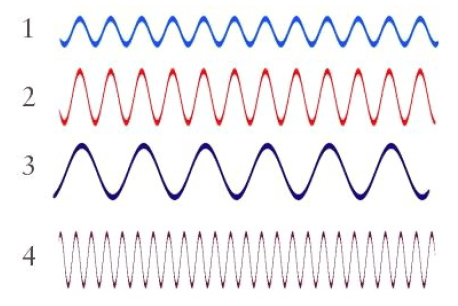
Which wave in the diagram has the greatest frequency?
a)
1
b)
2
c)
3
d)
4
6.
which material does sound travel the fastest?
a)
solid 
b)
liquid 
c)
gases
7.

When a wave bends as it passes through at an angle from one medium to another.(example: pencil in a glass of water)

a)
medium
b)
refraction
c)
reflection
d)
interference
8.

Sound waves are _______ waves.

a)

Transverse

b)

Seismic

c)

Longitudinal

d)

Slow

9.

As the temperature of a medium increases, the sound waves will travel ____________.

a)

Faster

b)

Slower

c)

As the same speed

10.

The part of the ear that is spiral shaped and will send nerve impulses to the auditory nerve is the ________.

a)

Ear drum

b)

Cochlea

c)

Outer Ear

11.

The amount of energy a wave carries is the _________.

a)

Amplitude

b)

Height

c)

Loudness

d)

Volume

12.

If someone is standing to the left of this wave, they would hear a ______ pitch than someone standing to the right of it.

a)

uglier

b)

prettier

c)

higher

d)

lower

13.

The speed of sound in air is 340 m/s. The frequency of the sound waves generated by my voice is 720 Hz. Calculate the wavelength of sound of my voice.

a)

380 m

b)

0.472 m

c)

2.11 m

d)

244,800

e)

none of these are correct

14.
Which explains why the fork looks different under water?
a)
light can't pass through the glass
b)
the wavelength of light lengthens
c)
the amount of light increases when going through water
d)
light is refracted at an angle
15.
What particles make up light?
a)
Photons
b)
Neutrons
c)
Protons
16.
What color has the shortest wavelength, or the highest frequency?
a)
yellow
b)
blue
c)
red
d)
violet
17.
The full spectrum of light energy is called the__________
a)
broad spectrum
b)
electromagnetic spectrum
c)
helium spectrum 
d)
natural light spectrum
18.
When the surface of a mirror curves inward, like the inside of a bowl, it is called a
a)
Plane Mirror
b)
Convex Mirror
c)
Concave Mirror
d)
Diffuse Mirror
19.
Which electromagnetic waves have the highest frequencies and the shortest wavelengths?
a)
microwaves
b)
visible light
c)
gamma rays
20.
Which electromagnetic waves are used in devices such as heat lamps & TV remote controls?
a)
ultraviolet rays
b)
microwaves
c)
infrared rays
21.
Why does green grass look green?
a)
It reflects all colors except green.
b)
It absorbs all colors except green.
c)
It only absorbs green.
d)
The colors mix to make green.
22.
Which type of lens is shown?
a)
Concave
b)
Convex
c)
Reflective
d)
Refracting
23.

In a vacuum radio waves, visible light and gamma rays all have the same ________.

a)

frequency

b)

energy

c)

wavelength

d)

speed

24.

What is the source of a magnetic field?

a)

Moving electric charge

b)

Stationary Electric Charge

c)

There is no source.

25.

if you break a bar magnet in half

a)

the poles will seperate

b)

You will have two complete magnets

c)

it becomes unmagnetized

26.
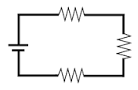
What type of circuit is pictured?
a)
series
b)
parallel
27.
What kind of circuit is this?
a)
Series
b)
Consecutive
c)
Parallel
d)
Training
28.
Substance that consists of one type of atom.  It is a pure substance. Found on the Periodic Table. 
a)

Element

b)

Compound

c)

Mixture

d)

I don't know

29.

Match the following

a)

a substance that consists of just one type of atom

1.

element

b)

a small particle that is a building block of matter

2.

atom

c)

a combination of two or more substances physically blended together

3.

mixture

d)

anything that has mass and takes up space

4.

matter

30.

A mixture in which the composition is NOT uniform throughout is called a _____ mixture.

a)

Heterogeneous

b)

Homogeneous

31.

What type of mixture is shown?

a)

Homogeneous

b)

Heterogeneous

c)

Compound

d)

Element

32.

What type of substance is shown?

a)

compound

b)

heterogeneous mixture

c)

homogeneous mixture

d)

element

33.

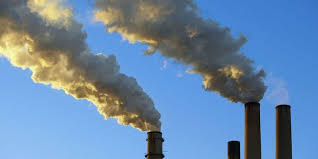
What type of material is pictured?

a)

Element

b)

Compound

c)

Heterogeneous mixture

d)

Homogeneous mixture

34.

Classify Kool-Aid as one of these 4 types of matter.

a)

Element

b)

Compound

c)

Homogeneous mixture

d)

Heterogeneous mixture

35.
Any measurable or observable attribute that describes matter
a)
Physical Property
b)
Chemical Property
36.

How tightly packed matter is in an object.

a)

Volume

b)

Density

c)

Mass

d)

Mixture

37.
The scattering of light by colloids is called ____. 
a)
homogeneous
b)
suspension
c)
air pollution
d)
The Tyndall effect
38.
Milk sours (goes bad)
a)
physical change
b)
chemical change
c)
physical property
d)
chemical property
39.
Salt dissolving in water is an example of what?
a)
A physical change
b)
A chemical change
c)
A physical property
d)
A chemical property
40.

Burning wood, like in a campfire, is an example of a

a)

chemical change

b)

physical change

41.

I have 92 electrons and was used in the first atomic bomb called "Fat Man"... Who am I?

a)

Radium

b)

Zirconium

c)

Niobium

d)

Uranium

42.

I am an Alkaline Earth Metal in Period 6. Who am I?

a)

Tungsten

b)

Calcium

c)

Barium

d)

Caesium

43.

Period 4 with 7 valence electrons

a)

Bromine

b)

Magnesium

c)

Fluorine

d)

Barium

44.

The most reactive nonmetal

a)

Fluorine

b)

Francium

c)

Chlorine

d)

Neon

45.

I have 1 more proton than lead and am found in Pepto Bismo.

a)

arsenic

b)

thallium

c)

bismuth

d)

xenon

46.

Period 4 and 1 valence electron. My symbol does not match my name

a)

Potassium

b)

Lithium

c)

Sodium

d)

Calcium

47.

The only metalloid in period 3

a)

Silicon

b)

Boron

c)

Germanium

d)

Arsenic

48.

Symbol Au

a)

Gold

b)

Silver

c)

Tin

d)

Mercury

49.

Symbol Fe

a)

Iron

b)

Fluorine

c)

Hafnium

d)

Francium

50.
CO2
a)
Ionic
b)
Covalent
c)
Polyatomic Ion 
d)
Metallic 
51.
Ionic bonds form between metals and ____.
a)
metalloids
b)
metals
c)
nonmetals
52.

Beryllium and sulfur will form a ______ bond

a)

ionic

b)

covalent

c)

metalloid

53.
How many atoms of carbon (C) are in C6H12O6?
a)
3
b)
6
c)
12
d)
24
54.
How many nitrogen atoms in 
Mg(NO3)2
a)
1
b)
2
c)
3
d)
6
55.

Formula for barium sulfide

a)

B2S3

b)

BaS

c)

Ba2S

d)

BaS2

56.

Formula for lead (II) chloride

a)

PbCl2

b)

Pb2Cl

c)

Pb2Cl3

d)

Pb3Cl2

57.

Formula for Disilicon Heptasulfide

a)

SiS6

b)

SiS7

c)

Si2S6

d)

Si2S7

58.

Formula for iron (II) carbonate

a)

FeCO3

b)

Fe2CO3

c)

FeCO2

d)

Fe2CO2

59.

Name the ionic compound, LiCl

a)

lithium chlorine

b)

lithium chloride

c)

lithium chlorate

d)

lithium monochloride

60.

Balance this equation. _CF+ _Br→ _CBr+ _F2

a)

3,1,2,1

b)

1,2,1,2

c)

2,2,2,2

61.
What is the little number after an element in a chemical equation called.
Example: H2
a)

Coefficient 

b)

Subscript

c)

Atom

d)

Equation

62.

The substances that go into a reaction are called the _______.

a)

products

b)

reactants

63.
How many HCl molecules do you need to balance this equation? 
Mg +  __HCl --->  MgCl2 + H2
a)
1
b)
2
c)
3
d)
4
64.
One element replaces another in a compound.
a)
Synthesis
b)
Combustion
c)
Single Replacement
d)
Double Replacement
65.

Cl2 + 2 SnI4 → I2 + SnCl4

a)

Single Replacement

b)

Decomposition

c)

Double Replacement

d)

Synthesis

e)

Combustion

66.
2 Na + Cl₂ →       2 NaCl
a)
Double Replacement
b)
Synthesis
c)
Single Replacement
d)
Decomposition
67.

2 H₂O₂ → 2 H₂O + O₂

a)

Double Replacement

b)

Single Replacement

c)

Synthesis

d)

Decomposition

e)

Neutralization

68.

HCl + AgNO3 → AgCl + HNO3

a)

Single Replacement

b)

Decomposition

c)

Double Replacement

d)

Synthesis

e)

Neutralization

69.

C7H14 + O₂ → CO₂ + H₂O

a)

Decomposition

b)

Single Replacement

c)

Double Replacement

d)

Combustion

e)

Neutralization

70.

Which of the following is a sign that a chemical change has occurred?

a)

Change in shape

b)

Change in size

c)

Change in texture

d)

Release of heat

71.

What is the Law of Conservation of Mass?

a)

Matter can neither be created or destroyed, it can only change forms

b)

Matter can only be destroyed

c)

Matter can only change forms

d)

Matter can be created or destroyed

72.
__BF3 + __Li2SO3 --> __B2(SO3)3 + __LiF
a)
2,3,1,3
b)
2,3,1,6
c)
4,4,2,12
d)
3,3,1,9
73.
Provides evidence that a chemical reaction has occurred. 
a)
dissolving 
b)
melting
c)
formation of a gas
d)
bending
74.
Fill in the blanks with coefficient:
PCl5+_ H2O→_ HCl+H3PO4
a)
4, 5
b)
1, 6
c)
3, 8
d)
2,2
75.

The two sides of a chemical equation are called?

a)

Reactants (left) and Products (right)

b)

Ingredients (left) and Product (right)

c)

Cations and Anions

d)

Reactants (left) and Results (right)

76.

What color of the rainbow has the longest wavelength?

a)

red

b)

blue

c)

green

d)

violet

77.
Light is a form of 
a)
energy
b)
radiation
c)
reflection
78.
Which of the following is true about waves?
a)
When wavelength increases frequency increases
b)
When wavelength decreases, frequency increases
c)
When wavelength decreases, frequency decreases
79.

Name the following compound, CF4

a)

carbon tetrafluoride

b)

monocarbon tetrafluride

c)

carbon fluoride

d)

carbon tetraflurine

80.

Name the following compound, Fe2O3

a)

Iron(III) oxide

b)

Iron trioxide

c)

Diiron trioxide

d)

Iron (II) oxide

81.

How many neutrons are in an atom of arsenic (As)

a)

42

b)

33

c)

6

d)

41

82.
What part of the eye is this?
a)
cornea
b)
lens
c)
iris
d)
cilicary body
83.
The "color" of someone's eye is actually the color of the ______.
a)
lens
b)
sclera
c)
cornea
d)
iris
84.

What is number 2 ?

a)

Vestibule

b)

Semicircular canals

c)

pinna

d)

Tympanic membrane (ear drum)

85.
What is the volume of Object X?
a)
10.0 cm3
b)
15.0 cm3
c)
20.0 cm3
d)
25.0 cm3
86.
What happens when you heat a gas?
a)
It gains mass.
b)
It loses mass.
c)
It increases in volume.
d)
It decreases in volume.
87.

The process of light bouncing off a surface

a)

refraction

b)

reflection

c)

diffraction

d)

diffusion

88.
Individuals that are nearsighted need to have prescription lenses that are ___________. 
a)
convex
b)
concave
c)
plane 
d)
flat
89.

A Polarizing filter is used to reduce glare on reflective surfaces including glass, windows, and water.

a)

True

b)

False

90.
The color of light is determined by _______ of the light waves?
a)
the medium
b)
the frequency
c)
the amplitude
d)
the speed
91.
Why do we see objects as white?
a)
They absorb all light
b)
They reflect all light
c)
They absorb some light and reflect some light
92.

What are the three primary colors of light?

a)

Red,Yellow,Blue

b)

Red,Green,Yellow

c)

Red,Green,Blue

d)

Yellow,Blue,Green

93.

What family is silicon (Si) a part of?

a)

Metal

b)

Nonmetal

c)

Metalloid

d)

Halogens

94.

Why are halogens so reactive?

a)

They want to get rid of their only valance electron

b)

They only need one more electron

c)

They are non reactive, they have a full shell

d)

They are awesome.

95.

What secondary color do I get when I mix blue lightwith green light?

a)

yellow

b)

cyan

c)

magenta

d)

pink

96.
During an endothermic reaction in a beaker if we are part of the surroundings and touched the beaker, it would feel _______. 
a)
Warm
b)
Cold
97.

Who first came up with the idea of atoms?

a)

Democritus

b)

Aristotle

c)

John Dalton

d)

JJ Thomson

98.

Who came up with the theory that Negative electrons

are spread through a positive sphere?

a)

JJ Thomson

b)

Ernest Rutherford

c)

James Chadwick

d)

Niels Bohr

99.

Who came up with the theory that the atom had a

dense, positively charged Nucleus surrounded

by electrons?

a)

Ernest Rutherford

b)

JJ Thomson

c)

Erwin Schrodinger

d)

James Chadwick

100.

Who came up with the theory of a neutral particle is

present in the nucleus of the atom?

a)

James Chadwick

b)

Niels Bohr

c)

JJ Thomson

d)

Erwin Schrodinger